117333
论文已发表
注册即可获取德孚的最新动态
IF 收录期刊
- 3.6 Breast Cancer (Dove Med Press)
- 4.3 Clin Epidemiol
- 2.6 Cancer Manag Res
- 3.2 Infect Drug Resist
- 4.1 Clin Interv Aging
- 6.1 Drug Des Dev Ther
- 4.1 Int J Chronic Obstr
- 8.7 Int J Nanomed
- 2.5 Int J Women's Health
- 3.2 Neuropsych Dis Treat
- 2.4 OncoTargets Ther
- 2.6 Patient Prefer Adher
- 2.6 Ther Clin Risk Manag
- 3.1 J Pain Res
- 3.5 Diabet Metab Synd Ob
- 4.5 Psychol Res Behav Ma
- 3.4 Nat Sci Sleep
- 2.4 Pharmgenomics Pers Med
- 2.6 Risk Manag Healthc Policy
- 4.6 J Inflamm Res
- 2.3 Int J Gen Med
- 3.9 J Hepatocell Carcinoma
- 3.3 J Asthma Allergy
- 2.5 Clin Cosmet Investig Dermatol
- 3.0 J Multidiscip Healthc

普伐他汀治疗对循环脂联素的影响:对随机对照试验的一项综合分析
Authors Shu X, Chi L
Received 10 September 2018
Accepted for publication 22 January 2019
Published 13 May 2019 Volume 2019:13 Pages 1633—1641
DOI https://doi.org/10.2147/DDDT.S186992
Checked for plagiarism Yes
Review by Single-blind
Peer reviewers approved by Dr Cristina Weinberg
Peer reviewer comments 3
Editor who approved publication: Professor Manfred Ogris
Objective: Pravastatin
has been suggested to increase circulating adiponectin in humans. However,
results of randomized controlled trials (RCTs) are inconsistent. We aimed to
systematically evaluate the influence of pravastatin on circulating adiponectin
in humans by performing a meta-analysis of RCTs.
Materials and methods: Studies
were identified via systematic searching of PubMed, Embase, and Cochrane’s
Library databases. A random effect model was used to pool the results.
Meta-regression and subgroup analyses were applied to explore the source of
heterogeneity.
Results: Eight
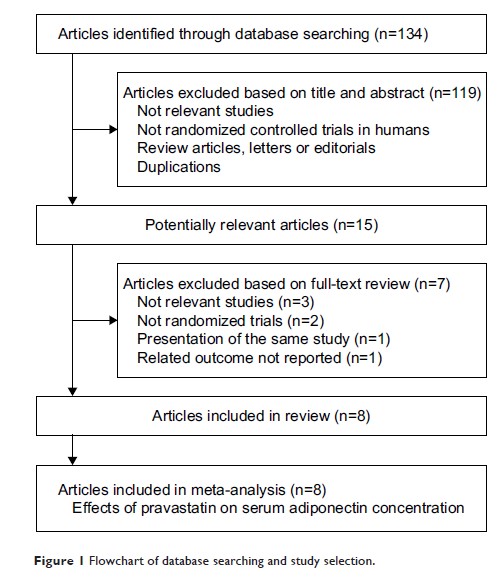
RCTs with nine comparisons of 595 participants were included. Pravastatin
treatment was associated with a significant increased level of circulating
adiponectin as compared with controls (weighted mean difference [WMD] =0.63
µg/mL; 95% CI, 0.17–1.09 µg/mL; P =0.007) with moderate heterogeneity (I2=28%). These
results were confirmed by meta-analysis of double-blinded placebo-controlled
RCTs (WMD =0.82 µg/mL; P =0.01). Meta-regression analyses indicated that
proportions of males in each study were positively correlated with the effect
of pravastatin on adiponectin (coefficient: 0.015, P =0.03). Subgroup
analyses confirmed that pravastatin significantly increased adiponectin in
studies of males (WMD =1.41 µg/mL; P =0.008), but not in those of females (WMD =-0.04
µg/mL; P =0.94).
Conclusion: Pravastatin
treatment is associated with increased circulating adiponectin. Gender
difference may exist regarding the effect of pravastatin treatment on
adiponectin.
Keywords: pravastatin,
adiponectin, meta-analysis, randomized controlled trials