117333
论文已发表
注册即可获取德孚的最新动态
IF 收录期刊
- 3.6 Breast Cancer (Dove Med Press)
- 4.3 Clin Epidemiol
- 2.6 Cancer Manag Res
- 3.2 Infect Drug Resist
- 4.1 Clin Interv Aging
- 6.1 Drug Des Dev Ther
- 4.1 Int J Chronic Obstr
- 8.7 Int J Nanomed
- 2.5 Int J Women's Health
- 3.2 Neuropsych Dis Treat
- 2.4 OncoTargets Ther
- 2.6 Patient Prefer Adher
- 2.6 Ther Clin Risk Manag
- 3.1 J Pain Res
- 3.5 Diabet Metab Synd Ob
- 4.5 Psychol Res Behav Ma
- 3.4 Nat Sci Sleep
- 2.4 Pharmgenomics Pers Med
- 2.6 Risk Manag Healthc Policy
- 4.6 J Inflamm Res
- 2.3 Int J Gen Med
- 3.9 J Hepatocell Carcinoma
- 3.3 J Asthma Allergy
- 2.5 Clin Cosmet Investig Dermatol
- 3.0 J Multidiscip Healthc

工作条件、职业压力和情绪智力对中国护士慢性疲劳的影响:一个横断面研究
Authors Huang H, Liu L, Yang S, Cui X, Zhang J, Wu H
Received 1 March 2019
Accepted for publication 10 April 2019
Published 13 May 2019 Volume 2019:12 Pages 351—360
DOI https://doi.org/10.2147/PRBM.S207283
Checked for plagiarism Yes
Review by Single-blind
Peer reviewers approved by Ms Justinn Cochran
Peer reviewer comments 2
Editor who approved publication: Dr Einar Thorsteinsson
Purpose: Nurses
are undertaking considerable emotional and physical work, which may lead to
unrecoverable fatigue. This study aimed to evaluate the level of chronic
fatigue and explore its associated factors among Chinese nurses in the hope of
providing scientific evidence for fatigue-reduction strategies.
Methods: This
cross-sectional study was carried out in Liaoning Province, China in 2018. The
study recruited 700 nurses and collected 566 effective respondents. Chronic
fatigue, demographic factors, job conditions, and emotional intelligence were
assessed through questionnaires. Chronic fatigue was assessed with the Fatigue
Scale 11, occupational stress with the Effort–Reward Imbalance Questionnaire,
and emotional intelligence with the Wong and Law Emotional Intelligence Scale.
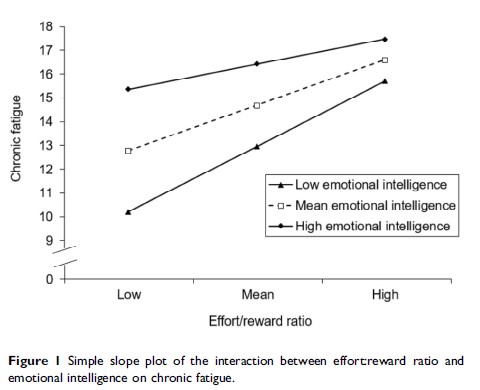
Hierarchical multiple regression was used to explore factors related to chronic
fatigue and to test the moderating effect of emotional intelligence on the
association between occupational stress and chronic fatigue. Simple slope
analysis was conducted to visualize the interaction.
Results: The mean
score of chronic fatigue among the Chinese nurses was 17.14±6.16. Being
married, having long weekly work time, working night shifts, and discontent
with the nurse–patient relationship were positively associated with chronic
fatigue. Effort:reward ratio, overcommitment, and emotional intelligence were
important factors related to chronic fatigue. Emotional intelligence played a
moderating role in the relationship between the effort:reward ratio and chronic
fatigue. When emotional intelligence was higher, the effect of the
effort:reward ratio on chronic fatigue became weaker.
Conclusion: Most
nurses surveyed in China might have relatively high levels of chronic fatigue.
Our results highlight the importance of interventions on these factors for the
reduction of fatigue among nurses in China. Providing more opportunities and
support and developing emotional intelligence are crucial strategies to reduce
chronic fatigue among nurses in China.
Keywords: chronic
fatigue, occupational stress, emotional intelligence, nurses, moderating effect