117333
论文已发表
注册即可获取德孚的最新动态
IF 收录期刊
- 3.6 Breast Cancer (Dove Med Press)
- 4.3 Clin Epidemiol
- 2.6 Cancer Manag Res
- 3.2 Infect Drug Resist
- 4.1 Clin Interv Aging
- 6.1 Drug Des Dev Ther
- 4.1 Int J Chronic Obstr
- 8.7 Int J Nanomed
- 2.5 Int J Women's Health
- 3.2 Neuropsych Dis Treat
- 2.4 OncoTargets Ther
- 2.6 Patient Prefer Adher
- 2.6 Ther Clin Risk Manag
- 3.1 J Pain Res
- 3.5 Diabet Metab Synd Ob
- 4.5 Psychol Res Behav Ma
- 3.4 Nat Sci Sleep
- 2.4 Pharmgenomics Pers Med
- 2.6 Risk Manag Healthc Policy
- 4.6 J Inflamm Res
- 2.3 Int J Gen Med
- 3.9 J Hepatocell Carcinoma
- 3.3 J Asthma Allergy
- 2.5 Clin Cosmet Investig Dermatol
- 3.0 J Multidiscip Healthc

发作性偏头痛患者的角膜基底神经丛改变:体内共聚焦显微镜研究
Authors Shen F, Dong X, Zhou X, Yan L, Wan Q
Received 1 December 2018
Accepted for publication 15 March 2019
Published 13 May 2019 Volume 2019:12 Pages 1489—1495
DOI https://doi.org/10.2147/JPR.S196705
Checked for plagiarism Yes
Review by Single-blind
Peer reviewers approved by Ms Justinn Cochran
Peer reviewer comments 2
Editor who approved publication: Dr Michael Ueberall
Background and purpose: It has
been generally thought that activation and sensitization of the
trigeminovascular system may contribute to the pathogenesis of migraine.
Nevertheless, there is little evidence on abnormalities in peripheral
trigeminal afferent nerves from humans in vivo. Alterations of corneal nerves
from the ophthalmic branch of the trigeminal nerve may support the notion that
trigeminal afferent nerves are involved in migraine pathophysiology. The aim of
the present study was to investigate the structural changes in corneal subbasal
nerve plexus in patients with episodic migraine (EM) with in vivo confocal
microscope (IVCM).
Methods: In this
cross-sectional observational study, 10 EM patients and 10 age- and sex-matched
healthy controls were included. Analysis of IVCM images with Image J software
was performed to quantify the changes in the corneal subbasal nerve plexus.
Results: EM
patients showed an increase in nerve fiber length (25.0±2.65 vs 22.3±2.41
mm/mm2, p =0.047) and nerve fiber density (36.3±7.29 vs
30.5±6.19 fibers/mm2, p =0.104) as compared with normal controls, but this
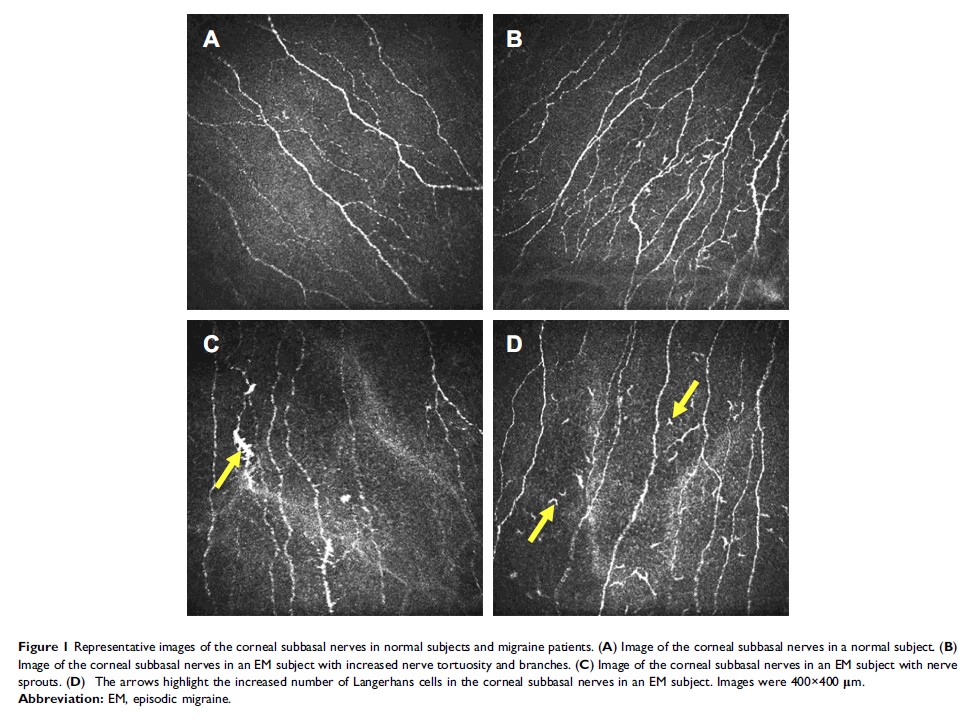
difference was not statistically significant. Nerve branching and tortuosity
were significantly increased in the EM subjects compared to the normal subjects
(91.3±13.8 vs 75.0±14.2 branches/mm2, p =0.030 and
2.30±0.46 versus 1.63±0.52, p =0.011, respectively). In addition, nerve sprouts and
increased number of Langerhans cells were observed in the EM patients.
Conclusion: The
morphologic changes of corneal subbasal nerve plexus and Langerhans cell
aggregation suggest the presence of nerve regeneration and inflammation in EM.
Furthermore, the alterations of corneal nerves from the ophthalmic branch of
the trigeminal nerve offer support for the hypothesis that the peripheral
trigeminal system may be involved in the pathogenesis of migraine.
Keywords: migraine,
corneal nerves, subbasal nerve plexus, in vivo confocal microscopy