117333
论文已发表
注册即可获取德孚的最新动态
IF 收录期刊
- 3.6 Breast Cancer (Dove Med Press)
- 4.3 Clin Epidemiol
- 2.6 Cancer Manag Res
- 3.2 Infect Drug Resist
- 4.1 Clin Interv Aging
- 6.1 Drug Des Dev Ther
- 4.1 Int J Chronic Obstr
- 8.7 Int J Nanomed
- 2.5 Int J Women's Health
- 3.2 Neuropsych Dis Treat
- 2.4 OncoTargets Ther
- 2.6 Patient Prefer Adher
- 2.6 Ther Clin Risk Manag
- 3.1 J Pain Res
- 3.5 Diabet Metab Synd Ob
- 4.5 Psychol Res Behav Ma
- 3.4 Nat Sci Sleep
- 2.4 Pharmgenomics Pers Med
- 2.6 Risk Manag Healthc Policy
- 4.6 J Inflamm Res
- 2.3 Int J Gen Med
- 3.9 J Hepatocell Carcinoma
- 3.3 J Asthma Allergy
- 2.5 Clin Cosmet Investig Dermatol
- 3.0 J Multidiscip Healthc

PAQR4 通过 CDK4-pRB-E2F1 途径促进非小细胞肺癌细胞增殖和转移
Authors Wu B, Liu R
Received 25 July 2018
Accepted for publication 17 January 2019
Published 13 May 2019 Volume 2019:12 Pages 3625—3633
DOI https://doi.org/10.2147/OTT.S181432
Checked for plagiarism Yes
Review by Single-blind
Peer reviewers approved by Ms Justinn Cochran
Peer reviewer comments 3
Editor who approved publication: Dr Leo Jen-Liang Su
Background: It is
reported that progestin and adipoQ receptor 4 (PAQR4) has a tumorigenic effect
on human breast cancer, but the role of PAQR4 in non-small-cell lung cancer
(NSCLC) is unknown. The aim of this study was to investigate the role of PAQR4
in NSCLC.
Methods: Quantitative
real-time PCR (qRT-PCR) and immunohistchemical (IHC) staining were used to
analyze the expression of PAQR4 in HCC tissues and adjacent normal tissues.
MTT, colony formation assay, flow cytometry (FCM), wound healing assays and
transwell invasion assays were used to investigate the effects of PAQR4 on cell
proliferation, colony formation, cell cycle, migration and invasion. Murine
xenograft model assay was carried out to characterize the effects of PAQR4
knockdown on tumor growth in vivo.
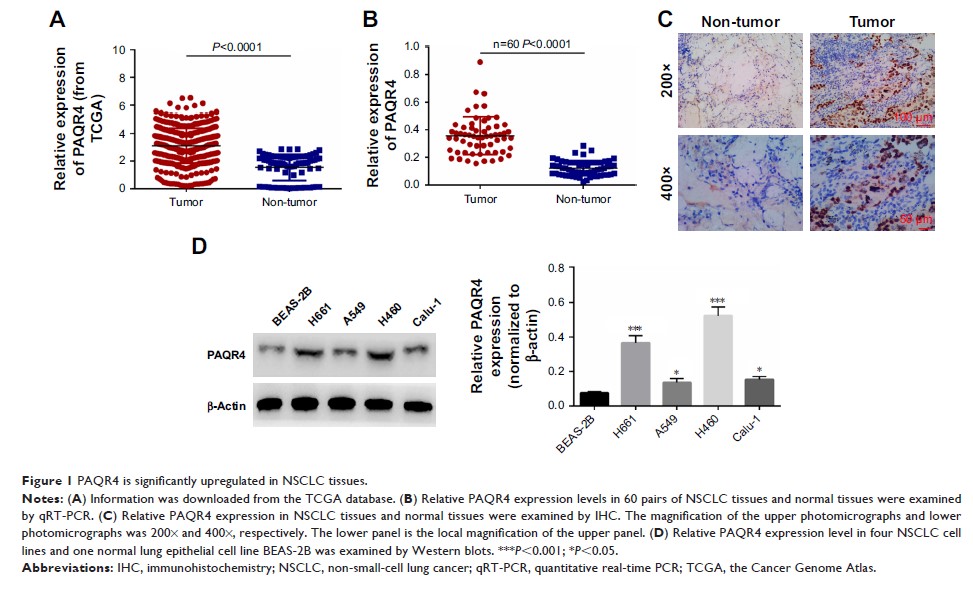
Results: In this
study, we found that the expression of PAQR4 was significantly upregulated in
the NSCLC tissues of patients compared with that in the matched non-cancerous
tissues. In addition, we found that PAQR4 was also significantly up-regulated
in the NSCLC cell lines compared with normal human lung epithelial cells.
Besides, we found that the over-expression of PAQR4 promoted promoted
proliferation, colony formation, migration and invasion of the NSCLC cells,
whereas the knockdown of PAQR4 inhibited proliferation, colony formation,
migration and invasion of the NSCLC cells. Furthermore, mechanistic studies
showed that the CDK4-pRB-E2F1 pathway was involved in NSCLC.
Conclusion: Hence,
these results suggest that PAQR4 may be used as a new target in NSCLC therapy.
Keywords: PAQR4,
cell proliferation, metastasis, CDK4-pRB-E2F1 pathway