117333
论文已发表
注册即可获取德孚的最新动态
IF 收录期刊
- 3.6 Breast Cancer (Dove Med Press)
- 4.3 Clin Epidemiol
- 2.6 Cancer Manag Res
- 3.2 Infect Drug Resist
- 4.1 Clin Interv Aging
- 6.1 Drug Des Dev Ther
- 4.1 Int J Chronic Obstr
- 8.7 Int J Nanomed
- 2.5 Int J Women's Health
- 3.2 Neuropsych Dis Treat
- 2.4 OncoTargets Ther
- 2.6 Patient Prefer Adher
- 2.6 Ther Clin Risk Manag
- 3.1 J Pain Res
- 3.5 Diabet Metab Synd Ob
- 4.5 Psychol Res Behav Ma
- 3.4 Nat Sci Sleep
- 2.4 Pharmgenomics Pers Med
- 2.6 Risk Manag Healthc Policy
- 4.6 J Inflamm Res
- 2.3 Int J Gen Med
- 3.9 J Hepatocell Carcinoma
- 3.3 J Asthma Allergy
- 2.5 Clin Cosmet Investig Dermatol
- 3.0 J Multidiscip Healthc

miR-106b 在肾癌中通过 MAPK 信号传导而靶向 Capicua,从而促进增殖和侵袭
Authors Miao LJ, Yan S, Zhuang QF, Mao QY, Xue D, He XZ, Chen JP
Received 21 August 2018
Accepted for publication 1 February 2019
Published 13 May 2019 Volume 2019:12 Pages 3595—3607
DOI https://doi.org/10.2147/OTT.S184674
Checked for plagiarism Yes
Review by Single-blind
Peer reviewers approved by Dr Amy Norman
Peer reviewer comments 2
Editor who approved publication: Prof. Dr. Geoffrey Pietersz
Background: miR-106b
has been reported to play a vital role in pathogenesis of some types of cancer,
whilst the role of miR-106b in renal carcinoma cancer (RCC) remains unknown.
Purpose: The
objective of this study was to identify the mechanism of miR-106b regulating
the progression of renal carcinoma.
Method: The
expression of miR-106b was analyzed in RCC cell lines, RCC and adjacent normal
renal tissues through qRT-PCR assays. Target mRNA of miR-106b was predicted
with databases and verified by luciferase reporter assays. And the effects of
miR-106b or targeted mRNA on cell proliferation, invasion, the process of
epithelial-mesenchymal transitions (EMTs) were assessed in vitrothrough CCK-8,
transwell cell invasion assays, qRT-PCR and Western blotting assays
respectively. In addition, the effects of miR-106b on the growth of xenografts
mice were analyzedin vivo.
Results: The
results demonstrated that miR-106b was significantly increased both in RCC
tissues and cell lines. Luciferase reporter assays revealed that miR-106b
inhibited Capicua expression by targeting its 3ʹ-UTR sequence. And miR-106b
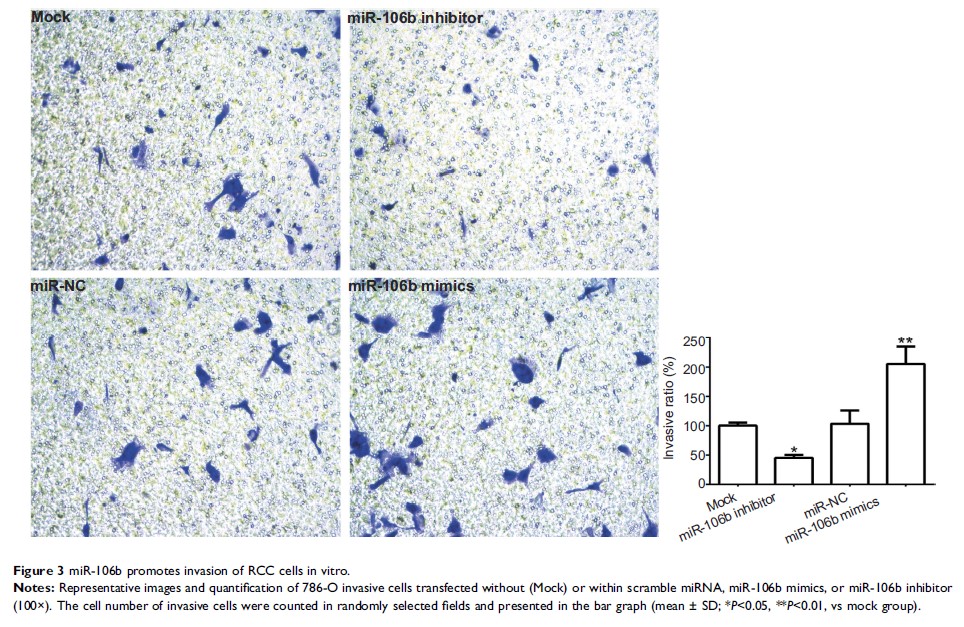
promoted cell proliferation, invasion, EMT progression in RCC cellin vitro, as
well as promoted the tumor growth of 786-O cells derived xenografts mice.
Additionally, loss of Capicua promoted the activation of MAPK signaling
pathway.
Conclusion: The study
suggested that miR-106b regulated RCC progression through MAPK signaling
pathway partly by targeting Capicua, which might provide valuable evidence for
therapeutic target development of RCC.
Keywords: renal
carcinoma, miR-106b, capicua, epithelial mesenchymal transitions