115195
论文已发表
注册即可获取德孚的最新动态
IF 收录期刊
- 3.6 Breast Cancer (Dove Med Press)
- 4.3 Clin Epidemiol
- 2.6 Cancer Manag Res
- 3.2 Infect Drug Resist
- 4.1 Clin Interv Aging
- 6.1 Drug Des Dev Ther
- 4.1 Int J Chronic Obstr
- 8.7 Int J Nanomed
- 2.5 Int J Women's Health
- 3.2 Neuropsych Dis Treat
- 2.4 OncoTargets Ther
- 2.6 Patient Prefer Adher
- 2.6 Ther Clin Risk Manag
- 3.1 J Pain Res
- 3.5 Diabet Metab Synd Ob
- 4.5 Psychol Res Behav Ma
- 3.4 Nat Sci Sleep
- 2.4 Pharmgenomics Pers Med
- 2.6 Risk Manag Healthc Policy
- 4.6 J Inflamm Res
- 2.3 Int J Gen Med
- 3.9 J Hepatocell Carcinoma
- 3.3 J Asthma Allergy
- 2.5 Clin Cosmet Investig Dermatol
- 3.0 J Multidiscip Healthc

哪些因素会影响医学生博士论文的质量?在中国大学附属医院的比较研究
Authors Yuan W, Liu Z
Received 17 January 2019
Accepted for publication 16 April 2019
Published 14 May 2019 Volume 2019:10 Pages 297—302
DOI https://doi.org/10.2147/AMEP.S201960
Checked for plagiarism Yes
Review by Single-blind
Peer reviewers approved by Dr Robert Robinson
Peer reviewer comments 2
Editor who approved publication: Dr Anwarul Azim Majumder
Background: The
quality of doctoral theses decides whether medical PhD and MD candidates could
get their doctoral degree successfully. Good quality theses could be rewarded
by Peking University which is a great honor for both doctoral candidates and
for mentors. The present study aims to determine factors affecting the quality
of medical doctoral theses.
Methods: Honored
theses and nonhonored theses were matched 1:3 randomly by specialty and
submission year. Conditional logistic regressions were utilized.
Results: Five
domains comprising 17 indicators were put forward to evaluate the quality of
doctoral theses. 41 honored theses and 119 matched nonhonored theses from years
2012–2016 were analyzed by univariate and multivariate conditional logistic
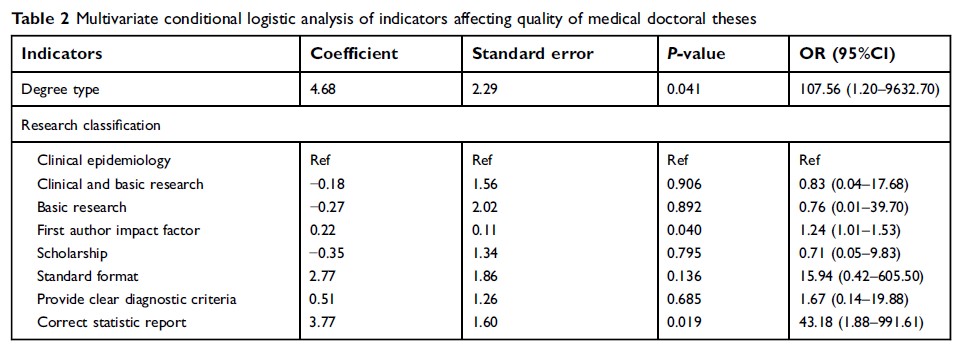
regression. Degree type (OR: 107.56, 95%CI: 1.20–9632.70, P =0.041), first
author impact factor (OR:1.24, 95%CI: 1.01–1.53, P =0.040) and
correctly reported statistic results (OR: 43.18, 95%CI: 1.88–991.61, P =0.019) are
independent factors influencing the quality of a doctoral thesis.
Conclusions: The
present study indicates that there is a significant gap between PhD and MD
students on quality of thesis. The rewarded theses have a feature of high first
author impact factor. However, most medical students need more training on
statistics to improve the quality of their doctoral theses.
Keywords: medicine
degree, doctoral thesis, quality, conditional logistic regression