117333
论文已发表
注册即可获取德孚的最新动态
IF 收录期刊
- 3.6 Breast Cancer (Dove Med Press)
- 4.3 Clin Epidemiol
- 2.6 Cancer Manag Res
- 3.2 Infect Drug Resist
- 4.1 Clin Interv Aging
- 6.1 Drug Des Dev Ther
- 4.1 Int J Chronic Obstr
- 8.7 Int J Nanomed
- 2.5 Int J Women's Health
- 3.2 Neuropsych Dis Treat
- 2.4 OncoTargets Ther
- 2.6 Patient Prefer Adher
- 2.6 Ther Clin Risk Manag
- 3.1 J Pain Res
- 3.5 Diabet Metab Synd Ob
- 4.5 Psychol Res Behav Ma
- 3.4 Nat Sci Sleep
- 2.4 Pharmgenomics Pers Med
- 2.6 Risk Manag Healthc Policy
- 4.6 J Inflamm Res
- 2.3 Int J Gen Med
- 3.9 J Hepatocell Carcinoma
- 3.3 J Asthma Allergy
- 2.5 Clin Cosmet Investig Dermatol
- 3.0 J Multidiscip Healthc

血浆胆碱酯酶与中国青少年超重或肥胖和代谢综合征预测有关
Authors Han Y, Ma Y, Liu Y, Zhao Z, Zhen S, Yang X, Xu Z, Wen D
Received 15 January 2019
Accepted for publication 16 April 2019
Published 14 May 2019 Volume 2019:12 Pages 685—702
DOI https://doi.org/10.2147/DMSO.S201594
Checked for plagiarism Yes
Review by Single-blind
Peer reviewers approved by Ms Justinn Cochran
Peer reviewer comments 2
Editor who approved publication: Dr Antonio Brunetti
Purpose: To
determine the plasma concentrations of butyrylcholinesterase (BChE), also known
as pseudocholinesterase, in different weight categories of adolescents, and to
explore the possible association between plasma BChE and overweight (OW),
obesity, and metabolic syndrome (MetS) in Chinese adolescents.
Patients and methods: This
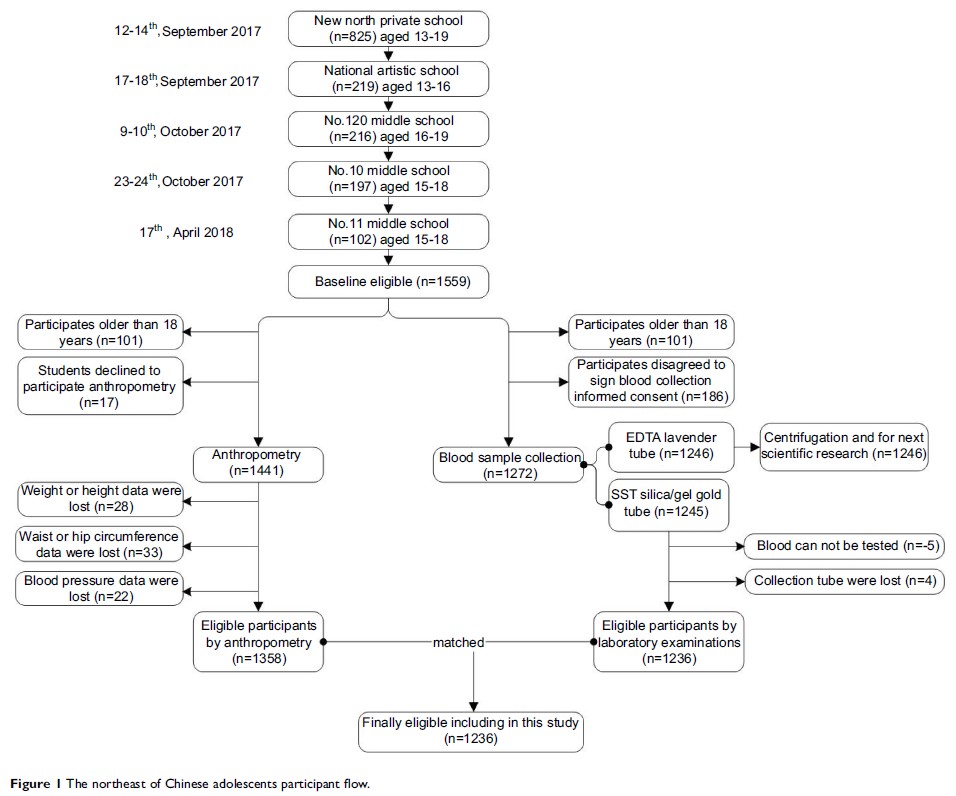
cross-sectional study included 1,236 Chinese adolescents (194 obese [OB], 188
OW, 732 normal weight [NW], and 122 underweight [UW]). The biochemical
variables and anthropometric variables of the study participants were
evaluated. Plasma BChE level was measured by DGKC method.
Results: OB was
associated with a higher prevalence of upper strata plasma BChE levels when compared
with the BChE levels in UW, NW, and OW group. A logistic regression analysis
showed that plasma BChE was positively associated with the OB group when
compared with the NW group. Boys in the OW group, but not the OB group, had a
significantly higher prevalence of upper stratum of BChE levels. Plasma
triglyceride, total cholesterol, low-density lipoprotein-cholesterol, and ApoB
levels were positively associated with the upper stratum of BChE levels when
compared with lower stratum. MetS and most of its components were more
prevalent among subjects with upper stratum rather than lower stratum BChE
levels. Receiver operating characteristic curves for plasma BChE in subjects
with MetS indicated that the AUC was 0.80 (95%CI:0.70–0.90, P <0.001) and
0.89 (95%CI:0.82–0.95,P <0.001) in girls and boys, respectively. After
adjusting for age, the multivariate-adjusted odds ratio for MetS in the upper
stratum of BChE levels was 8.73 (95%CI: 3.49–21.84) in the boys cohorts and
also in the girls cohorts (OR=1.71, 95%CI: 1.35–21.70).
Conclusion: This
study confirmed an association between BChE levels and weight status in Chinese
adolescents, and demonstrated that the upper strata of plasma BChE levels were
associated with being OW, and even more highly associated with obesity. Plasma
BChE levels were positively associated with MetS and its components and could
be useful for identifying adolescents with MetS.
Keywords: butyrylcholinesterase
(BChE), adolescents obesity, metabolic syndrome, dyslipidemia