117333
论文已发表
注册即可获取德孚的最新动态
IF 收录期刊
- 3.6 Breast Cancer (Dove Med Press)
- 4.3 Clin Epidemiol
- 2.6 Cancer Manag Res
- 3.2 Infect Drug Resist
- 4.1 Clin Interv Aging
- 6.1 Drug Des Dev Ther
- 4.1 Int J Chronic Obstr
- 8.7 Int J Nanomed
- 2.5 Int J Women's Health
- 3.2 Neuropsych Dis Treat
- 2.4 OncoTargets Ther
- 2.6 Patient Prefer Adher
- 2.6 Ther Clin Risk Manag
- 3.1 J Pain Res
- 3.5 Diabet Metab Synd Ob
- 4.5 Psychol Res Behav Ma
- 3.4 Nat Sci Sleep
- 2.4 Pharmgenomics Pers Med
- 2.6 Risk Manag Healthc Policy
- 4.6 J Inflamm Res
- 2.3 Int J Gen Med
- 3.9 J Hepatocell Carcinoma
- 3.3 J Asthma Allergy
- 2.5 Clin Cosmet Investig Dermatol
- 3.0 J Multidiscip Healthc

血浆吲哚胺 2,3-双加氧酶活性作为结核病患者多药耐药结核病早期诊断的潜在生物标志物
Authors Shi W, Wu J, Tan Q, Hu CM, Zhang X, Pan HQ, Yang Z, He MY, Yu M, Zhang B, Xie WP, Wang H
Received 24 January 2019
Accepted for publication 29 March 2019
Published 14 May 2019 Volume 2019:12 Pages 1265—1276
DOI https://doi.org/10.2147/IDR.S202369
Checked for plagiarism Yes
Review by Single-blind
Peer reviewers approved by Dr Andrew Yee
Peer reviewer comments 2
Editor who approved publication: Dr Joachim Wink
Purpose: Multidrug-resistant
tuberculosis (MDR-TB) remains a challenge of global TB control, with difficulty
in early detection of drug-sensitive tuberculosis (DS-TB). We investigate the
diagnostic significance of IDO as a potential biomarker to discriminate MDR
patients among the TB patients.
Patients and methods: Plasma
indoleamine 2,3-dioxygenase (IDO) was measured by the ratio of kynurenine (Kyn)
to tryptophan (Trp) concentrations, using high performance liquid
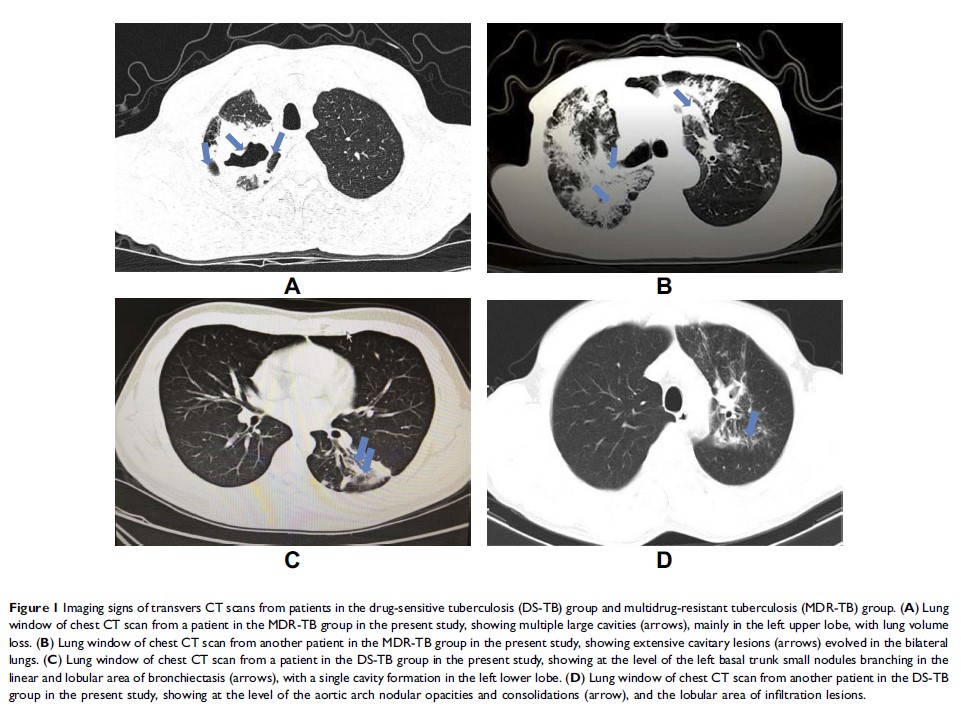
chromatography-mass spectrometry (LC-MS/MS). Chest computed tomography (CT)
imaging signs from TB patients were collected and analyzed in 18 DS-TB
patients, 16 MDR-TB patients, 6 lung cancer (LC) patients, and 11 healthy
individuals. Lung imaging signs from TB patients were collected and analyzed.
Results: We found
that plasma IDO activity was significantly higher in the MDR-TB patients than
in the DS-TB patients (p =0.012) and in the LC patients (p =0.003). We
evaluated the diagnostic significance of plasma IDO activity in discriminating
the MDR-TB group from the DS-TB group using a receiver operating characteristic
(ROC) curve. With a cutoff level of 46.58 uM/mM, the diagnostic sensitivity,
specificity, positive predictive value (PPV), and negative predictive value
(NPV) for IDO activity were 87.50%, 72.22%, 73.68%, and 86.67%, respectively.
Plasma IDO activity was higher in cavity cases than in non-cavity cases (p =0.042), proving a
positive correlation between lung cavity number and cavity size (p <0.05,
separately) among all the TB patients studied.
Conclusion: Our
findings confirmed that plasma IDO activity might have an auxiliary diagnosis
value for early discrimination of MDR-TB patients from DS-TB patients. Among
the TB patients with cavitary lung lesions, higher plasma IDO activity can
indicate a higher risk of MDR-TB.
Keywords: IDO,
MDR-TB, LC-MS/MS, cavitary lung lesion