117333
论文已发表
注册即可获取德孚的最新动态
IF 收录期刊
- 3.6 Breast Cancer (Dove Med Press)
- 4.3 Clin Epidemiol
- 2.6 Cancer Manag Res
- 3.2 Infect Drug Resist
- 4.1 Clin Interv Aging
- 6.1 Drug Des Dev Ther
- 4.1 Int J Chronic Obstr
- 8.7 Int J Nanomed
- 2.5 Int J Women's Health
- 3.2 Neuropsych Dis Treat
- 2.4 OncoTargets Ther
- 2.6 Patient Prefer Adher
- 2.6 Ther Clin Risk Manag
- 3.1 J Pain Res
- 3.5 Diabet Metab Synd Ob
- 4.5 Psychol Res Behav Ma
- 3.4 Nat Sci Sleep
- 2.4 Pharmgenomics Pers Med
- 2.6 Risk Manag Healthc Policy
- 4.6 J Inflamm Res
- 2.3 Int J Gen Med
- 3.9 J Hepatocell Carcinoma
- 3.3 J Asthma Allergy
- 2.5 Clin Cosmet Investig Dermatol
- 3.0 J Multidiscip Healthc

ITGBL1 通过激活前列腺癌中的 NF-κB 信号通路促进 EMT、侵袭和迁移
Authors Li W, Li S, Yang J, Cui C, Yu M, Zhang Y
Received 1 January 2019
Accepted for publication 1 April 2019
Published 16 May 2019 Volume 2019:12 Pages 3753—3763
DOI https://doi.org/10.2147/OTT.S200082
Checked for plagiarism Yes
Review by Single-blind
Peer reviewers approved by Ms Shreya Arora
Peer reviewer comments 2
Editor who approved publication: Dr Jianmin Xu
Background: Integrin
beta-like 1 (ITGBL1) was extensively demonstrated to contribute the metastasis
and progression in a variety of cancers. However, its role of ITGBL1 in
prostate cancer (PCa) is still not reported.
Methods: Reverse
transcription-quantitative polymerase chain reaction (RT-qPCR) and western blot
were performed to detect ITGBL1 expression in PCa tissues and cell lines.
Immunohistochemical (IHC) staining of ITGBL1 in 174 PCa tissues was performed.
The influence of ITGL1 expression in PCa cells epithelial-mesenchymal transition
(EMT), migration and invasion was investigated. Notably, the possible
mechanisms underlying the action of ITGBL1 in vivo and vitro assays were
explored.
Results: We
analyzed PCa dataset from The Cancer Genome Atlas (TCGA) and found that ITGBL1
was upregulated in PCa tissues. Overexpression of ITGBL1 is positively
associated with the progression and lymph node metastasis in PCa patients.
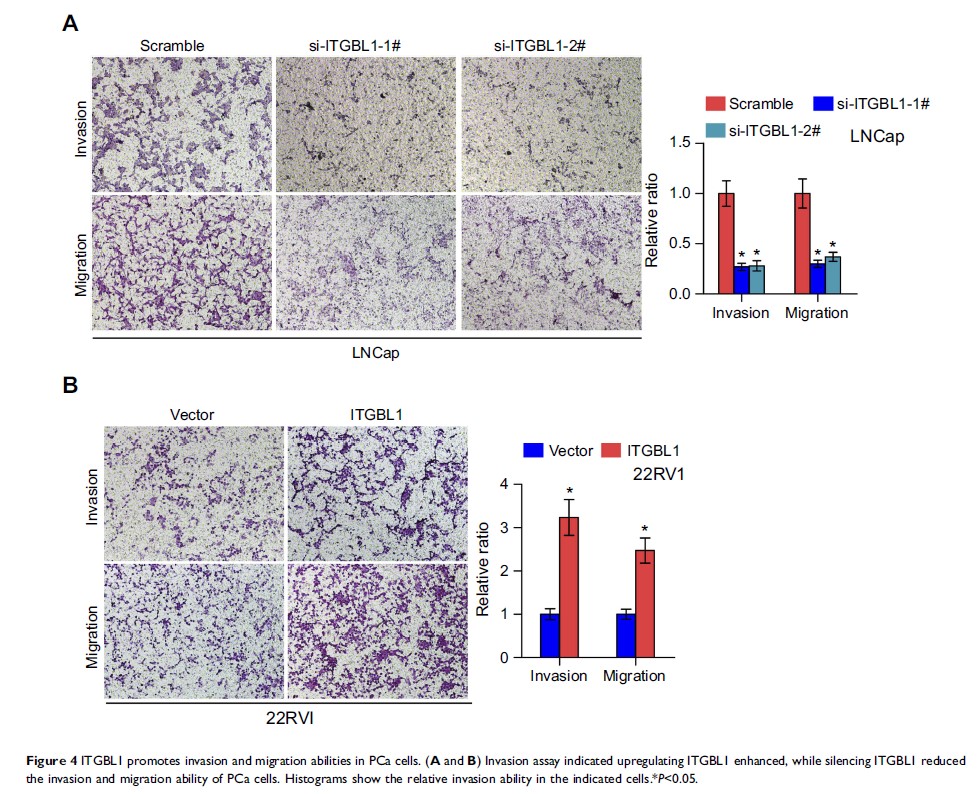
Furthermore, upregulating ITGBL1 enhanced the invasion, migration abilities and
EMT in PCa cells. Conversely, downregulating ITGBL1 exhibited an opposite
effect. Our findings further demonstrated that ITGBL1 promoted invasion and
migration via activating NF-κB signaling in PCa cells.
Conclusion: Therefore,
our results identify a novel metastasis-related gene in PCa, which will help to
develop a novel therapeutic strategy in metastatic PCa.
Keywords: ITGBL1,
EMT, NF-κB signaling, lymph node metastasis and prostate cancer