117333
论文已发表
注册即可获取德孚的最新动态
IF 收录期刊
- 3.6 Breast Cancer (Dove Med Press)
- 4.3 Clin Epidemiol
- 2.6 Cancer Manag Res
- 3.2 Infect Drug Resist
- 4.1 Clin Interv Aging
- 6.1 Drug Des Dev Ther
- 4.1 Int J Chronic Obstr
- 8.7 Int J Nanomed
- 2.5 Int J Women's Health
- 3.2 Neuropsych Dis Treat
- 2.4 OncoTargets Ther
- 2.6 Patient Prefer Adher
- 2.6 Ther Clin Risk Manag
- 3.1 J Pain Res
- 3.5 Diabet Metab Synd Ob
- 4.5 Psychol Res Behav Ma
- 3.4 Nat Sci Sleep
- 2.4 Pharmgenomics Pers Med
- 2.6 Risk Manag Healthc Policy
- 4.6 J Inflamm Res
- 2.3 Int J Gen Med
- 3.9 J Hepatocell Carcinoma
- 3.3 J Asthma Allergy
- 2.5 Clin Cosmet Investig Dermatol
- 3.0 J Multidiscip Healthc

LncRNA MIR210HG 通过与 DNMT1 结合使 CACNA2D2 启动子甲基化上调,促进非小细胞肺癌的增殖和侵袭
Authors Kang X, Kong F, Huang K, Li L, Li Z, Wang X, Zhang W, Wu X
Received 2 October 2018
Accepted for publication 15 February 2019
Published 16 May 2019 Volume 2019:12 Pages 3779—3790
DOI https://doi.org/10.2147/OTT.S189468
Checked for plagiarism Yes
Review by Single-blind
Peer reviewers approved by Dr Andrew Yee
Peer reviewer comments 4
Editor who approved publication: Prof. Dr. Geoffrey Pietersz
Background: In recent years, a large number of
studies have shown that differentially expressed lncRNAs are capable of
promoting the occurrence and development of tumors by regulating cell
proliferation and differentiation. However, the biological effects of lncRNAs
in non-small cell lung cancer (NSCLC) are still needed to be further
investigated.
Methods: The
differentially expressed lncRNAs in NSCLC tissues in the downloaded profiles
from GEO database were analyzed and further verified in 100 pairs of NSCLC
samples collected in our hospital. After identification of the target gene
MIR210HG, the relationship between MIR210HG expression and clinical data of
NSCLC patients was analyzed. Regulatory effects of MIR210HG on proliferation,
migration, and invasion of NSCLC cells were detected by CCK-8, colony
formation, and transwell assay, respectively. The binding condition of MIR210HG
and DNA methyltransferase 1 (DNMT1) was detected by RNA binding protein
immunoprecipitation. Subsequently, chromatin immunoprecipitation assay assessed
the promoter binding of DNMT1 to CACNA2D2. Rescue experiments were conducted to
assess whether CACNA2D2 can reverse the function of MIR210HG.
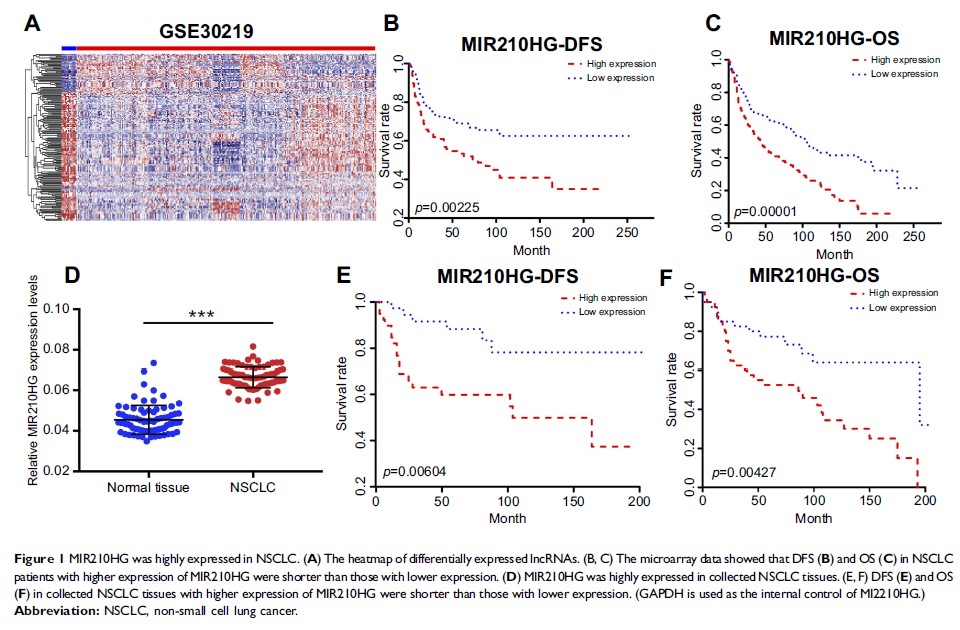
Results: MIR210HG
was highly expressed in NSCLC tissues not only in GSE30219 dataset but also in
our collected NSCLC tissues. MIR210HG expression was correlated to tumor stage
and lymph node metastasis of NSCLC patients. Besides, lower disease-free
survival (DFS) and overall survival (OS) were found in NSCLC patients with
high-level MIR210HG compared with those with low-level MIR210HG. Regression
analysis indicated that MIR210HG was the independent risk factor for DFS and OS
of NSCLC patients. In vitro experiments demonstrated that MIR210HG knockdown
remarkably inhibited proliferation and migration of NSCLC cells. MIR210HG could
recruit DNMT1, thereafter promoting methylation of CACNA2D2 promoter region.
CACNA2D2 overexpression remarkably inhibited cell proliferation. Moreover,
inhibited proliferation induced by MIR210HG knockdown was reversed by CACNA2D2
knockdown.
Conclusion: MIR210HG
can promote the tumorigenesis of NSCLC by inhibiting the expression of
CACNA2D2. Our findings provide new therapeutic strategies for the future
treatment of NSCLC.
Keywords: MIR210HG,
DNMT1, CACNA2D2, non-small cell lung cancer, proliferation