117333
论文已发表
注册即可获取德孚的最新动态
IF 收录期刊
- 3.6 Breast Cancer (Dove Med Press)
- 4.3 Clin Epidemiol
- 2.6 Cancer Manag Res
- 3.2 Infect Drug Resist
- 4.1 Clin Interv Aging
- 6.1 Drug Des Dev Ther
- 4.1 Int J Chronic Obstr
- 8.7 Int J Nanomed
- 2.5 Int J Women's Health
- 3.2 Neuropsych Dis Treat
- 2.4 OncoTargets Ther
- 2.6 Patient Prefer Adher
- 2.6 Ther Clin Risk Manag
- 3.1 J Pain Res
- 3.5 Diabet Metab Synd Ob
- 4.5 Psychol Res Behav Ma
- 3.4 Nat Sci Sleep
- 2.4 Pharmgenomics Pers Med
- 2.6 Risk Manag Healthc Policy
- 4.6 J Inflamm Res
- 2.3 Int J Gen Med
- 3.9 J Hepatocell Carcinoma
- 3.3 J Asthma Allergy
- 2.5 Clin Cosmet Investig Dermatol
- 3.0 J Multidiscip Healthc

来自弥漫性大 B 细胞淋巴瘤细胞的 NSE 可调节巨噬细胞极化
Authors Zhu MY, Liu WJ, Wang H, Wang WD, Liu NW, Lu Y
Received 26 January 2019
Accepted for publication 20 April 2019
Published 17 May 2019 Volume 2019:11 Pages 4577—4595
DOI https://doi.org/10.2147/CMAR.S203010
Checked for plagiarism Yes
Review by Single-blind
Peer reviewers approved by Dr Cristina Weinberg
Peer reviewer comments 2
Editor who approved publication: Professor Nakshatri
Background/aims: Diffuse
large B-cell lymphoma (DLBCL) is a highly common type of malignant and
heterogeneous non-Hodgkin’s lymphoma. Tumor-associated macrophages, specially
the M2-type, promote tumor progression and drug resistance. The clinical
outcome of patients with high neuron-specific enolase (NSE) expression is worse
than that with low NSE expression. The tumor-promoting mechanism of NSE,
however, remains unclear. This study explored the role of NSE in macrophage
polarization associated with the immune microenvironment of DLBCL.
Results: Our
results showed that NSE protein expression was higher in lymphoma cell lines
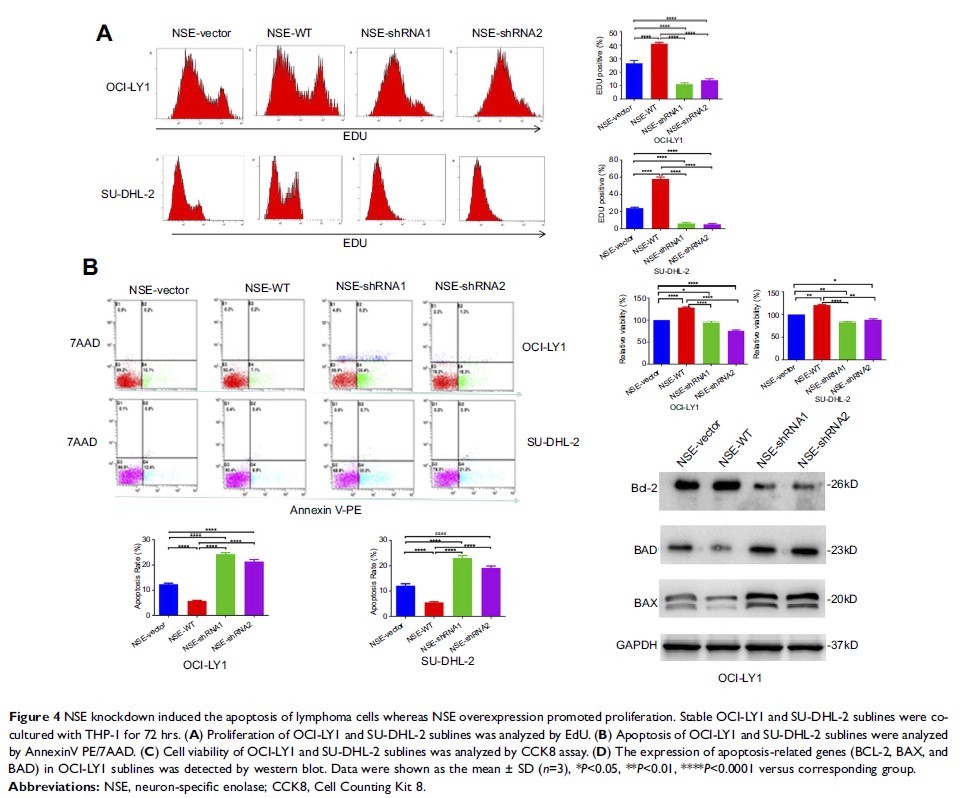
than in the B lymphocytes. Functional studies demonstrated that upregulation of
NSE in lymphoma cells could promote M2 polarization and migration ability of
macrophage, thereby consequently promoting the progression of lymphoma in vitro
and in vivo. Further mechanism studies revealed that lymphoma-derived exosomes
could mediate NSE into macrophages, NSE enhanced nuclear p50 translocation with
subsequent defective classical nuclear factor-κB activity in macrophages.
Conclusions: These
results indicate that NSE may be a potential target for lymphoma therapy and a
prognosis marker for lymphoma.
Keywords: neuron-specific
enolase, diffuse large B-cell lymphoma, macrophage