117333
论文已发表
注册即可获取德孚的最新动态
IF 收录期刊
- 3.6 Breast Cancer (Dove Med Press)
- 4.3 Clin Epidemiol
- 2.6 Cancer Manag Res
- 3.2 Infect Drug Resist
- 4.1 Clin Interv Aging
- 6.1 Drug Des Dev Ther
- 4.1 Int J Chronic Obstr
- 8.7 Int J Nanomed
- 2.5 Int J Women's Health
- 3.2 Neuropsych Dis Treat
- 2.4 OncoTargets Ther
- 2.6 Patient Prefer Adher
- 2.6 Ther Clin Risk Manag
- 3.1 J Pain Res
- 3.5 Diabet Metab Synd Ob
- 4.5 Psychol Res Behav Ma
- 3.4 Nat Sci Sleep
- 2.4 Pharmgenomics Pers Med
- 2.6 Risk Manag Healthc Policy
- 4.6 J Inflamm Res
- 2.3 Int J Gen Med
- 3.9 J Hepatocell Carcinoma
- 3.3 J Asthma Allergy
- 2.5 Clin Cosmet Investig Dermatol
- 3.0 J Multidiscip Healthc

姜黄素通过调节 TGF-β/Smad2/3 信号通路逆转人结直肠癌中奥沙利铂的耐药性
Authors Yin J, Wang L, Wang Y, Shen H, Wang X, Wu L
Received 26 December 2018
Accepted for publication 11 April 2019
Published 17 May 2019 Volume 2019:12 Pages 3893—3903
DOI https://doi.org/10.2147/OTT.S199601
Checked for plagiarism Yes
Review by Single-blind
Peer reviewers approved by Dr Jyoti Bajaj
Peer reviewer comments 2
Editor who approved publication: Dr Gaetano Romano
Background: Oxaliplatin
(OXA) resistance is a main obstacle to the chemotherapy of colorectal cancer
(CRC). Epithelial-mesenchymal transition (EMT), which is mainly regulated by
TGF-β/Smad signaling pathway, has gradually been recognized as an important
mechanism for tumor chemoresistance. Studies have shown that curcumin regulated
EMT processes in many human cancers. However, whether curcumin could regulate
OXA resistance in CRC through modulating TGF-β/Smad signaling-mediated EMT
remains unclear.
Methods: In an
attempt to investigate the effect of curcumin on OXA resistance in CRC,
OXA-resistant cell line HCT116/OXA was established firstly. The effect of
curcumin on cell proliferation was evaluated by MTT assay and Ki67
immunofluorescence staining, respectively. Cell apoptosis was evaluated by flow
cytometry. In addition, transwell assay was used to detect the effect of
curcumin on cell invasion and the activation of TGF-β/Smad signaling was
examined by immunofluorescence and Western blot. Moreover, the therapeutic potential
of curcumin was further examined in vivo using a CRC animal model.
Results: The
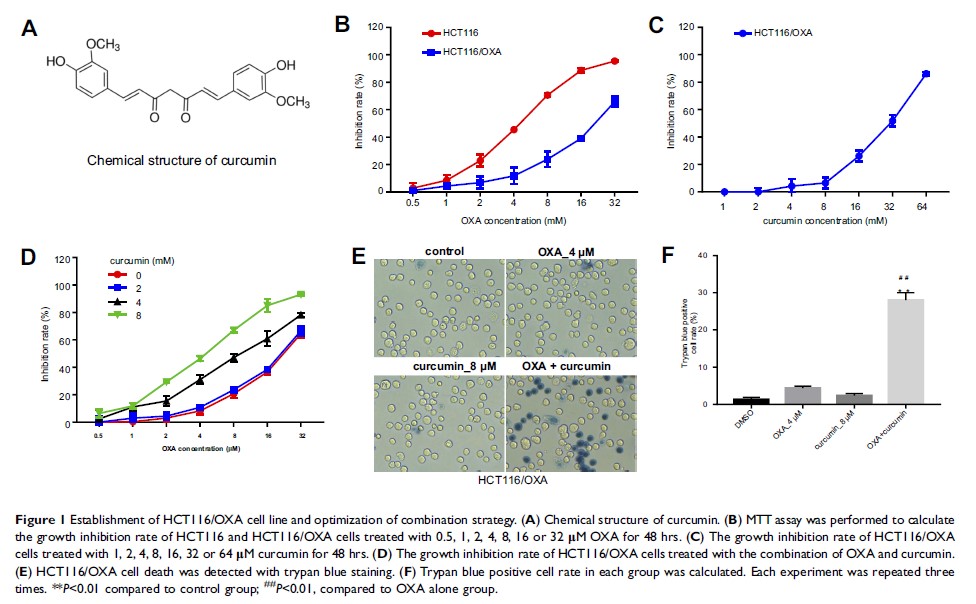
OXA-resistant cell line HCT116/OXA was successfully established, and
combination of OXA with curcumin reduced OXA resistance in vitro. Besides, the
combination treatment inhibited the expressions of p-p65 and Bcl-2, but
increased the level of active-caspase3. In addition, curcumin inhibited EMT via
regulation of TGF-β/Smad2/3 signaling pathway. Moreover, in vivo study
confirmed curcumin could reverse OXA resistance in CRC.
Conclusion: Our study
indicated that curcumin could reserve OXA resistance in CRC through dampening
TGF-β/Smads signaling in vitro and in vivo.
Keywords: colorectal
cancer, oxaliplatin resistance, curcumin, epithelial-mesenchymal transition,
TGF-β/Smad signaling pathway