117333
论文已发表
注册即可获取德孚的最新动态
IF 收录期刊
- 3.6 Breast Cancer (Dove Med Press)
- 4.3 Clin Epidemiol
- 2.6 Cancer Manag Res
- 3.2 Infect Drug Resist
- 4.1 Clin Interv Aging
- 6.1 Drug Des Dev Ther
- 4.1 Int J Chronic Obstr
- 8.7 Int J Nanomed
- 2.5 Int J Women's Health
- 3.2 Neuropsych Dis Treat
- 2.4 OncoTargets Ther
- 2.6 Patient Prefer Adher
- 2.6 Ther Clin Risk Manag
- 3.1 J Pain Res
- 3.5 Diabet Metab Synd Ob
- 4.5 Psychol Res Behav Ma
- 3.4 Nat Sci Sleep
- 2.4 Pharmgenomics Pers Med
- 2.6 Risk Manag Healthc Policy
- 4.6 J Inflamm Res
- 2.3 Int J Gen Med
- 3.9 J Hepatocell Carcinoma
- 3.3 J Asthma Allergy
- 2.5 Clin Cosmet Investig Dermatol
- 3.0 J Multidiscip Healthc

纳米功能性 miRNA 脂质体及其在通过 Slug 基因沉默治疗 TNBC 中的应用
Authors Yan Y, Li XQ, Duan JL, Bao CJ, Cui YN, Su ZB, Xu JR, Luo Q, Chen M, Xie Y, Lu WL
Received 6 March 2019
Accepted for publication 1 May 2019
Published 17 May 2019 Volume 2019:14 Pages 3645—3667
DOI https://doi.org/10.2147/IJN.S207837
Checked for plagiarism Yes
Review by Single-blind
Peer reviewers approved by Dr Alexander Kharlamov
Peer reviewer comments 2
Editor who approved publication: Dr Mian Wang
Background: Neo-adjuvant
chemotherapy is an effective strategy for improving treatment of breast
cancers. However, the efficacy of this treatment strategy is limited for
treatment of triple negative breast cancer (TNBC). Gene therapy may be a more
effective strategy for improving the prognosis of TNBC.
Methods: A novel
25 nucleotide sense strand of miRNA was designed to treat TNBC by silencing the
Slug gene, and encapsulated into DSPE-PEG2000-tLyp-1 peptide-modified
functional liposomes. The efficacy of miRNA liposomes was evaluated on invasive
TNBC cells and TNBC cancer-bearing nude mice. Furthermore, functional
vinorelbine liposomes were constructed to investigate the anticancer effects of
combined treatment.
Results: The
functional miRNA liposomes had a round shape and were nanosized (120 nm).
Functional miRNA liposomes were effectively captured by TNBC cells in vitro and
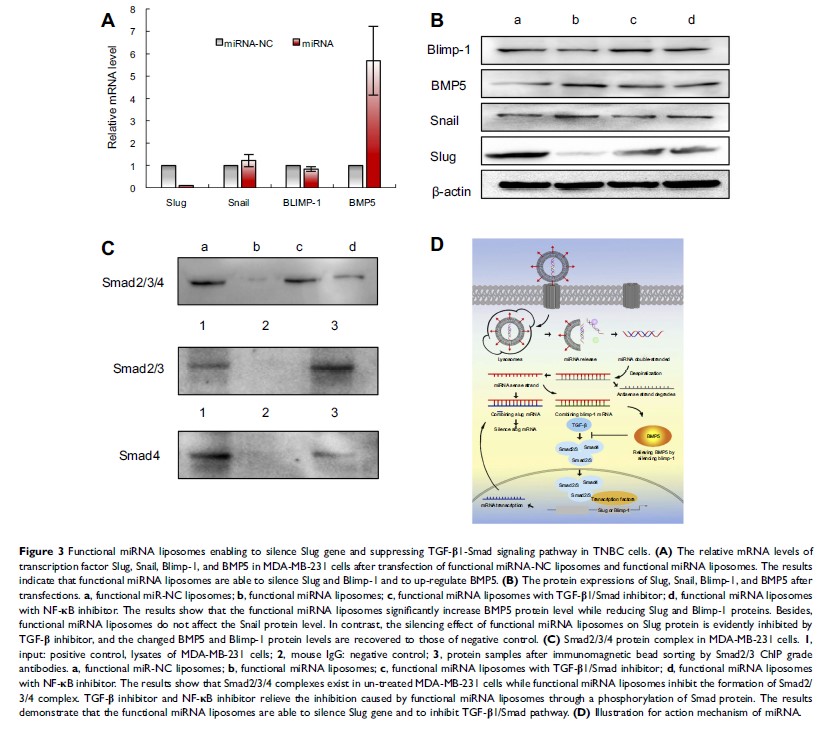
were target to mitochondria. Treatment with functional liposomes silenced the expression
of Slug and
Slug protein, inhibited the TGF-β1/Smad pathway, and inhibited invasiveness and
growth of TNBC cells. In TNBC cancer-bearing mice, functional miRNA liposomes
exerted a stronger anticancer effect than functional vinorelbine liposomes, and
combination therapy with these two formulations resulted in nearly complete
inhibition of tumor growth. Preliminary safety evaluations indicated that the
functional miRNA liposomes did not affect body weight or cause damage to any
major organs. Furthermore, the functional liposomes significantly increased the
half-life of the drug in the blood of cancer-bearing nude mice, and increased
drug accumulation in breast cancer tissues.
Conclusion: In this
study, we constructed novel functional miRNA liposomes. These liposomes
silenced Slug expression and inhibited the TGF-β1/Smad pathway in TNBC cells,
and enhanced anticancer efficacy in mice using combined chemotherapy. Hence,
the present study demonstrated a promising strategy for gene therapy of
invasive breast cancer.
Keywords: functional
miRNA liposomes, Slug, TGF-β1/Smad, gene therapy, TNBC