117333
论文已发表
注册即可获取德孚的最新动态
IF 收录期刊
- 3.6 Breast Cancer (Dove Med Press)
- 4.3 Clin Epidemiol
- 2.6 Cancer Manag Res
- 3.2 Infect Drug Resist
- 4.1 Clin Interv Aging
- 6.1 Drug Des Dev Ther
- 4.1 Int J Chronic Obstr
- 8.7 Int J Nanomed
- 2.5 Int J Women's Health
- 3.2 Neuropsych Dis Treat
- 2.4 OncoTargets Ther
- 2.6 Patient Prefer Adher
- 2.6 Ther Clin Risk Manag
- 3.1 J Pain Res
- 3.5 Diabet Metab Synd Ob
- 4.5 Psychol Res Behav Ma
- 3.4 Nat Sci Sleep
- 2.4 Pharmgenomics Pers Med
- 2.6 Risk Manag Healthc Policy
- 4.6 J Inflamm Res
- 2.3 Int J Gen Med
- 3.9 J Hepatocell Carcinoma
- 3.3 J Asthma Allergy
- 2.5 Clin Cosmet Investig Dermatol
- 3.0 J Multidiscip Healthc

LncRNA GAS5 介导的 miR-1323 通过靶向肝细胞癌中的 TP53INP1 促进肿瘤进展
Authors Zhang F, Yang C, Xing Z, Liu P, Zhang B, Ma X, Huang L, Zhuang L
Received 20 March 2019
Accepted for publication 29 April 2019
Published 21 May 2019 Volume 2019:12 Pages 4013—4023
DOI https://doi.org/10.2147/OTT.S209439
Checked for plagiarism Yes
Review by Single-blind
Peer reviewers approved by Dr Jyoti Bajaj
Peer reviewer comments 2
Editor who approved publication: Dr Sanjeev Srivastava
Background: MiR-1323
was identified in 2006. Until now, the roles and mechanisms of miR-1323 in the
progression of cancers including hepatocellular carcinoma (HCC) remain unknown.
The aim of this study was to investigate the expressions, roles and mechanisms
of miR-1323 in HCC development.
Methods: QRT-PCR
was used to evaluate the expressions of miR-1323, GAS5 and TP53INP1 in HCC
tissues and cell lines. CCK-8 assay, transwell invasion assay and flow
cytometry assay were conducted to evaluate the proliferation, invasion and
apoptosis of HCC cells. Luciferase assay was used to identify microRNA-target
interaction.
Results: Firstly,
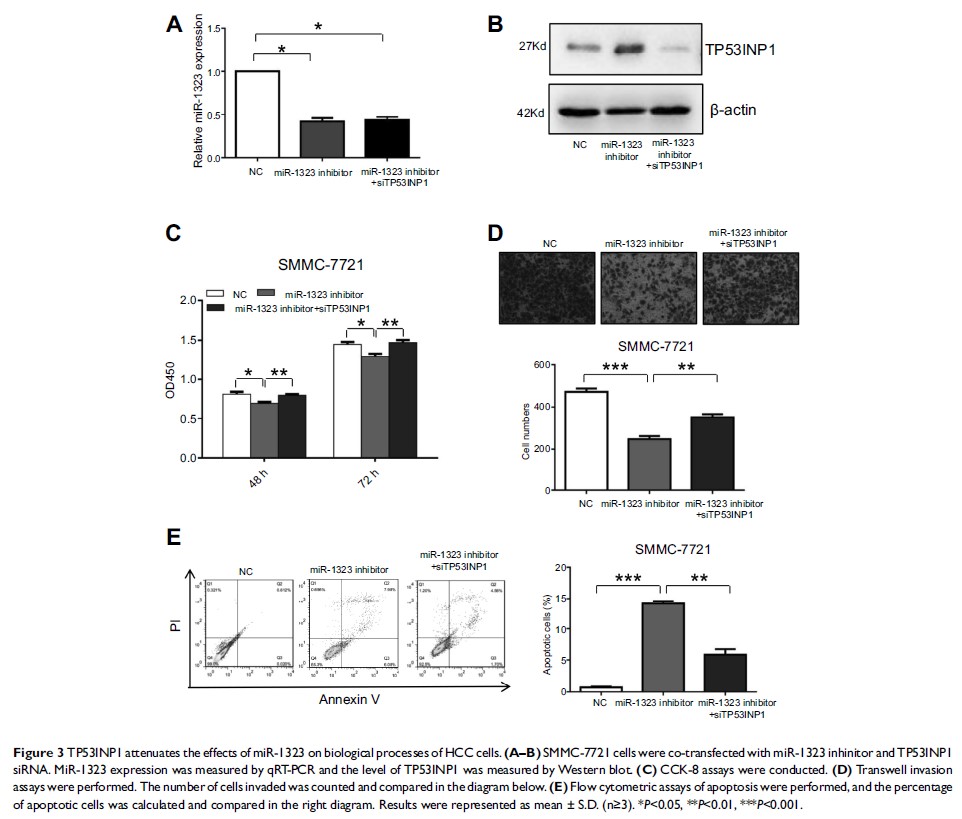
our results showed that miR-1323 promoted proliferation and invasion, and
inhibited apoptosis of HCC cells. Secondly, we found that TP53INP1 was a direct
target of miR-1323 and could reverse the effects of miR-1323 on proliferation,
invasion and apoptosis of HCC cells. Thirdly, our results showed that long
non-coding RNA (lncRNA) GAS5 and miR-1323 could interact with each other and
affect biological processes of HCC cells. Furthermore, we identified the
negative correlations between miR-1323 and TP53INP1, and between miR-1323 and
GAS5 in tumor tissues of patients with HCC.
Conclusion: Taken
together, our study revealed the important roles of GAS5/miR-1323/TP53INP1 axis
in HCC progression. This study also provided promising strategies for targeted
therapy of patients with HCC.
Keywords: miR-1323,
TP53INP1, GAS5, HCC, cell proliferation and invasion