115195
论文已发表
注册即可获取德孚的最新动态
IF 收录期刊
- 3.6 Breast Cancer (Dove Med Press)
- 4.3 Clin Epidemiol
- 2.6 Cancer Manag Res
- 3.2 Infect Drug Resist
- 4.1 Clin Interv Aging
- 6.1 Drug Des Dev Ther
- 4.1 Int J Chronic Obstr
- 8.7 Int J Nanomed
- 2.5 Int J Women's Health
- 3.2 Neuropsych Dis Treat
- 2.4 OncoTargets Ther
- 2.6 Patient Prefer Adher
- 2.6 Ther Clin Risk Manag
- 3.1 J Pain Res
- 3.5 Diabet Metab Synd Ob
- 4.5 Psychol Res Behav Ma
- 3.4 Nat Sci Sleep
- 2.4 Pharmgenomics Pers Med
- 2.6 Risk Manag Healthc Policy
- 4.6 J Inflamm Res
- 2.3 Int J Gen Med
- 3.9 J Hepatocell Carcinoma
- 3.3 J Asthma Allergy
- 2.5 Clin Cosmet Investig Dermatol
- 3.0 J Multidiscip Healthc

NSD3(WHSC1L1)下调通过 ERK1/2 失活抑制细胞增殖和迁移,降低结直肠癌细胞中 CAPG 的表达
Authors Yi L, Yi L, Liu Q, Li C
Received 22 October 2018
Accepted for publication 14 March 2019
Published 21 May 2019 Volume 2019:12 Pages 3933—3943
DOI https://doi.org/10.2147/OTT.S191732
Checked for plagiarism Yes
Review by Single-blind
Peer reviewers approved by Ms Justinn Cochran
Peer reviewer comments 2
Editor who approved publication: Dr Federico Perche
Purpose: NSD3
(WHSC1L1) is a protein lysine methyltransferase that is recurrently amplified
(8p11.23) in several cancer types, and its upregulation is involved in tumor
cell proliferation, metastasis, and epithelial-mesenchymal transition (EMT). We
aimed to evaluate its potential function as an oncogenic force in colorectal
cancer (CRC), and to elucidate relevant mechanisms of its oncogenic activity.
Materials and methods: NSD3
levels were analyzed in human CRC and adjacent normal tissues or cells by
Western blot analysis and RT-qPCR. Expression levels of the proteins were
detected by Western blot analysis and RT-qPCR.
Results: NSD3 was
significantly upregulated in both CRC tissues and cell lines. Knockdown of NSD3
expression resulted in significant decreases in CRC cell proliferation,
migration, and EMT process marker proteins vimentin, simultaneously reducing
E-cadherin and N-cadherin expression. The opposite results were observed when
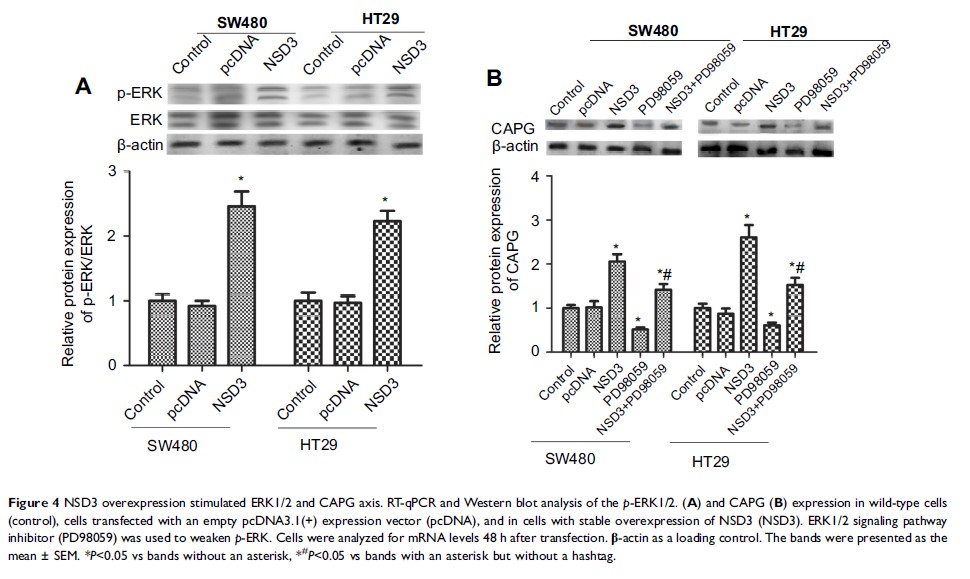
NSD3 was overexpressed. Additionally, overexpressing of NSD3 dramatically
activated the extracellular signal-regulated kinase 1/2 (ERK1/2) signaling
pathway and enhanced actin-capping protein (CAPG) expression. Furthermore, the
proliferation and migration abilities evidently facilitated by pcDNA3.1(+)
expression vector containing full-length CDS of NSD3 (pcDNA3.1(+)-NSD3, or
NSD3) were partially decreased after incubation with ERK1/2 signaling pathway
inhibitor (PD98059) and/or specific siRNA against CAPG (siCAPG) in SW480 and
HT-29 CRC cells.
Conclusion: NSD3
overexpression stimulated CRC cell proliferation and migration through
targeting the ERK1/2 signaling pathway and downstream CAPG. Thus, NSD3 could
serve as a promising target for anticancer drug development for patients with
CRC.
Keywords: colorectal
cancer, histone methyltransferase NSD3, extracellular signal-regulated kinase
1/2, actin-capping protein (CAPG)