115195
论文已发表
注册即可获取德孚的最新动态
IF 收录期刊
- 3.6 Breast Cancer (Dove Med Press)
- 4.3 Clin Epidemiol
- 2.6 Cancer Manag Res
- 3.2 Infect Drug Resist
- 4.1 Clin Interv Aging
- 6.1 Drug Des Dev Ther
- 4.1 Int J Chronic Obstr
- 8.7 Int J Nanomed
- 2.5 Int J Women's Health
- 3.2 Neuropsych Dis Treat
- 2.4 OncoTargets Ther
- 2.6 Patient Prefer Adher
- 2.6 Ther Clin Risk Manag
- 3.1 J Pain Res
- 3.5 Diabet Metab Synd Ob
- 4.5 Psychol Res Behav Ma
- 3.4 Nat Sci Sleep
- 2.4 Pharmgenomics Pers Med
- 2.6 Risk Manag Healthc Policy
- 4.6 J Inflamm Res
- 2.3 Int J Gen Med
- 3.9 J Hepatocell Carcinoma
- 3.3 J Asthma Allergy
- 2.5 Clin Cosmet Investig Dermatol
- 3.0 J Multidiscip Healthc

电石棉/PCL 纳米纤维支架在体外和体内负载石墨烯的特性及毒性评价
Authors Chen X, Feng B, Zhu DQ, Chen YW, Ji W, Ji TJ, Li F
Received 12 February 2019
Accepted for publication 9 April 2019
Published 21 May 2019 Volume 2019:14 Pages 3669—3678
DOI https://doi.org/10.2147/IJN.S204971
Checked for plagiarism Yes
Review by Single-blind
Peer reviewers approved by Dr Thiruganesh Ramasamy
Peer reviewer comments 2
Editor who approved publication: Dr Linlin Sun
Background: Electrospun
gelatin/polycaprolactone (Gt/PCL) nanofibrous scaffolds loaded with graphene
are novel nanomaterials with the uniquely strong property of electrical conductivity,
which have been widely investigated for their potential applications in
cardiovascular tissue engineering, including in bypass tracts for
atrioventricular block.
Purpose: Electrospun
Gt/PCL/graphene nanofibrous mats were successfully produced. Scanning electron
micrography showed that the fibers with graphene were smooth and homogeneous.
In vitro, to determine the biocompatibility of the scaffolds, hybrid scaffolds
with different fractions of graphene were seeded with neonatal rat ventricular
myocytes. In vivo, Gt/PCL scaffolds with different concentrations of graphene
were implanted into rats for 4, 8 and 12 weeks.
Results: CCK-8
assays and histopathological staining (including DAPI, cTNT, and CX43)
indicated that cells grew and survived well on the hybrid scaffolds if the mass
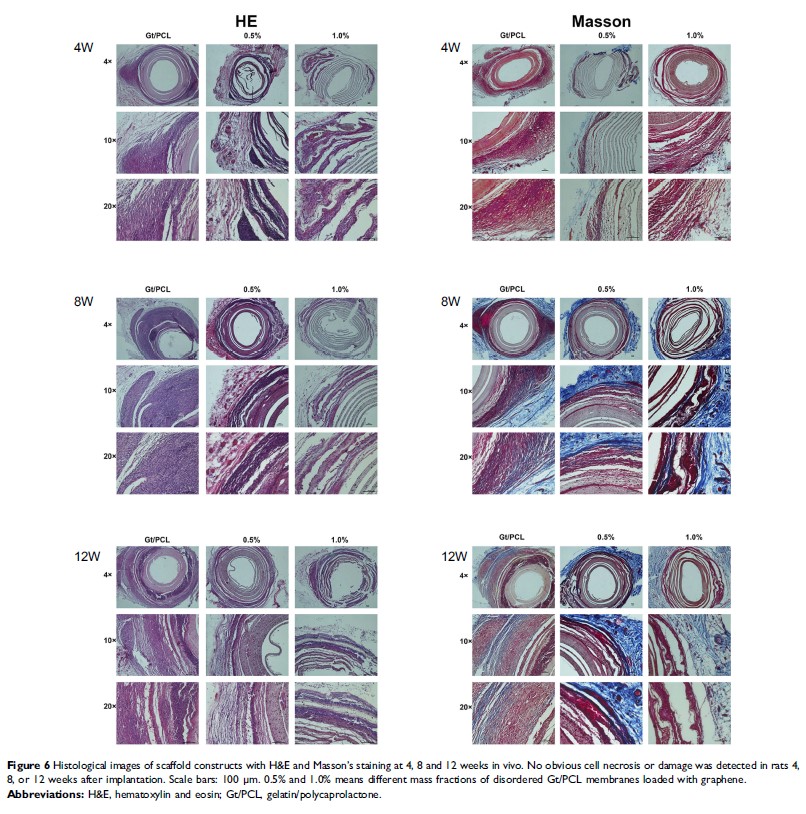
fraction of graphene was lower than 0.5%. After implanting into rats for 4, 8
or 12 weeks, there was no gathering of inflammatory cells around the
nanomaterials according to the HE staining results.
Conclusion: The
results indicate that Gt/PCL nanofibrous scaffolds loaded with graphene have
favorable electrical conductivity and biological properties and may be suitable
scaffolds for use in the treatment of atrioventricular block. These findings
alleviate safety concerns and provide novel insights into the potential
applications of Gt/PCL loaded with graphene, offering a solid foundation for
comprehensive in vivo studies.
Keywords: gelatin,
polycaprolactone, graphene, electrical conductivity, toxicity, atrioventricular
block