117333
论文已发表
注册即可获取德孚的最新动态
IF 收录期刊
- 3.6 Breast Cancer (Dove Med Press)
- 4.3 Clin Epidemiol
- 2.6 Cancer Manag Res
- 3.2 Infect Drug Resist
- 4.1 Clin Interv Aging
- 6.1 Drug Des Dev Ther
- 4.1 Int J Chronic Obstr
- 8.7 Int J Nanomed
- 2.5 Int J Women's Health
- 3.2 Neuropsych Dis Treat
- 2.4 OncoTargets Ther
- 2.6 Patient Prefer Adher
- 2.6 Ther Clin Risk Manag
- 3.1 J Pain Res
- 3.5 Diabet Metab Synd Ob
- 4.5 Psychol Res Behav Ma
- 3.4 Nat Sci Sleep
- 2.4 Pharmgenomics Pers Med
- 2.6 Risk Manag Healthc Policy
- 4.6 J Inflamm Res
- 2.3 Int J Gen Med
- 3.9 J Hepatocell Carcinoma
- 3.3 J Asthma Allergy
- 2.5 Clin Cosmet Investig Dermatol
- 3.0 J Multidiscip Healthc

脑白质病变患者的结构变化及其与认知障碍的关联
Authors Wang J, Liang Y, Chen H, Wang W, Wang Y, Liang Y, Zhang Y
Received 15 November 2018
Accepted for publication 20 February 2019
Published 21 May 2019 Volume 2019:15 Pages 1355—1363
DOI https://doi.org/10.2147/NDT.S194803
Checked for plagiarism Yes
Review by Single-blind
Peer reviewers approved by Ms Justinn Cochran
Peer reviewer comments 2
Editor who approved publication: Professor Jun Chen
Background: White
matter lesions (WMLs) play a role in cognitive decline and dementia. Little is
known about gray matter (GM) changes in WMLs. This study aimed to investigate
GM changes in WML patients.
Materials and methods: Correlations
between altered structural volume and cognitive assessment scores were
investigated. GM and white matter (WM) changes in 23 WML-vascular dementia
(VaD) patients, 22 WML-non-dementia vascular cognitive impairment (VCIND)
patients, and 23 healthy control (HC) subjects were examined. Gray matter
density (GMD) was calculated by measuring local proportions of GM at thousands
of homologous cortical locations. WM volume was obtained by fully automated
software using voxel-based morphometry (VBM).
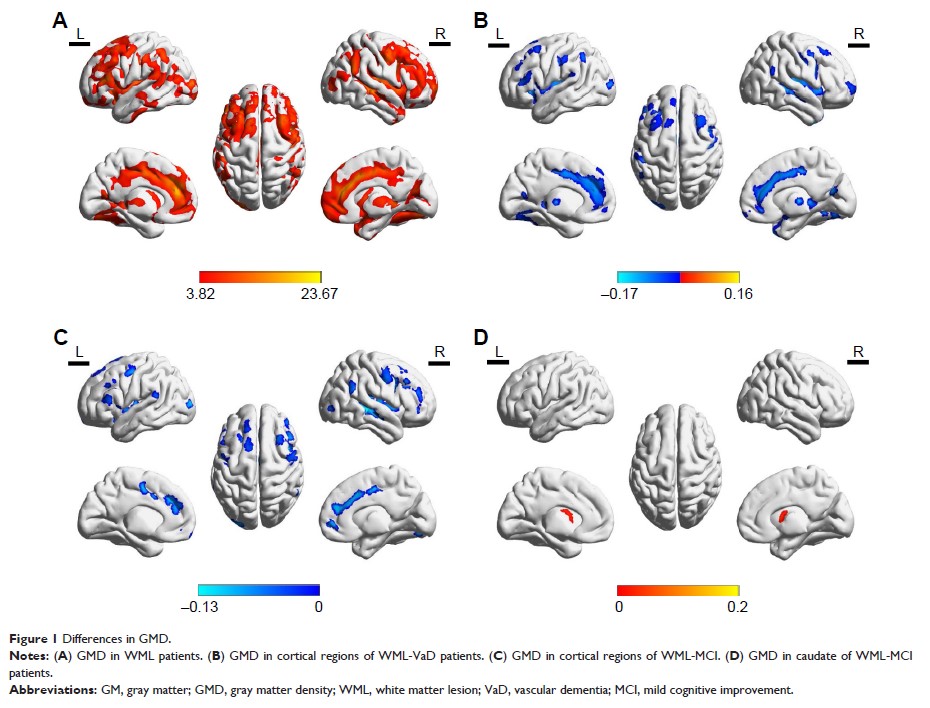
Results: Widespread
GMD was significantly lower in WML patients compared to control subjects in
cortical and subcortical regions (p <0.05). Greatest differences were found in the
bilateral anterior cingulate cortex, inferior frontal gyrus, insula, angular
gyrus, caudate, precentral gyrus, and right middle temporal gyrus, right thalamus.
Secondary region of interest (ROI) analysis indicated significantly greater GMD
in the bilateral caudate among WML-VCIND patients (n=22) compared to HCs (p <0.05). There
was a significant difference in WM volume between WML patients and control subjects
(p <0.05).
Greatest differences were located in the genu/body/splenium of the corpus
callosum and superior corona radiata L, and posterior corona radiata L. There
was a significant association between structural changes and cognitive scores
(Montreal Cognitive Assessment [MoCA] score) (p <0.05). There
was no significant correlation between structural changes and Mini Mental State
Examination (MMSE) scores (p >0.05).
Conclusion: GMD and
WM volume were changed in WMLs, and the changes were detectable. Correlation
between structural changes and cognitive function was promising in
understanding the pathological and physiological mechanisms of WMLs.
Keywords: white
matter lesions, vascular dementia, gray matter density, dementia