115195
论文已发表
注册即可获取德孚的最新动态
IF 收录期刊
- 3.6 Breast Cancer (Dove Med Press)
- 4.3 Clin Epidemiol
- 2.6 Cancer Manag Res
- 3.2 Infect Drug Resist
- 4.1 Clin Interv Aging
- 6.1 Drug Des Dev Ther
- 4.1 Int J Chronic Obstr
- 8.7 Int J Nanomed
- 2.5 Int J Women's Health
- 3.2 Neuropsych Dis Treat
- 2.4 OncoTargets Ther
- 2.6 Patient Prefer Adher
- 2.6 Ther Clin Risk Manag
- 3.1 J Pain Res
- 3.5 Diabet Metab Synd Ob
- 4.5 Psychol Res Behav Ma
- 3.4 Nat Sci Sleep
- 2.4 Pharmgenomics Pers Med
- 2.6 Risk Manag Healthc Policy
- 4.6 J Inflamm Res
- 2.3 Int J Gen Med
- 3.9 J Hepatocell Carcinoma
- 3.3 J Asthma Allergy
- 2.5 Clin Cosmet Investig Dermatol
- 3.0 J Multidiscip Healthc

用于肿瘤治疗的缺氧活性纳米颗粒
Authors Wang Y, Shang W, Niu M, Tian J, Xu K
Received 4 December 2018
Accepted for publication 4 April 2019
Published 22 May 2019 Volume 2019:14 Pages 3705—3722
DOI https://doi.org/10.2147/IJN.S196959
Checked for plagiarism Yes
Review by Single-blind
Peer reviewers approved by Dr Govarthanan Muthusamy
Peer reviewer comments 3
Editor who approved publication: Dr Mian Wang
Abstract: Hypoxia
is a hallmark of malignant tumors and often correlates with increasing tumor
aggressiveness and poor treatment outcomes. Therefore, early diagnosis and
effective killing of hypoxic tumor cells are crucial for successful tumor
control. There has been a surge of interdisciplinary research aimed at
developing functional molecules and nanomaterials that can be used to
noninvasively image and efficiently treat hypoxic tumors. These mainly include
hypoxia-active nanoparticles, anti-hypoxia agents, and agents that target
biomarkers of tumor hypoxia. Hypoxia-active nanoparticles have been intensively
investigated and have demonstrated advanced effects on targeting tumor hypoxia.
In this review, we present an overview of the reports published to date on
hypoxia-activated prodrugs and their nanoparticle forms used in tumor-targeted
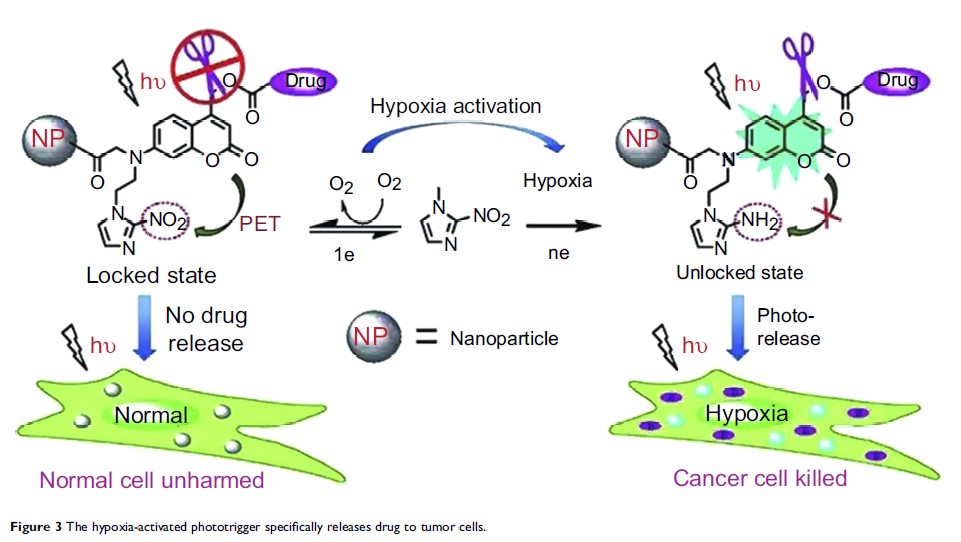
therapy. Hypoxia-responsive nanoparticles are inactive during blood circulation
and normal physiological conditions but are activated by hypoxia once they
extravasate into the hypoxic tumor microenvironment. Their use can enhance the
efficiency of tumor chemotherapy, radiotherapy, fluorescence and photoacoustic
intensity, and other imaging and therapeutic strategies. By targeting the broad
habitats of tumors, rather than tumor-specific receptors, this strategy has the
potential to overcome the problem of tumor heterogeneity and could be used to
design diagnostic and therapeutic nanoparticles for a broad range of solid
tumors.
Keywords: prodrug,
tumor microenvironment, metal complex, bioreductive