117333
论文已发表
注册即可获取德孚的最新动态
IF 收录期刊
- 3.6 Breast Cancer (Dove Med Press)
- 4.3 Clin Epidemiol
- 2.6 Cancer Manag Res
- 3.2 Infect Drug Resist
- 4.1 Clin Interv Aging
- 6.1 Drug Des Dev Ther
- 4.1 Int J Chronic Obstr
- 8.7 Int J Nanomed
- 2.5 Int J Women's Health
- 3.2 Neuropsych Dis Treat
- 2.4 OncoTargets Ther
- 2.6 Patient Prefer Adher
- 2.6 Ther Clin Risk Manag
- 3.1 J Pain Res
- 3.5 Diabet Metab Synd Ob
- 4.5 Psychol Res Behav Ma
- 3.4 Nat Sci Sleep
- 2.4 Pharmgenomics Pers Med
- 2.6 Risk Manag Healthc Policy
- 4.6 J Inflamm Res
- 2.3 Int J Gen Med
- 3.9 J Hepatocell Carcinoma
- 3.3 J Asthma Allergy
- 2.5 Clin Cosmet Investig Dermatol
- 3.0 J Multidiscip Healthc

放射科医师是否需要重新扫描乳房病变以验证在诊断状态下针对静态图像而进行的最终 BI-RADS US 评估?
Authors Hu Y, Mei J, Jiang X, Gu R, Liu F, Yang Y, Wang H, Shen S, Jia H, Liu Q, Gong C
Received 16 December 2018
Accepted for publication 22 March 2019
Published 22 May 2019 Volume 2019:11 Pages 4607—4615
DOI https://doi.org/10.2147/CMAR.S198435
Checked for plagiarism Yes
Review by Single-blind
Peer reviewers approved by Dr Amy Norman
Peer reviewer comments 3
Editor who approved publication: Dr Beicheng Sun
Purpose: To assess
whether radiologist needs to rescan the breast lesion to validate the final
American College of Radiology (ACR) Breast Imaging Reporting and Data System
(BI-RADS) ultrasonography (US) assessment made on the static images in the
diagnostic setting.
Patients and methods: Image
data on 1,070 patients with 1,070 category 3–5 breast lesions with a
pathological diagnosis scanned between January and June 2016 were included.
Both real-time and static image assessments were acquired for each lesion. The
diagnostic performance was evaluated by receiver operating characteristic (ROC)
curves. The positive predictive values (PPVs) of each category in the two
groups were calculated according to the ACR BI-RADS manual and compared. Kappas
were determined for agreement on two assessment approaches.
Results: The
sensitivity, specificity, PPV, and negative predictive value for real-time US
were 98.9%, 58.2%, 44.8% and 99.4%, and for static images were 98.9%, 57.1%,
44.1% and 99.3%, respectively. The performance of the two groups was not
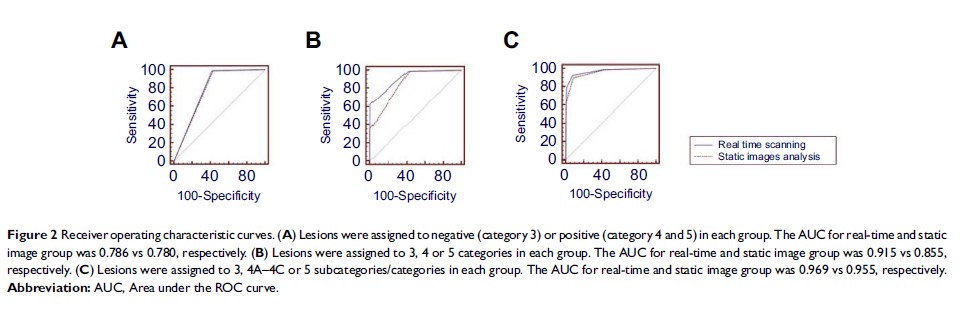
significantly different (areas under ROCs: 0.786 vs 0.780, P =0.566) if the
final assessment was only dichotomized as negative (category 3) and positive
(categories 4 and 5). All PPVs of each category for each assessment were within
the reference range provided by the ACR in 2013 except subcategory 4B
(reference range: >10% and ≤50%) of static image evaluation, which was also
significantly higher than that of real-time assessment (54.8% vs 40.7%, P =0.037). The
overall agreement of the two approaches was moderate (κ =0.43–0.56
according to different detailed assessment).
Conclusion: Both
static image and real-time assessment had similar diagnostic performance if
only the treatment recommendations were considered, that is, follow-up or
biopsy. However, as for subcategory 4B lesions without obviously benign or
malignant US features, real-time scanning by the interpreter is recommended to
obtain a more accurate BI-RADS assessment after assessing static images.
Keywords: Breast
Imaging Reporting and Data System, ultrasonography, diagnosis, real-time
scanning