115195
论文已发表
注册即可获取德孚的最新动态
IF 收录期刊
- 3.6 Breast Cancer (Dove Med Press)
- 4.3 Clin Epidemiol
- 2.6 Cancer Manag Res
- 3.2 Infect Drug Resist
- 4.1 Clin Interv Aging
- 6.1 Drug Des Dev Ther
- 4.1 Int J Chronic Obstr
- 8.7 Int J Nanomed
- 2.5 Int J Women's Health
- 3.2 Neuropsych Dis Treat
- 2.4 OncoTargets Ther
- 2.6 Patient Prefer Adher
- 2.6 Ther Clin Risk Manag
- 3.1 J Pain Res
- 3.5 Diabet Metab Synd Ob
- 4.5 Psychol Res Behav Ma
- 3.4 Nat Sci Sleep
- 2.4 Pharmgenomics Pers Med
- 2.6 Risk Manag Healthc Policy
- 4.6 J Inflamm Res
- 2.3 Int J Gen Med
- 3.9 J Hepatocell Carcinoma
- 3.3 J Asthma Allergy
- 2.5 Clin Cosmet Investig Dermatol
- 3.0 J Multidiscip Healthc

结肠癌进展的危险因素分析
Authors Yang Z, Chen Y, Wu D, Min Z, Quan Y
Received 2 March 2019
Accepted for publication 24 April 2019
Published 22 May 2019 Volume 2019:12 Pages 3991—4000
DOI https://doi.org/10.2147/OTT.S207390
Checked for plagiarism Yes
Review by Single-blind
Peer reviewers approved by Ms Rachel Predeepa
Peer reviewer comments 2
Editor who approved publication: Dr Arseniy Yuzhalin
Purpose: This
study aimed to find risk factors for colon cancer progression with
bioinformatics methods, and validated by clinical patients.
Methods: Differentially
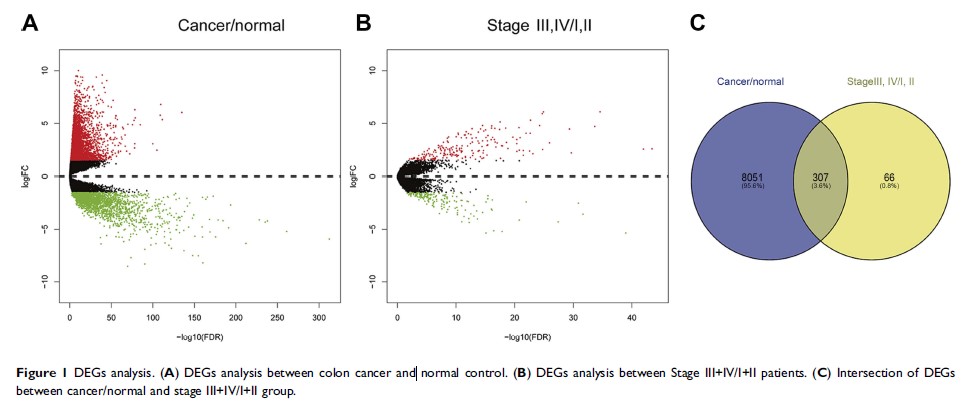
expressed genes (DEGs) between colon cancer tissues and normal colon tissues
were extracted from The Cancer Genome Atlas (TCGA) database using R software,
amounted to 8,051. DEGs between pathologic stage I+II and stage III+IV amounted
to 373, and were compared with DEGs of cancer/normal analyzed above to get the
intersection of both. Ninety-six intersected DEGs were identified and defined
as progressive DEGs of colon cancer. Then these 96 progressive DEGs were
studied by Gene ontology and KEGG (Kyoto Encyclopedia of Genes and Genomes)
pathway analysis using the DAVID database and visualizing by R software. A
protein–protein interaction (PPI) network and functional modules were
established using the STRING database. Further, an overall survival (OS) curve
was drawn via the GEPIA website based on the CGA database and six progressive
DEGs were found to be involved with OS of colon cancer patients. The
Linkedomics website was used for detailed analysis of specific subsets of TNM.
Results: Pregnancy
specific glycoprotein (PSG), vitamin digestion, and absorption were confirmed
to promote the progression of colon cancer. Furthermore, NTF4 was found to be
associated with both OS and each subset of TNM; therefore, defined as a key risk
factor for colon cancer progression. Further analysis of NTF4 expression using
clinical data showed it acted as a key risk factor and diagnosis marker for
colon cancer progression.
Conclusion: NTF4 is a
risk factor contributing to colon cancer progression and associated with
overall survival.
Keywords: colon
cancer, differentially expressed genes, tumor progression, NTF4