117333
论文已发表
注册即可获取德孚的最新动态
IF 收录期刊
- 3.6 Breast Cancer (Dove Med Press)
- 4.3 Clin Epidemiol
- 2.6 Cancer Manag Res
- 3.2 Infect Drug Resist
- 4.1 Clin Interv Aging
- 6.1 Drug Des Dev Ther
- 4.1 Int J Chronic Obstr
- 8.7 Int J Nanomed
- 2.5 Int J Women's Health
- 3.2 Neuropsych Dis Treat
- 2.4 OncoTargets Ther
- 2.6 Patient Prefer Adher
- 2.6 Ther Clin Risk Manag
- 3.1 J Pain Res
- 3.5 Diabet Metab Synd Ob
- 4.5 Psychol Res Behav Ma
- 3.4 Nat Sci Sleep
- 2.4 Pharmgenomics Pers Med
- 2.6 Risk Manag Healthc Policy
- 4.6 J Inflamm Res
- 2.3 Int J Gen Med
- 3.9 J Hepatocell Carcinoma
- 3.3 J Asthma Allergy
- 2.5 Clin Cosmet Investig Dermatol
- 3.0 J Multidiscip Healthc

与 PD-L1 表达相关联的 TLR4 表达显示了外周T细胞淋巴瘤患者的预后不良
Authors Zhao S, Sun M, Meng H, Ji H, Liu Y, Zhang M, Li H, Li P, Zhang Y, Zhang Q
Received 28 January 2019
Accepted for publication 30 April 2019
Published 23 May 2019 Volume 2019:11 Pages 4743—4756
DOI https://doi.org/10.2147/CMAR.S203156
Checked for plagiarism Yes
Review by Single-blind
Peer reviewers approved by Dr Cristina Weinberg
Peer reviewer comments 2
Editor who approved publication: Dr Antonella D'Anneo
Background: Toll-like
receptor 4 (TLR4), a member of the pattern recognition receptors, has been
reported to be involved in carcinogenesis. However, the clinical impact of TLR4
in peripheral T-cell lymphomas (PTCL) remains unclear.
Methods: The
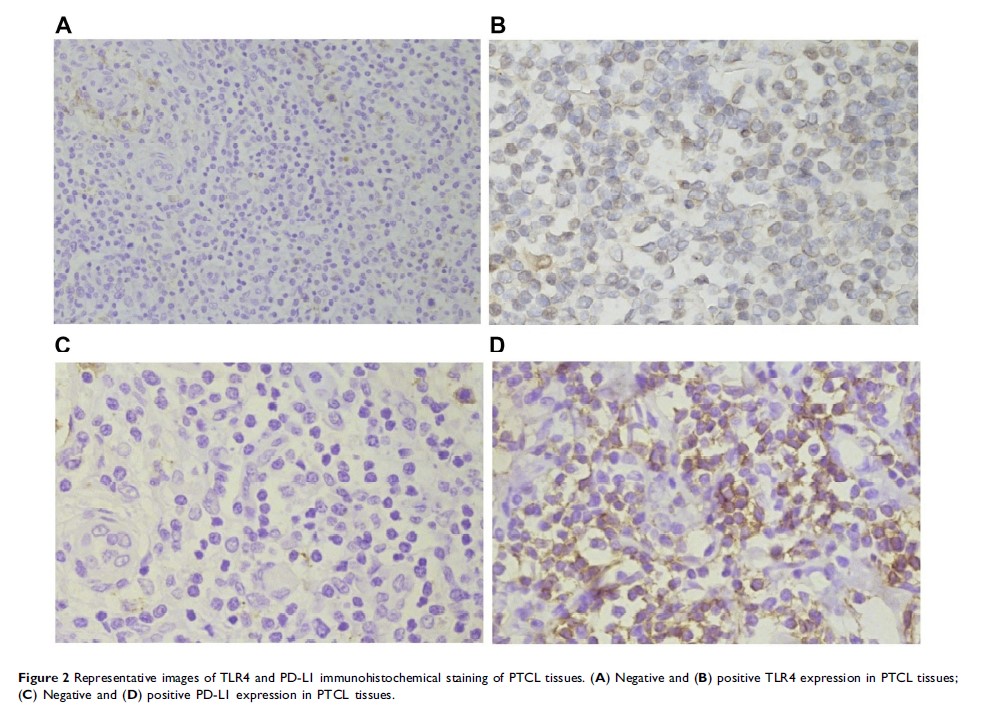
current study, using immunohistochemical staining, first examined TLR4 and
programmed cell death-ligand 1 (PD-L1) expression in patients with PTCL, to
correlate TLR4 and PD-L1 expression with clinicopathological parameters.
Results: It was
found that the rates of high expression of TLR4 and PD-L1 were 41.7% and 45.8%,
respectively. TLR4 expression was closely associated with PD-L1 expression. The
expression of TLR4 was closely related to primary extranodal site involvement,
increased Ann Arbor stage, and low hemoglobin expression, while the expression
of PD-L1 was closely related to a low platelet count and multiple extranodal
organ involvements (>1). High expression of either TLR4 or PD-L1 indicated a
poor survival rate for patients with PTCL. Multivariate analyses further
confirmed that increased expression levels of TLR4 and PD-L1 are unfavorable
prognostic factors for PTCL.
Conclusion: This
study demonstrates that the expressions of TLR4 and PD-L1 are independent
predictors of survival time for patients with PTCL. Thus, TLR4 and PD-L1 may
serve as potential therapeutic targets in PTCL patients.
Keywords: TLR4,
PD-L1, peripheral T-cell lymphomas, non-Hodgkin’s lymphoma, immune checkpoint
inhibitor, survival