117923
论文已发表
注册即可获取德孚的最新动态
IF 收录期刊
- 3.6 Breast Cancer (Dove Med Press)
- 4.3 Clin Epidemiol
- 2.6 Cancer Manag Res
- 3.2 Infect Drug Resist
- 4.1 Clin Interv Aging
- 6.1 Drug Des Dev Ther
- 4.1 Int J Chronic Obstr
- 8.7 Int J Nanomed
- 2.5 Int J Women's Health
- 3.2 Neuropsych Dis Treat
- 2.4 OncoTargets Ther
- 2.6 Patient Prefer Adher
- 2.6 Ther Clin Risk Manag
- 3.1 J Pain Res
- 3.5 Diabet Metab Synd Ob
- 4.5 Psychol Res Behav Ma
- 3.4 Nat Sci Sleep
- 2.4 Pharmgenomics Pers Med
- 2.6 Risk Manag Healthc Policy
- 4.6 J Inflamm Res
- 2.3 Int J Gen Med
- 3.9 J Hepatocell Carcinoma
- 3.3 J Asthma Allergy
- 2.5 Clin Cosmet Investig Dermatol
- 3.0 J Multidiscip Healthc

三苯氧胺的温度敏感相变水凝胶实现了对乳腺癌细胞的长效抗肿瘤活化
Authors Meng D, Lei H, Zheng X, Han Y, Sun R, Zhao D, Liu R
Received 13 January 2019
Accepted for publication 16 April 2019
Published 24 May 2019 Volume 2019:12 Pages 3919—3931
DOI https://doi.org/10.2147/OTT.S201421
Checked for plagiarism Yes
Review by Single-blind
Peer reviewers approved by Ms Shreya Arora
Peer reviewer comments 3
Editor who approved publication: Dr Takuya Aoki
Background: Breast cancer is one of the foremost threats to female health
nowadays. Tamoxifen, an antagonist of estrogen receptor-α (ERα), is the first
choice for endocrine-dependent breast cancer (ERα-positive breast cancer)
treatment. However, ERα has an important function in the normal physical regulation
of estrogen, and current oral administration of tamoxifen has potential side
effects on normal endocrine secretion. In the present work, we aim to develop
novel approaches to increase the antitumor effect of tamoxifen on breast cancer
cells and decrease the potential side effects in the human body during
treatment.
Methods: A temperature-sensitive phase-change hydrogel for tamoxifen
(Tam-Gel) was generated. After establishing subcutaneous tumors formed by
MCF-7, an ERα-positive breast cancer cell line, in nude mice, an intratumoral
injection of Tam-Gel was performed to examine whether Tam-Gel facilitated the
slow-release or antitumor effect of tamoxifen. A metastatic breast cancer model
was established using the intrahepatic growth of MCF-7 cells in immunodeficient
rats.
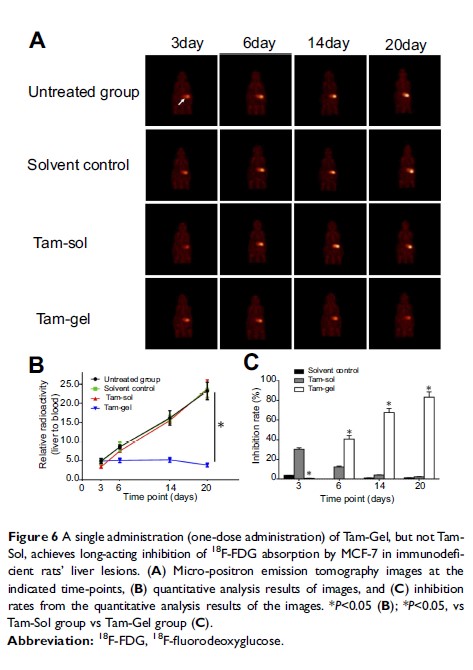
Results: Tam-Gel can transform from liquid to hydrogel at room temperature.
An intratumoral injection of Tam-Gel facilitated the slow-release or antitumor
effect of tamoxifen. Once Tam-Gel, but not Tam-Sol, was administered by
intratumoral injection, it significantly decreased the uptake of radionuclide
probes (18F-fluoroestradiol
or 18F-fluorodeoxyglucose)
by cells in rats’ livers and the intrahepatic growth of MCF-7 cells in rats’
livers.
Conclusion: A novel slow-release system was successfully prepared to
facilitate the long-term release of tamoxifen in breast cancer tissues, and
achieved an antitumor effect in the long term.
Keywords: breast cancer, estrogen receptor-α, tamoxifen nanoparticle,
temperature-sensitive phase-change hydrogel