117923
论文已发表
注册即可获取德孚的最新动态
IF 收录期刊
- 3.6 Breast Cancer (Dove Med Press)
- 4.3 Clin Epidemiol
- 2.6 Cancer Manag Res
- 3.2 Infect Drug Resist
- 4.1 Clin Interv Aging
- 6.1 Drug Des Dev Ther
- 4.1 Int J Chronic Obstr
- 8.7 Int J Nanomed
- 2.5 Int J Women's Health
- 3.2 Neuropsych Dis Treat
- 2.4 OncoTargets Ther
- 2.6 Patient Prefer Adher
- 2.6 Ther Clin Risk Manag
- 3.1 J Pain Res
- 3.5 Diabet Metab Synd Ob
- 4.5 Psychol Res Behav Ma
- 3.4 Nat Sci Sleep
- 2.4 Pharmgenomics Pers Med
- 2.6 Risk Manag Healthc Policy
- 4.6 J Inflamm Res
- 2.3 Int J Gen Med
- 3.9 J Hepatocell Carcinoma
- 3.3 J Asthma Allergy
- 2.5 Clin Cosmet Investig Dermatol
- 3.0 J Multidiscip Healthc

Porous Se@SiO2 纳米复合材料促进大鼠骨髓间充质干细胞迁移和成骨分化,加速大鼠骨折愈合
Authors Li C, Wang Q, Gu X, Kang Y, Zhang Y, Hu Y, Li T, Jin H, Deng G, Wang Q
Received 25 January 2019
Accepted for publication 14 April 2019
Published 24 May 2019 Volume 2019:14 Pages 3845—3860
DOI https://doi.org/10.2147/IJN.S202741
Checked for plagiarism Yes
Review by Single-blind
Peer reviewers approved by Dr Alexander Kharlamov
Peer reviewer comments 2
Editor who approved publication: Dr Mian Wang
Background: Delay or failure of bone union is a significant clinical challenge
all over the world, and it has been reported that bone marrow mesenchymal stem
cells (BMSCs) offer a promising approach to accelerate bone fracture healing.
Se can modulate the proliferation and differentiation of BMSCs. Se-treatment
enhances the osteoblastic differentiation of BMSCs and inhibiting the differentiation
and formation of mature osteoclasts. The purpose of this study was to assess
the effects of porous Se@SiO2 nanocomposite
on bone regeneration and the underlying biological mechanisms.
Methods: We oxidized Se2- to
develop Se quantum dots, then we used the Se quantum dots to form a solid
Se@SiO2 nanocomposite which was then coated with
polyvinylpyrrolidone (PVP) and etched in hot water to synthesize porous Se@SiO2 nanocomposite. We used XRD pattern to assess
the phase structure of the solid Se@SiO2 nanocomposite.
The morphology of porous Se@SiO2 nanocomposite
were evaluated by scanning electron microscope (SEM) and the biocompatibility
of porous Se@SiO2 nanocomposite were
investigated by cell counting kit-8 (CCK-8) assays. Then, a release assay was
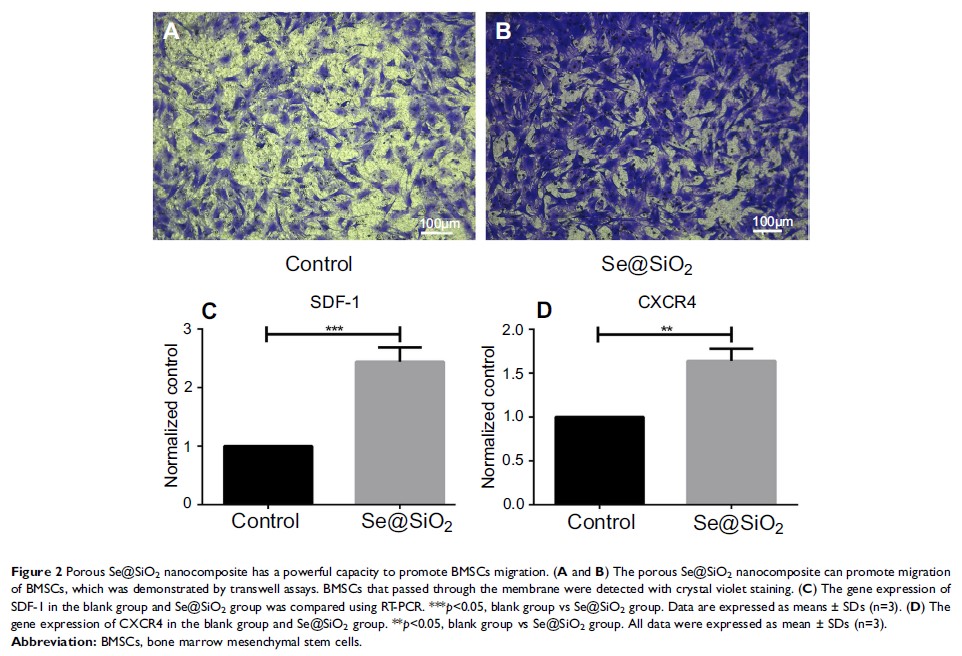
also performed. We used a Transwell assay to determine cell mobility in
response to the porous Se@SiO2 nanocomposite.
For in vitro experiments, BMSCs were divided into four groups to detect
reactive oxygen species (ROS) generation, cell apoptosis, alkaline
phosphatase activity, calcium deposition, gene activation and protein
expression. For in vivo experiments, femur fracture model of rats was
constructed to assess the osteogenic effects of porous Se@SiO2 nanocomposite.
Results: In vitro, intervention with porous Se@SiO2 nanocomposite can promote migration and
osteogenic differentiation of BMSCs, and protect BMSCs against H2O2-induced
inhibition of osteogenic differentiation. In vivo, we demonstrated that the
porous Se@SiO2 nanocomposite accelerated
bone fracture healing using a rat femur fracture model.
Conclusion: Porous Se@SiO2 nanocomposite
promotes migration and osteogenesis differentiation of rat BMSCs
and accelerates bone fracture healing, and porous Se@SiO2 nanocomposite may provide clinic benefit for
bone tissue engineering.
Keywords: bone marrow
mesenchymal stem cells, porous Se@SiO2 nanocomposite,
antioxidant, migration, osteogenic differentiation