117923
论文已发表
注册即可获取德孚的最新动态
IF 收录期刊
- 3.6 Breast Cancer (Dove Med Press)
- 4.3 Clin Epidemiol
- 2.6 Cancer Manag Res
- 3.2 Infect Drug Resist
- 4.1 Clin Interv Aging
- 6.1 Drug Des Dev Ther
- 4.1 Int J Chronic Obstr
- 8.7 Int J Nanomed
- 2.5 Int J Women's Health
- 3.2 Neuropsych Dis Treat
- 2.4 OncoTargets Ther
- 2.6 Patient Prefer Adher
- 2.6 Ther Clin Risk Manag
- 3.1 J Pain Res
- 3.5 Diabet Metab Synd Ob
- 4.5 Psychol Res Behav Ma
- 3.4 Nat Sci Sleep
- 2.4 Pharmgenomics Pers Med
- 2.6 Risk Manag Healthc Policy
- 4.6 J Inflamm Res
- 2.3 Int J Gen Med
- 3.9 J Hepatocell Carcinoma
- 3.3 J Asthma Allergy
- 2.5 Clin Cosmet Investig Dermatol
- 3.0 J Multidiscip Healthc

对于接受最终放射治疗的老年宫颈癌患者选择性地使用同步化疗治疗:来自两个机构的经验
Authors You K, Peng H, Jiang Y, Bi Z, Qiu X
Received 7 October 2018
Accepted for publication 15 March 2019
Published 27 May 2019 Volume 2019:11 Pages 4815—4823
DOI https://doi.org/10.2147/CMAR.S190025
Checked for plagiarism Yes
Review by Single-blind
Peer reviewers approved by Dr Andrew Yee
Peer reviewer comments 3
Editor who approved publication: Dr Beicheng Sun
Background: Whether
concurrent chemotherapy could bring about better oncological outcomes in
elderly patients receiving definitive radiotherapy is still unknown. So, the
purpose of this study was to find out whether it is essential for elderly
patients to undergo concurrent chemotherapy.
Methods: We performed
a retrospective study of 246 elderly cervical cancer patients who were treated
with definitive radiotherapy or chemo-radiation between August 2004 and August
2015. All patients were divided into two groups according to whether they were
receiving concurrent chemotherapy or not. Overall survival (OS) and
disease-free survival (DFS) were compared between the two groups. Recurrence
patterns were also analyzed. Multivariate analysis was performed to explore
clinical factors significantly associated with DFS, local recurrence-free
survival, and distant metastasis-free survival (DMFS).
Results: The
5-year OS in the radiotherapy and chemo-radiation groups were 72.89% and
82.25%, respectively. A significant difference was found between the two groups
(P =0.016). The
5-year DFS in the radiotherapy and chemo-radiaton groups were 58.19% and
75.52%, respectively, also with a significant difference between the two groups
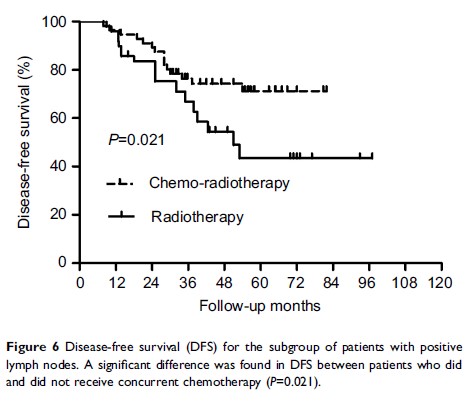
(P =0.028). Further
subgroup analysis showed that in patients with negative lymph nodes, there were
no differences in both OS and DFS between patients who did and did not receive
concurrent chemotherapy. However, in patients with positive lymph nodes,
patients who received concurrent chemotherapy acquired better OS and DFS than
those who did not. Multivariable analysis showed that concurrent chemotherapy
was an independent predictor of DFS and DMFS.
Conclusion: Concurrent
chemotherapy could improve oncological outcomes in elderly cervical cancer
patients with positive lymph nodes, but not in those with negative lymph nodes.
Keywords: cervical
cancer, chemotherapy, radiotherapy