117923
论文已发表
注册即可获取德孚的最新动态
IF 收录期刊
- 3.6 Breast Cancer (Dove Med Press)
- 4.3 Clin Epidemiol
- 2.6 Cancer Manag Res
- 3.2 Infect Drug Resist
- 4.1 Clin Interv Aging
- 6.1 Drug Des Dev Ther
- 4.1 Int J Chronic Obstr
- 8.7 Int J Nanomed
- 2.5 Int J Women's Health
- 3.2 Neuropsych Dis Treat
- 2.4 OncoTargets Ther
- 2.6 Patient Prefer Adher
- 2.6 Ther Clin Risk Manag
- 3.1 J Pain Res
- 3.5 Diabet Metab Synd Ob
- 4.5 Psychol Res Behav Ma
- 3.4 Nat Sci Sleep
- 2.4 Pharmgenomics Pers Med
- 2.6 Risk Manag Healthc Policy
- 4.6 J Inflamm Res
- 2.3 Int J Gen Med
- 3.9 J Hepatocell Carcinoma
- 3.3 J Asthma Allergy
- 2.5 Clin Cosmet Investig Dermatol
- 3.0 J Multidiscip Healthc

右美托咪定在依托咪酯诱导的肌阵挛中的作用:一项随机双盲对照试验
Authors Miao S, Zou L, Wang G, Wang X, Liu S, Shi M
Received 28 December 2018
Accepted for publication 25 March 2019
Published 27 May 2019 Volume 2019:13 Pages 1803—1808
DOI https://doi.org/10.2147/DDDT.S194456
Checked for plagiarism Yes
Review by Single-blind
Peer reviewers approved by Dr Colin Mak
Peer reviewer comments 2
Editor who approved publication: Dr Sukesh Voruganti
Background: Etomidate
used for the induction of general anesthesia can result in myoclonus. We tested
the hypothesis that pretreatment with dexmedetomidine (Dex) reduces the
incidence of etomidate-induced myoclonus during the induction of general
anesthesia.
Materials and methods: One
hundred patients who were scheduled for selective operations under general
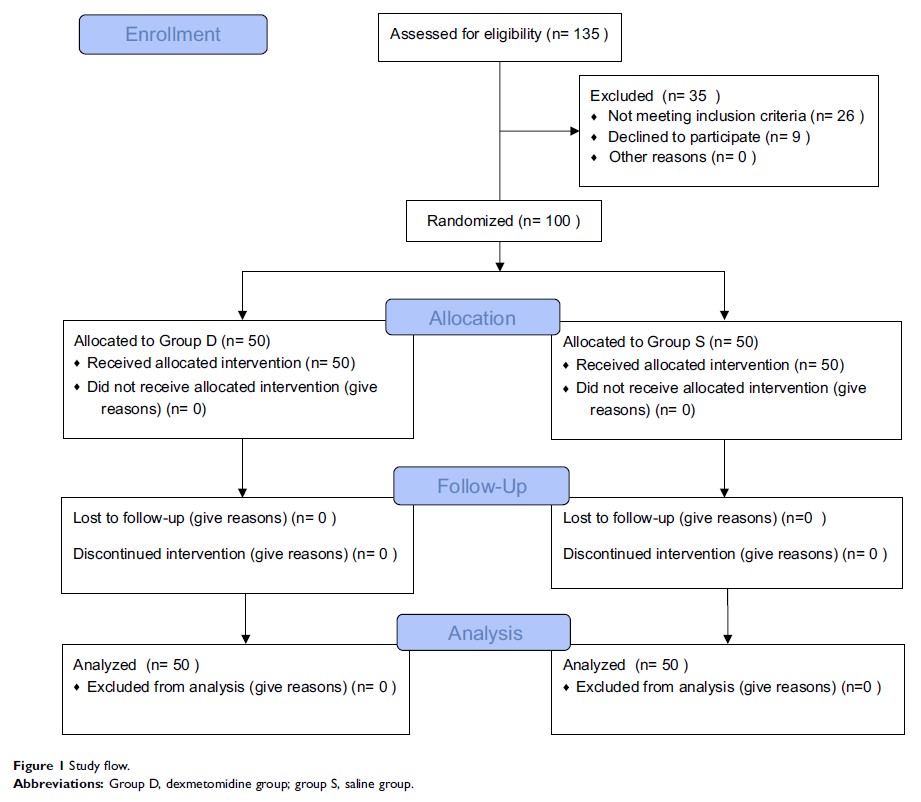
anesthesia were included in this randomized, double-blind controlled trial.
Patients were randomized to receive either Dex 0.5 μg/kg in 20 mL of normal
saline or the same volume of normal saline as pretreatment agents 15 mins
before the injection of etomidate 0.3 mg/kg. The primary endpoint was the
incidence of etomidate-induced myoclonus. Secondary endpoints were the severity
of etomidate-induced myoclonus and the incidence of adverse effects from the
onset of action of Dex or normal saline to the injection of etomidate, such as
dizziness, respiratory depression, bradycardia, hypotension and
nausea/vomiting.
Results: All of
the 100 patients completed the trial. Dex resulted in a significant 38%
reduction in the number of patients who experienced etomidate-induced
myoclonus: 13 (26%) vs 32 (64%) (P =0.0001). Additionally, the severity of myoclonus was
also reduced in the Dex group than that in the placebo group (P =0.02). Incidence
of dizziness, respiratory depression, bradycardia, hypotension and
nausea/vomiting was similar in both groups.
Conclusions: Pretreatment
with Dex 0.5 μg/kg 15 mins before the induction of general anesthesia not only
resulted in a 38% reduction in the incidence of etomidate-induced myoclonus,
but also reduced the severity of myoclonus, without inducing any adverse effects.
Keywords: general
anesthesia, adverse effects, myoclonus