117923
论文已发表
注册即可获取德孚的最新动态
IF 收录期刊
- 3.6 Breast Cancer (Dove Med Press)
- 4.3 Clin Epidemiol
- 2.6 Cancer Manag Res
- 3.2 Infect Drug Resist
- 4.1 Clin Interv Aging
- 6.1 Drug Des Dev Ther
- 4.1 Int J Chronic Obstr
- 8.7 Int J Nanomed
- 2.5 Int J Women's Health
- 3.2 Neuropsych Dis Treat
- 2.4 OncoTargets Ther
- 2.6 Patient Prefer Adher
- 2.6 Ther Clin Risk Manag
- 3.1 J Pain Res
- 3.5 Diabet Metab Synd Ob
- 4.5 Psychol Res Behav Ma
- 3.4 Nat Sci Sleep
- 2.4 Pharmgenomics Pers Med
- 2.6 Risk Manag Healthc Policy
- 4.6 J Inflamm Res
- 2.3 Int J Gen Med
- 3.9 J Hepatocell Carcinoma
- 3.3 J Asthma Allergy
- 2.5 Clin Cosmet Investig Dermatol
- 3.0 J Multidiscip Healthc

通过电沉积用于骨再生的分层聚(l-乳酸)/聚(ε-己内酯)纳米纤维支架的快速矿化
Authors Nie W, Gao Y, McCoul DJ, Gillispie GJ, Zhang Y, Liang L, He C
Received 16 February 2019
Accepted for publication 16 April 2019
Published 27 May 2019 Volume 2019:14 Pages 3929—3941
DOI https://doi.org/10.2147/IJN.S205194
Checked for plagiarism Yes
Review by Single-blind
Peer reviewers approved by Dr Cristina Weinberg
Peer reviewer comments 4
Editor who approved publication: Prof. Dr. Anderson Oliveira Lobo
Introduction: Hierarchical nanofibrous scaffolds are emerging as a
promising bone repair material due to their high cell adhesion activity and
nutrient permeability. However, the existing method for hierarchical
nanofibrous scaffolds fabrication is complicated and not perfectly suitable for
further biomedical application in view of both structure and function. In this
study, we constructed a hierarchical nanofibrous poly (l-lactic
acid)/poly(ϵ-caprolactone) (PLLA/PCL) scaffold and further evaluated its bone
healing ability.
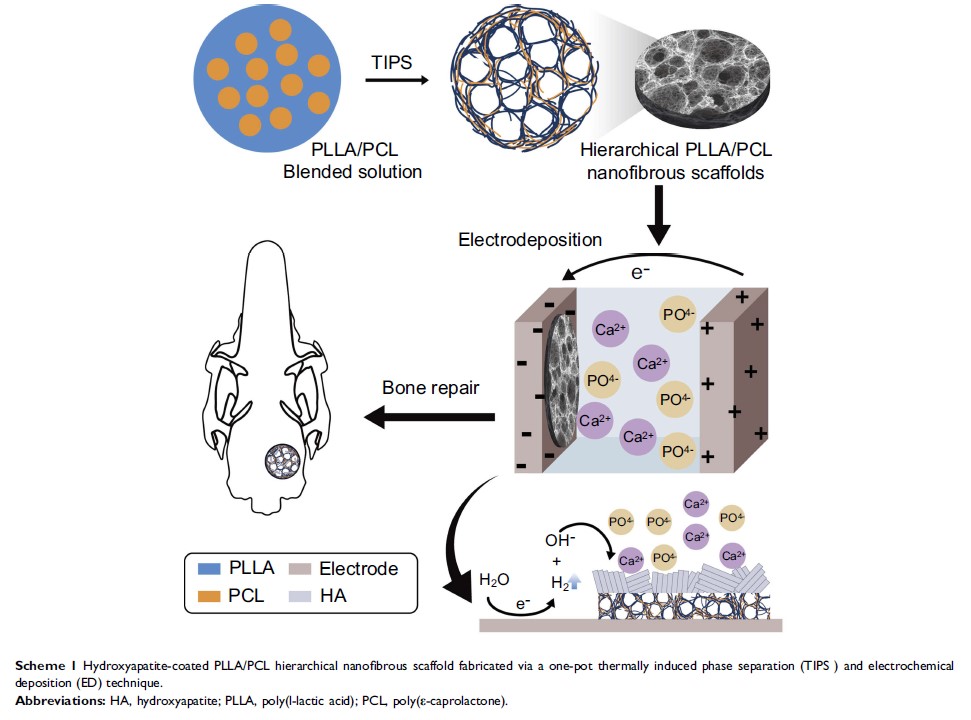
Methods: The hierarchical PLLA/PCL nanofibrous
scaffold (PLLA/PCL) was prepared by one-pot TIPS and then rapidly mineralized
at room temperature by an electrochemical deposition technique. After
electrode-positioning at 2 V for 2 hrs, a scaffold coated with hydroxyapatite
(M-PLLA/PCL) could be obtained.
Results: The pore size of the M-PLLA/PCL scaffold
was hierarchically distributed so as to match the biophysical structure for
osteoblast growth. The M-PLLA/PCL scaffold showed better cell proliferation and
osteogenesis activity compared to the PLLA/PCL scaffold. Further in vivo bone
repair studies indicated that the M-PLLA/PCL scaffold could accelerate defect
healing in 12 weeks.
Conclusion: The results of this study implied that
the as-prepared hydroxyapatite coated hierarchical PLLA/PCL nanofibrous
scaffolds could be developed as a promising material for efficient bone tissue
repair after carefully tuning the TIPS and electrodeposition parameters.
Keywords: mineralization, hierarchical porous
scaffold, electrodeposition, bone repair