117923
论文已发表
注册即可获取德孚的最新动态
IF 收录期刊
- 3.6 Breast Cancer (Dove Med Press)
- 4.3 Clin Epidemiol
- 2.6 Cancer Manag Res
- 3.2 Infect Drug Resist
- 4.1 Clin Interv Aging
- 6.1 Drug Des Dev Ther
- 4.1 Int J Chronic Obstr
- 8.7 Int J Nanomed
- 2.5 Int J Women's Health
- 3.2 Neuropsych Dis Treat
- 2.4 OncoTargets Ther
- 2.6 Patient Prefer Adher
- 2.6 Ther Clin Risk Manag
- 3.1 J Pain Res
- 3.5 Diabet Metab Synd Ob
- 4.5 Psychol Res Behav Ma
- 3.4 Nat Sci Sleep
- 2.4 Pharmgenomics Pers Med
- 2.6 Risk Manag Healthc Policy
- 4.6 J Inflamm Res
- 2.3 Int J Gen Med
- 3.9 J Hepatocell Carcinoma
- 3.3 J Asthma Allergy
- 2.5 Clin Cosmet Investig Dermatol
- 3.0 J Multidiscip Healthc

β-榄香烯通过 Prx-1/NF-κB/HIF-1α 信号通路抑制辐射和缺氧诱导的巨噬细胞浸润
Authors Yu X, Li Z, Zhang Y, Xu M, Che Y, Tian X, Wang R, Zou K, Zou L
Received 4 December 2018
Accepted for publication 4 April 2019
Published 28 May 2019 Volume 2019:12 Pages 4203—4211
DOI https://doi.org/10.2147/OTT.S196910
Checked for plagiarism Yes
Review by Single-blind
Peer reviewers approved by Dr Andrew Yee
Peer reviewer comments 2
Editor who approved publication: Dr Sanjay Singh
Background: In
cancers, tumor-associated macrophages (TAMs) play an important role in the
progression, evasion of immunity and sensitivity to therapy. Unfortunately,
radiation and hypoxia could induce the M2 macrophages infiltration and
polarization.
Materials and methods: In this study,
we investigated the relevance of macrophage recruitment with radiation and
hypoxia by transwell. We also evaluated the effect of β-elemene on the
infiltration of M2 macrophages and explored its underlying molecular mechanism
by a series of in vitro and in vivo experiments.
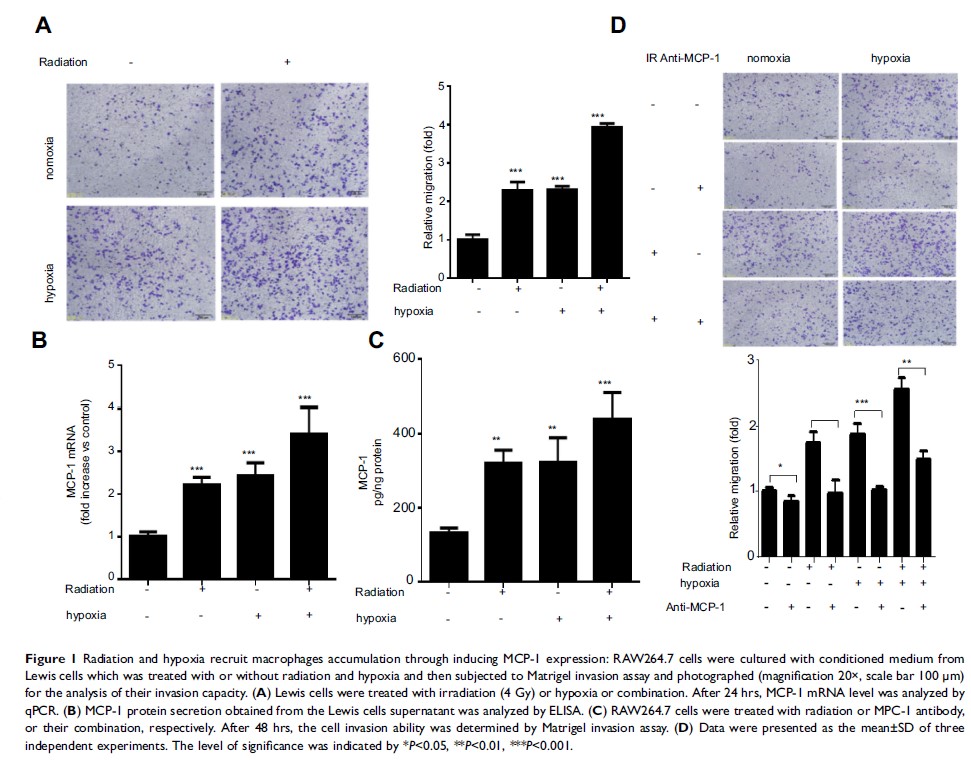
Results: Irradiated or
hypoxia lung cancer cells recruit macrophages, and the recruitment is MCP-1 dependent.
We also found that radiation and hypoxia-induced MCP-1 secretion follows
upregulation of Prx-1, which leads to nuclear accumulation of NF-κB and HIF-1α
expression. In addition, β-elemene could effectively suppress this recruitment
phenomenon through Prx-1/NF-κB/HIF-1α signaling.
Conclusion: Our study
showed that radiation and hypoxia significantly promoted the macrophages
recruitment. β-elemene could effectively suppress this recruitment phenomenon
and MCP-1 expression via inhibiting Prx-1/NF-κB/HIF-1α pathways.
Keywords: β-elemene,
radiation, hypoxia, macrophages infiltration, MCP-1, lung cancer