117923
论文已发表
注册即可获取德孚的最新动态
IF 收录期刊
- 3.6 Breast Cancer (Dove Med Press)
- 4.3 Clin Epidemiol
- 2.6 Cancer Manag Res
- 3.2 Infect Drug Resist
- 4.1 Clin Interv Aging
- 6.1 Drug Des Dev Ther
- 4.1 Int J Chronic Obstr
- 8.7 Int J Nanomed
- 2.5 Int J Women's Health
- 3.2 Neuropsych Dis Treat
- 2.4 OncoTargets Ther
- 2.6 Patient Prefer Adher
- 2.6 Ther Clin Risk Manag
- 3.1 J Pain Res
- 3.5 Diabet Metab Synd Ob
- 4.5 Psychol Res Behav Ma
- 3.4 Nat Sci Sleep
- 2.4 Pharmgenomics Pers Med
- 2.6 Risk Manag Healthc Policy
- 4.6 J Inflamm Res
- 2.3 Int J Gen Med
- 3.9 J Hepatocell Carcinoma
- 3.3 J Asthma Allergy
- 2.5 Clin Cosmet Investig Dermatol
- 3.0 J Multidiscip Healthc

基于 chr1p/19q 共缺失的基因综合分析揭示了低级别胶质瘤的强大 4 个基因预后特征
Authors Zhang C, Yu R, Li Z, Song H, Zang D, Deng M, Fan Y, Liu Y, Zhang Y, Qu X
Received 24 December 2018
Accepted for publication 24 April 2019
Published 29 May 2019 Volume 2019:11 Pages 4971—4984
DOI https://doi.org/10.2147/CMAR.S199396
Checked for plagiarism Yes
Review by Single-blind
Peer reviewers approved by Dr Amy Norman
Peer reviewer comments 2
Editor who approved publication: Dr Kenan Onel
Purpose: The chr1p/19q co-deletion is a favorable prognostic factor in patients with lower grade glioma. The aim of this study was to reveal key genes for prognosis and establish prognostic gene signatures based on genes encoded by chr1p/19q.
Materials and methods: The data was downloaded from The Cancer Genome Atlas (TCGA), Chinese Glioma Genome Atlas (CGGA) and Gene Expression Omnibus (GEO). Differentially expressed genes (DEGs) between lower grade glioma tissue and normal brain were identified. The univariate COX regression, robust likelihood-base survival analysis (rbsurv) and multivariate COX regression analysis were used to establish the 4-gene-signature based on the DEGs. The receiver operating characteristic (ROC) curve and the Kaplan-Mere curve were used to verify the prediction accuracy of the signature. Gene Set Enrichment Analysis (GSEA) and Kyoto Encyclopedia of Genes and Genomes (KEGG) analysis were also performed to explore the reasons for good prognosis in patients with chr1p/19q deletion.
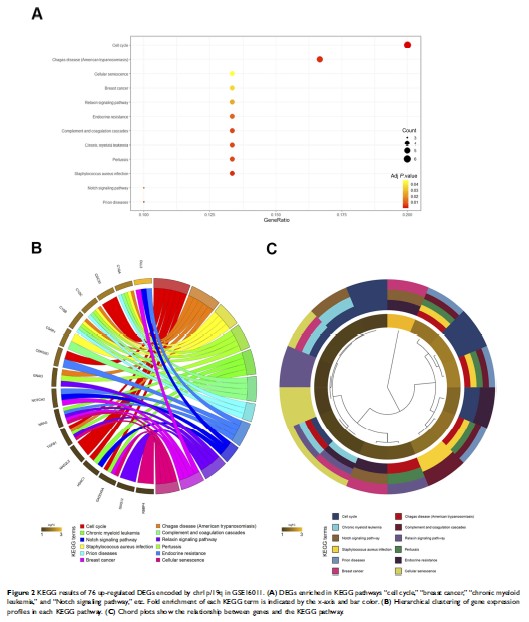
Results: A total of 1346 DEGs were identified between lower grade glioma samples and normal brain samples in GSE16011, including 56 up-regulated mRNAs located on chr1p and 20 up-regulated mRNAs located on chr19q. We established a 4-gene-signature that was significantly associated with survival based on the 76 gene. The AUC of the 4-gene-signature for 5-year OS in TCGA and CGGA was 0.837 and 0.876, respectively, which was superior compared to other parameters such as chr1p/19q co-deletion, IDH mutant, WHO grade and histology type, especially in chr1p/19q non-co-deletion patients. GSEA and KEGG analysis suggested that the prolongation of chr1p/19q in patients could be associated with cell cycle and DNA mismatch repairing.
Conclusions: We established a robust 4-gene-signature based on the chr1p/19q and we explored the potential function of these newly identified survival-associated genes by bioinformatics analysis. The 4-gene from the signature are promising molecular targets to be used in the future.
Keywords: lower grade glioma, prognostic signature, 1p/19q co-deletion, rbsurv