117923
论文已发表
注册即可获取德孚的最新动态
IF 收录期刊
- 3.6 Breast Cancer (Dove Med Press)
- 4.3 Clin Epidemiol
- 2.6 Cancer Manag Res
- 3.2 Infect Drug Resist
- 4.1 Clin Interv Aging
- 6.1 Drug Des Dev Ther
- 4.1 Int J Chronic Obstr
- 8.7 Int J Nanomed
- 2.5 Int J Women's Health
- 3.2 Neuropsych Dis Treat
- 2.4 OncoTargets Ther
- 2.6 Patient Prefer Adher
- 2.6 Ther Clin Risk Manag
- 3.1 J Pain Res
- 3.5 Diabet Metab Synd Ob
- 4.5 Psychol Res Behav Ma
- 3.4 Nat Sci Sleep
- 2.4 Pharmgenomics Pers Med
- 2.6 Risk Manag Healthc Policy
- 4.6 J Inflamm Res
- 2.3 Int J Gen Med
- 3.9 J Hepatocell Carcinoma
- 3.3 J Asthma Allergy
- 2.5 Clin Cosmet Investig Dermatol
- 3.0 J Multidiscip Healthc

靶向递送多肽纳米颗粒用于治疗创伤性脑损伤
Authors Wu P, Zhao H, Gou X, Wu X, Zhang S, Deng G, Chen Q
Received 25 January 2019
Accepted for publication 14 May 2019
Published 31 May 2019 Volume 2019:14 Pages 4059—4069
DOI https://doi.org/10.2147/IJN.S202353
Checked for plagiarism Yes
Review by Single-blind
Peer reviewers approved by Dr Andrew Yee
Peer reviewer comments 4
Editor who approved publication: Dr Mian Wang
Background and purpose: Traumatic brain injury (TBI) is a major disease without effective treatment. Recently, Tat-NR2B9c peptide emerged as a promising neuroprotective agent, but limited in clinical translation by it low brain penetrability. We synthesized Tat-NR2B9c loaded self-assembled activatable protein nanoparticles, termed TN-APNPs, and demonstrated that TN-APNPs enhanced the delivery of Tat-NR2B9c to the brain lesion in stroke. Herein we developed a novel approach to further engineering TN-APNPs for targeted delivery of Tat-NR2B9c to the injured brain with enhanced efficiency through conjugation of CAQK or CCAQK, a short peptide.
Methods: Short peptide-conjugated TN-APNPs were synthesized by conjugated with CAQK or CCAQK via a click condensation reaction with CBT, then analyzed by dynamic light scattering, transmission electron microscopy and thrombin responsive assay. Characterization of short peptide-conjugated TN-APNPs were investigated by using cell excitotoxicity assay and transwell blood-brain-barrier model in vitro, and pharmacokinetics, IVIS imaging system and confocal analysis in TBI-bearing mice. Evaluation of therapeutic effects were analyzed by H&E staining, Elevated Plus Maze analysis and Rotarod test.
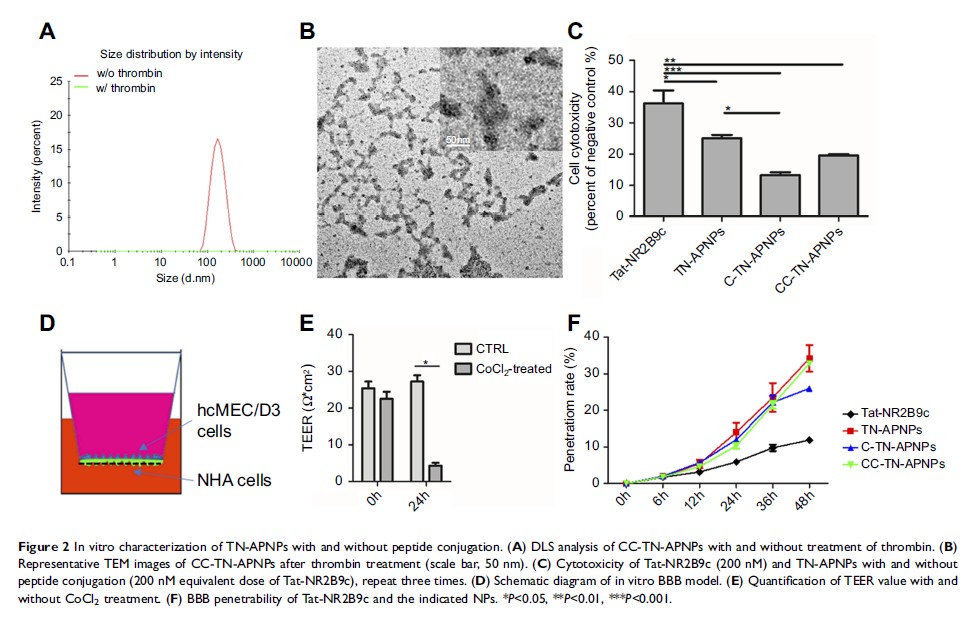
Results: CAQK-conjugated TN-APNPs (C-TN-APNPs) and CCAQK-conjugated TN-APNPs (CC-TN-APNPs) were spherical in morphology and 30 nm in diameter. In vitro studies revealed that TN-APNPs, C-TN-APNPs and CC-TN-APNPs were responsive to thrombin cleavage, reduced the cytotoxicity of Tat-NR2B9c, and increased BBB permeability of Tat-NR2B9c. CC-TN-APNPs demonstrated the better circulation time, better targeting ability and penetrating efficiency to the injured brain, and better therapeutic benefits in vivo studies.
Conclusion: This study demonstrated CC-TN-APNPs as a promising therapeutic for clinical management of TBI.
Keywords: traumatic brain injury, Nanoparticle, Tat-NR2B9c, CAQK, CCAQK