117806
论文已发表
注册即可获取德孚的最新动态
IF 收录期刊
- 3.6 Breast Cancer (Dove Med Press)
- 4.3 Clin Epidemiol
- 2.6 Cancer Manag Res
- 3.2 Infect Drug Resist
- 4.1 Clin Interv Aging
- 6.1 Drug Des Dev Ther
- 4.1 Int J Chronic Obstr
- 8.7 Int J Nanomed
- 2.5 Int J Women's Health
- 3.2 Neuropsych Dis Treat
- 2.4 OncoTargets Ther
- 2.6 Patient Prefer Adher
- 2.6 Ther Clin Risk Manag
- 3.1 J Pain Res
- 3.5 Diabet Metab Synd Ob
- 4.5 Psychol Res Behav Ma
- 3.4 Nat Sci Sleep
- 2.4 Pharmgenomics Pers Med
- 2.6 Risk Manag Healthc Policy
- 4.6 J Inflamm Res
- 2.3 Int J Gen Med
- 3.9 J Hepatocell Carcinoma
- 3.3 J Asthma Allergy
- 2.5 Clin Cosmet Investig Dermatol
- 3.0 J Multidiscip Healthc

通过采用高放射性 UCNP 和具有低键离解能的光可切割接头,超低强度近红外光可触发按需药物释放
Authors Shi J, Zhao Z, Liu Z, Wu R, Wang Y
Received 18 January 2019
Accepted for publication 21 April 2019
Published 31 May 2019 Volume 2019:14 Pages 4017—4028
DOI https://doi.org/10.2147/IJN.S201982
Checked for plagiarism Yes
Review by Single-blind
Peer reviewers approved by Dr Farooq Shiekh
Peer reviewer comments 3
Editor who approved publication: Dr Linlin Sun
Background: The design of novel nanoparticles with higher therapeutic efficacy and lower side effects, is still difficult but encouraging in cancer therapy. Specifically, for upconversion nanoparticles (UCNP)-based drug release, a high intensity of NIR light (1.4∼5.0 W/cm2) above the maximum permissible exposure (0.33 W/cm2 for 980 nm) is commonly used and severely limits its practical application.
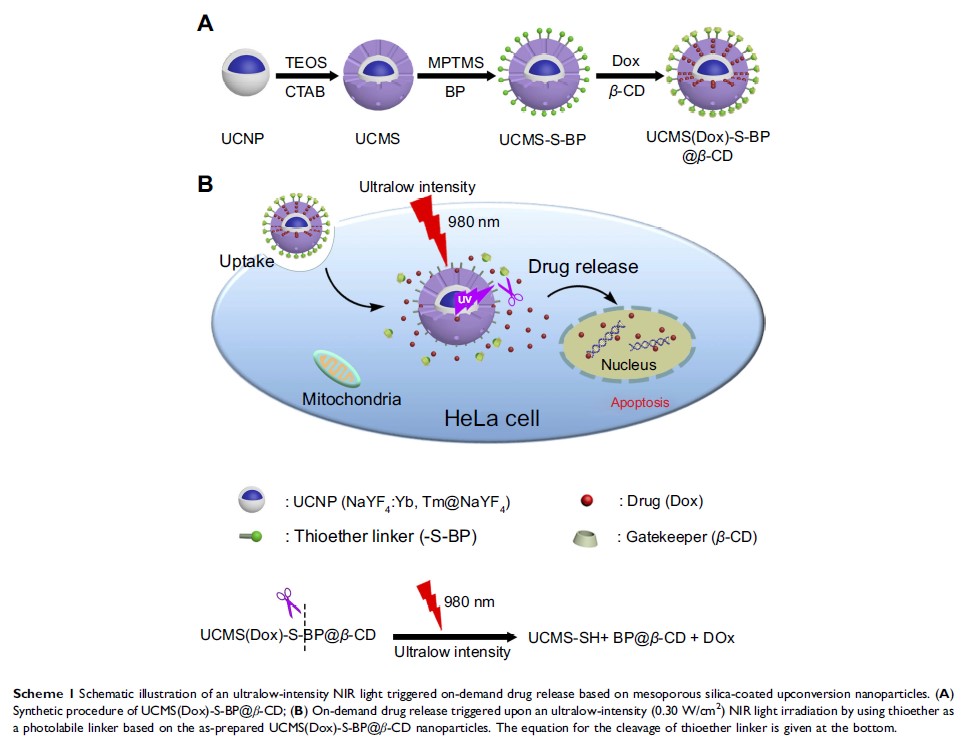
Methods: The highly emissive UCNP is first synthesized and then coated with mesoporous silica (MS) shell (UCMS). Next, the surface of UCMS is modified with the thioether (-S-BP) linker, leading to UCMS-S-BP nanoparticles. Finally, after the drug doxorubicin (Dox) is loaded into the pore channels of UCMS, the pore openings are blocked by the β -cyclodextrin (β -CD) gatekeeper through the association with the -S-BP linker (UCMS(Dox)-S-BP@β -CD).
Results: Upon 980 nm NIR light irradiation with an ultralow intensity of 0.30 W/cm2 it is found that the loaded Dox can be released through the cleavage of thioether linkers triggering dissociation of β -CD gatekeepers. The in vitro results exhibited significantly therapeutic efficacy with 85.2% of HeLa cells killed in this study.
Conclusions: An ultralow-intensity NIR light triggered on-demand drug release system has been developed by employing highly emissive UCNP and photocleavable linker with low bond dissociation energy to avoid the potential photodamage on healthy neighbor cells.
Keywords: drug release, ultralow intensity, density functional theory, near infrared light, upconversion nanoparticles