117806
论文已发表
注册即可获取德孚的最新动态
IF 收录期刊
- 3.6 Breast Cancer (Dove Med Press)
- 4.3 Clin Epidemiol
- 2.6 Cancer Manag Res
- 3.2 Infect Drug Resist
- 4.1 Clin Interv Aging
- 6.1 Drug Des Dev Ther
- 4.1 Int J Chronic Obstr
- 8.7 Int J Nanomed
- 2.5 Int J Women's Health
- 3.2 Neuropsych Dis Treat
- 2.4 OncoTargets Ther
- 2.6 Patient Prefer Adher
- 2.6 Ther Clin Risk Manag
- 3.1 J Pain Res
- 3.5 Diabet Metab Synd Ob
- 4.5 Psychol Res Behav Ma
- 3.4 Nat Sci Sleep
- 2.4 Pharmgenomics Pers Med
- 2.6 Risk Manag Healthc Policy
- 4.6 J Inflamm Res
- 2.3 Int J Gen Med
- 3.9 J Hepatocell Carcinoma
- 3.3 J Asthma Allergy
- 2.5 Clin Cosmet Investig Dermatol
- 3.0 J Multidiscip Healthc

雄激素受体通过增加 EGFR 磷酸化促进口腔鳞状细胞癌细胞迁移
Authors Liu X, Qing S, Che K, Li L, Liao X
Received 7 January 2019
Accepted for publication 24 April 2019
Published 4 June 2019 Volume 2019:12 Pages 4245—4252
DOI https://doi.org/10.2147/OTT.S200718
Checked for plagiarism Yes
Review by Single-blind
Peer reviewers approved by Dr Jyoti Bajaj
Peer reviewer comments 3
Editor who approved publication: Dr Takuya Aoki
Objectives: This study is aimed to investigate the role of androgen receptor (AR) in regulating oral squamous cell carcinoma (OSCC) cells migration.
Materials and methods: Tumors from 23 patients with OSCC and five OSCC cell lines were used for analyzing AR expression. The effects of AR agonist and antagonist were used to examine the role of AR in regulating the migration of OSCC cells.
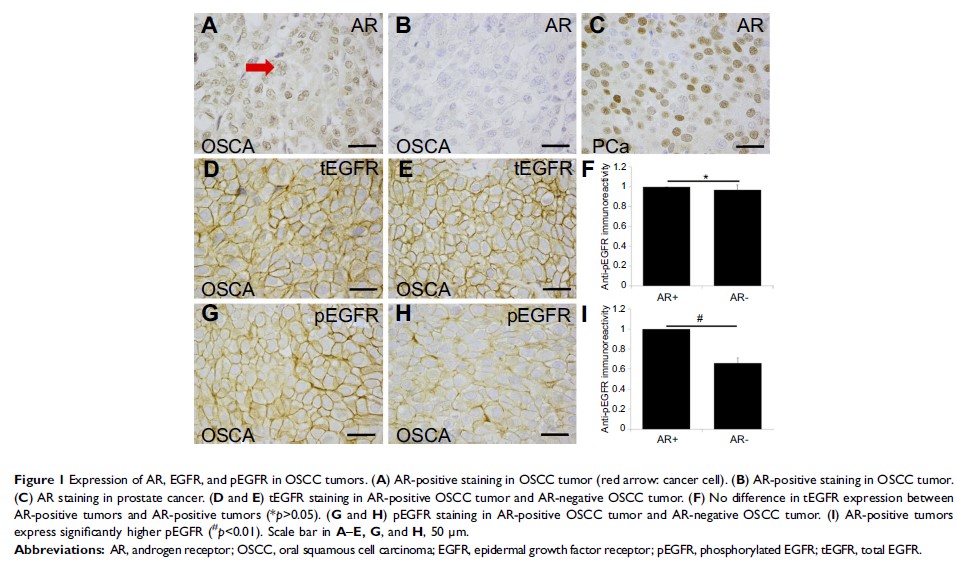
Results: Ten of 23 tumors from patients with OSCC were AR positive. There was no significant difference in total EGFR (tEGFR) expression between AR-positive tumors and AR-negative tumors. However, the expression of phosphorylated EGFR (pEGFR) in AR-positive tumors was significantly higher than that in AR-negative tumors (p <0.01). Stimulation of AR by dihydrotestosterone in SCC9 (AR-positive OSCC cell) caused an increase in pEGFR and pAKT expression and promoted cell migration without changed tEGFR expression, whereas treatment with bicalutamide led to a decrement in pEGFR expression and pAKT and inhibited cell migration. No effects were found in SCC25 cell line (AR-negative) either treated by dihydrotestosterone or bicalutamide. Furthermore, SCC9 cell line treated by EGF or cetuximab (EGFR inhibitor) significantly promoted or inhibited cell migration.
Conclusion: Our data indicate that OSSC tumors and OSCC cell lines express AR which is critical for promoting cell migration by increasing EGFR phosphorylation.
Keywords: oral squamous cell carcinoma, androgen receptor, EGFR, migration, phosphorylation