115195
论文已发表
注册即可获取德孚的最新动态
IF 收录期刊
- 3.6 Breast Cancer (Dove Med Press)
- 4.3 Clin Epidemiol
- 2.6 Cancer Manag Res
- 3.2 Infect Drug Resist
- 4.1 Clin Interv Aging
- 6.1 Drug Des Dev Ther
- 4.1 Int J Chronic Obstr
- 8.7 Int J Nanomed
- 2.5 Int J Women's Health
- 3.2 Neuropsych Dis Treat
- 2.4 OncoTargets Ther
- 2.6 Patient Prefer Adher
- 2.6 Ther Clin Risk Manag
- 3.1 J Pain Res
- 3.5 Diabet Metab Synd Ob
- 4.5 Psychol Res Behav Ma
- 3.4 Nat Sci Sleep
- 2.4 Pharmgenomics Pers Med
- 2.6 Risk Manag Healthc Policy
- 4.6 J Inflamm Res
- 2.3 Int J Gen Med
- 3.9 J Hepatocell Carcinoma
- 3.3 J Asthma Allergy
- 2.5 Clin Cosmet Investig Dermatol
- 3.0 J Multidiscip Healthc

高流量鼻导管氧疗与无创通气治疗慢性阻塞性肺病急性中度高碳酸血症呼吸衰竭: 一项观察队列研究
Authors Sun J, Li Y, Ling B, Zhu Q, Hu Y, Tan D, Geng P, Xu J
Received 23 February 2019
Accepted for publication 21 May 2019
Published 5 June 2019 Volume 2019:14 Pages 1229—1237
DOI https://doi.org/10.2147/COPD.S206567
Checked for plagiarism Yes
Review by Single-blind
Peer reviewers approved by Dr Melinda Thomas
Peer reviewer comments 3
Editor who approved publication: Prof. Dr. Chunxue Bai
Background: High-flow nasal cannula (HFNC) oxygen therapy in acute hypoxic respiratory failure is becoming increasingly popular. However, evidence to support the use of HFNC in acute respiratory failure (ARF) with hypercapnia is limited.
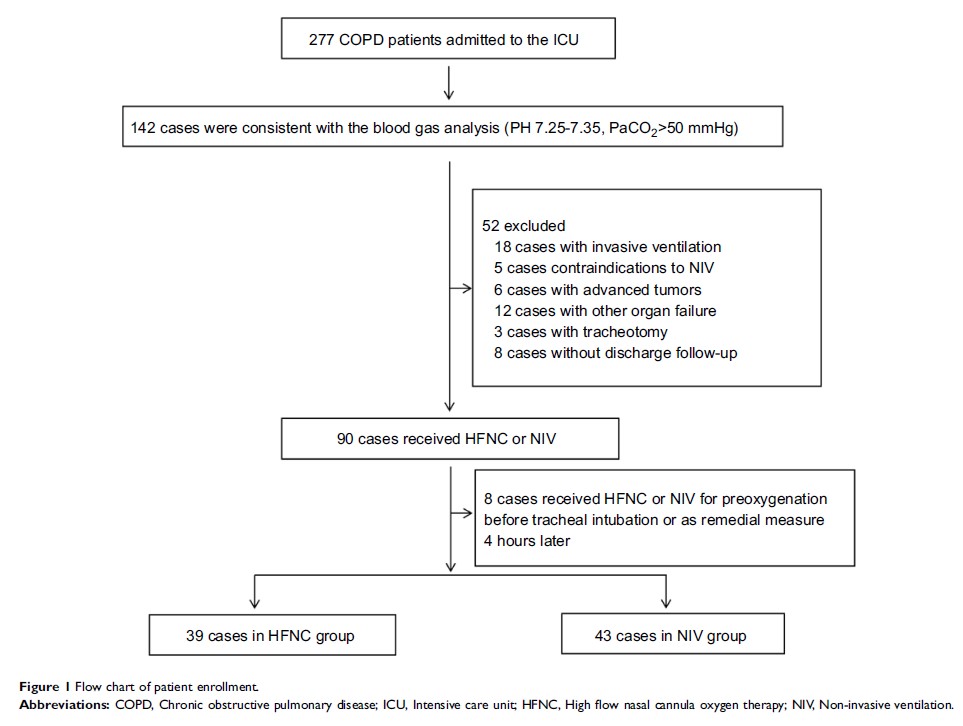
Methods: Chronic obstructive pulmonary disease (COPD) patients with moderate hypercapnic ARF (arterial blood gas pH 7.25–7.35, PaCO2>50 mmHg) who received HFNC or non-invasive ventilation (NIV) in the intensive care uint from April 2016 to March 2018 were analyzed retrospectively. The endpoint was treatment failure, defined as either invasive ventilation, or a switch to the other study treatment (NIV for patients in the NFNC group, and vice-versa), and 28-day mortality.
Results: Eighty-two COPD patients (39 in the HFNC group and 43 in the NIV group) were enrolled in this study. The mean age was 71.8±8.2 and 54 patients (65.9%) were male. The treatment failed in 11 out of 39 patients with HFNC (28.2%) and in 17 of 43 patients with NIV (39.5%) (P =0.268). No significant differences were found for 28-day mortality (15.4% in the HFNC group and 14% in the NIV group, P =0.824). During the first 24 hrs of treatment, the number of nursing airway care interventions in the HFNC group was significantly less than in the NIV group, while the duration of device application was significantly longer in the HFNC group (all P <0.05). Skin breakdown was significantly more common in the NIV group (20.9% vs 5.1%, P <0.05).
Conclusion: Among COPD patients with moderate hypercarbic ARF, the use of HFNC compared with NIV did not result in increased rates of treatment failure, while there were fewer nursing interventions and skin breakdown episodes reported in the HFNC group.
Keywords: chronic obstructive pulmonary diseases, respiratory failure, high-flow nasal cannula, non-invasive ventilation, cohort study