115195
论文已发表
注册即可获取德孚的最新动态
IF 收录期刊
- 3.6 Breast Cancer (Dove Med Press)
- 4.3 Clin Epidemiol
- 2.6 Cancer Manag Res
- 3.2 Infect Drug Resist
- 4.1 Clin Interv Aging
- 6.1 Drug Des Dev Ther
- 4.1 Int J Chronic Obstr
- 8.7 Int J Nanomed
- 2.5 Int J Women's Health
- 3.2 Neuropsych Dis Treat
- 2.4 OncoTargets Ther
- 2.6 Patient Prefer Adher
- 2.6 Ther Clin Risk Manag
- 3.1 J Pain Res
- 3.5 Diabet Metab Synd Ob
- 4.5 Psychol Res Behav Ma
- 3.4 Nat Sci Sleep
- 2.4 Pharmgenomics Pers Med
- 2.6 Risk Manag Healthc Policy
- 4.6 J Inflamm Res
- 2.3 Int J Gen Med
- 3.9 J Hepatocell Carcinoma
- 3.3 J Asthma Allergy
- 2.5 Clin Cosmet Investig Dermatol
- 3.0 J Multidiscip Healthc

工程纳米材料诱导的神经毒性
Authors Ge D, Du Q, Ran B, Liu X, Wang X, Ma X, Cheng F, Sun B
Received 30 January 2019
Accepted for publication 9 April 2019
Published 6 June 2019 Volume 2019:14 Pages 4167—4186
DOI https://doi.org/10.2147/IJN.S203352
Checked for plagiarism Yes
Review by Single-blind
Peer reviewers approved by Dr Ashutosh Singhal
Peer reviewer comments 3
Editor who approved publication: Dr Linlin Sun
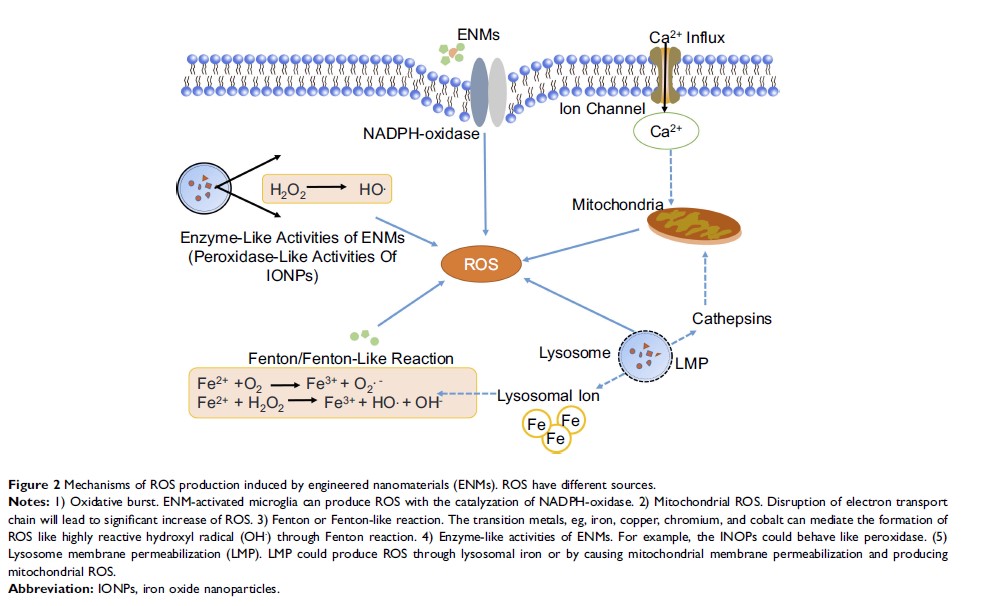
Abstract: Engineered nanomaterials (ENMs) have been widely used in various fields due to their novel physicochemical properties. However, the use of ENMs has led to an increased exposure in humans, and the safety of ENMs has attracted much attention. It is universally acknowledged that ENMs could enter the human body via different routes, eg, inhalation, skin contact, and intravenous injection. Studies have proven that ENMs can cross or bypass the blood–brain barrier and then access the central nervous system and cause neurotoxicity. Until now, diverse in vivo and in vitro models have been developed to evaluate the neurotoxicity of ENMs, and oxidative stress, inflammation, DNA damage, and cell death have been identified as being involved. However, due to various physicochemical properties of ENMs and diverse study models in existing studies, it remains challenging to establish the structure-activity relationship of nanomaterials in neurotoxicity. In this paper, we aimed to review current studies on ENM-induced neurotoxicity, with an emphasis on the molecular and cellular mechanisms involved. We hope to provide a rational material design strategy for ENMs when they are applied in biomedical or other engineering applications.
Keywords: engineered nanomaterials, neurotoxicity, oxidative stress, inflammation, DNA damage, cell death