115195
论文已发表
注册即可获取德孚的最新动态
IF 收录期刊
- 3.6 Breast Cancer (Dove Med Press)
- 4.3 Clin Epidemiol
- 2.6 Cancer Manag Res
- 3.2 Infect Drug Resist
- 4.1 Clin Interv Aging
- 6.1 Drug Des Dev Ther
- 4.1 Int J Chronic Obstr
- 8.7 Int J Nanomed
- 2.5 Int J Women's Health
- 3.2 Neuropsych Dis Treat
- 2.4 OncoTargets Ther
- 2.6 Patient Prefer Adher
- 2.6 Ther Clin Risk Manag
- 3.1 J Pain Res
- 3.5 Diabet Metab Synd Ob
- 4.5 Psychol Res Behav Ma
- 3.4 Nat Sci Sleep
- 2.4 Pharmgenomics Pers Med
- 2.6 Risk Manag Healthc Policy
- 4.6 J Inflamm Res
- 2.3 Int J Gen Med
- 3.9 J Hepatocell Carcinoma
- 3.3 J Asthma Allergy
- 2.5 Clin Cosmet Investig Dermatol
- 3.0 J Multidiscip Healthc

阿巴替尼和阿霉素联合治疗转移性软组织肉瘤的安全性和有效性:来自多个机构的观察性研究
Authors Tian Z, Wang X, Liu Z, Wang J, Yao W, Zhao Y, Gao S, Zhang P, Ge H
Received 1 March 2019
Accepted for publication 13 May 2019
Published 6 June 2019 Volume 2019:11 Pages 5293—5300
DOI https://doi.org/10.2147/CMAR.S207150
Checked for plagiarism Yes
Review by Single-blind
Peer reviewers approved by Dr Amy Norman
Peer reviewer comments 2
Editor who approved publication: Dr Chien-Feng L
Purpose: Apatinib has shown effectiveness in treating sarcoma. This study aimed to assess the safety and efficacy of apatinib and doxorubicin combination therapy in metastatic soft tissue sarcomas (STS) and to compare the therapeutic effects of two treatments (apatinib after doxorubicin vs apatinib plus doxorubicin) on STS.
Patients and methods: A total of 76 patients with metastatic STS who received apatinib and doxorubicin between May 2016 and June 2017 were retrospectively reviewed. Patients were divided into either the apatinib after doxorubicin group (in which apatinib was used after six cycles of doxorubicin chemotherapy) or the apatinib plus doxorubicin group (in which apatinib was used in combination with doxorubicin chemotherapy).
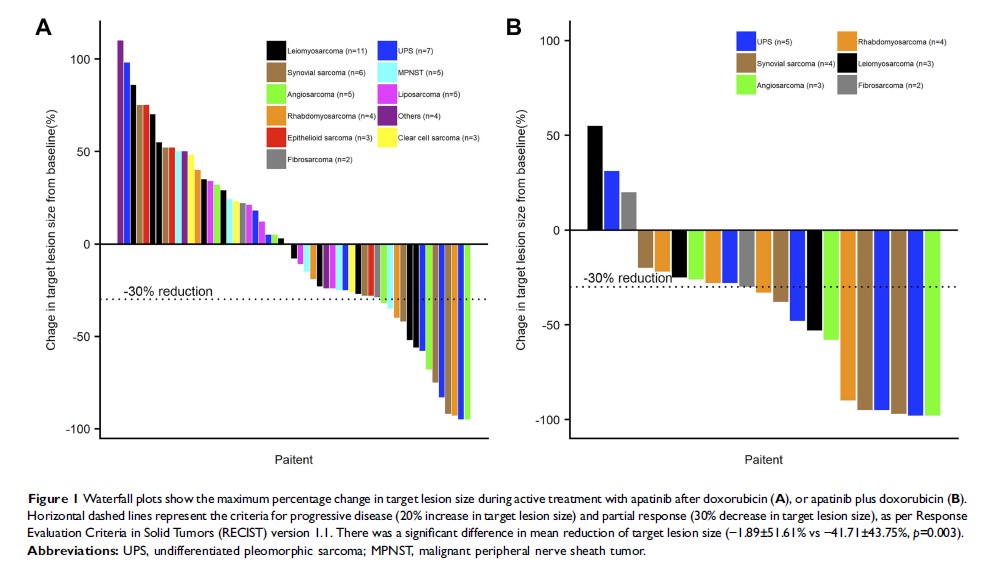
Results: There were 55 patients in the apatinib after doxorubicin group and 21 patients in the apatinib plus doxorubicin group. There were significant differences between the apatinib plus doxorubicin group and the apatinib after doxorubicin group in the objective response rate (57.14% vs 25.45%, respectively, p =0.016) and average change from baseline in the target lesion size (−41.71±43.75% vs −1.89±51.61%, respectively, p =0.03). There were no significant differences in disease control rate (85.71% vs 63.64%, p =0.093) and median progression-free survival (8.8 months vs 10.3 months, p =1). Grade 3–4 adverse events were more common with apatinib plus doxorubicin than with apatinib after doxorubicin, and these included leukopenia (5.45% vs 38.1%, respectively, p =0.001), anemia (7.27% vs 28.57%, respectively, p =0.023), oral mucositis (3.64% vs 19.05%, respectively, p =0.046), transaminase increases (0% vs 14.29%, respectively, p =0.011).
Conclusion: Our results do not support the use of apatinib plus doxorubicin for metastatic STS unless the specific objective is tumor shrinkage.
Keywords: chemotherapy, apatinib, tyrosine-kinase inhibitor, sarcoma, adverse events