115195
论文已发表
注册即可获取德孚的最新动态
IF 收录期刊
- 3.6 Breast Cancer (Dove Med Press)
- 4.3 Clin Epidemiol
- 2.6 Cancer Manag Res
- 3.2 Infect Drug Resist
- 4.1 Clin Interv Aging
- 6.1 Drug Des Dev Ther
- 4.1 Int J Chronic Obstr
- 8.7 Int J Nanomed
- 2.5 Int J Women's Health
- 3.2 Neuropsych Dis Treat
- 2.4 OncoTargets Ther
- 2.6 Patient Prefer Adher
- 2.6 Ther Clin Risk Manag
- 3.1 J Pain Res
- 3.5 Diabet Metab Synd Ob
- 4.5 Psychol Res Behav Ma
- 3.4 Nat Sci Sleep
- 2.4 Pharmgenomics Pers Med
- 2.6 Risk Manag Healthc Policy
- 4.6 J Inflamm Res
- 2.3 Int J Gen Med
- 3.9 J Hepatocell Carcinoma
- 3.3 J Asthma Allergy
- 2.5 Clin Cosmet Investig Dermatol
- 3.0 J Multidiscip Healthc

中国呼伦贝尔市脊髓布鲁氏菌病,2011-2016
Authors Liang C, Wei W, Liang X, De E, Zheng B
Received 21 January 2019
Accepted for publication 7 May 2019
Published 6 June 2019 Volume 2019:12 Pages 1565—1571
DOI https://doi.org/10.2147/IDR.S202440
Checked for plagiarism Yes
Review by Single-blind
Peer reviewers approved by Dr Amy Norman
Peer reviewer comments 2
Editor who approved publication: Professor Suresh Antony
Purpose: To investigate the demographic, epidemiological, clinical, and laboratory characteristics; treatment options; and outcome of human brucellosis with spine involvement at a major hospital in Hulunbuir, a brucellosis epidemic region of China.
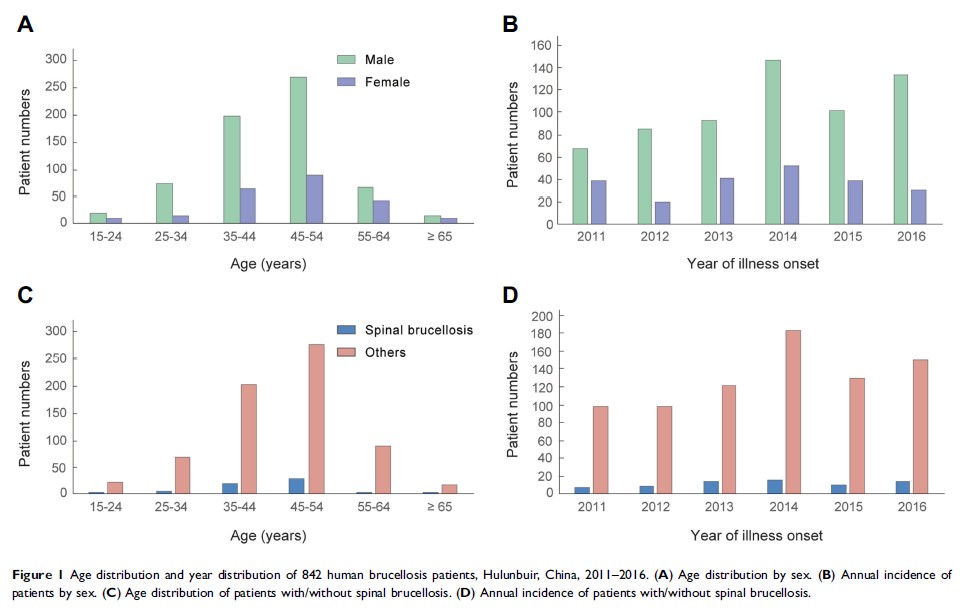
Patients and methods: A total of 842 patients with human brucellosis treated in the Department of Brucellosis, Hulunbuir People’s Hospital from January 2011 to December 2016 were included and analyzed in this study. The results of 67 brucellar spondylodiscitis (BS) cases were compared with those that were negative for spine involvements.
Results: The mean age of spinal brucellosis patients was 50.5±10.2 years (43 males and 24 females; age range 29–70). The risk factors for transmission are direct contact with animals, such as working in the farm, and consumption of unpasteurized milk or daily products. Back pain (92.5%), fever (85.1%), sweating (62.7%), and fatigue (52.8%) were the most common symptoms. Magnetic resonance imaging (MRI) was performed in all the patients with spondylodiscitis. The sites of involvement were lumbar (81.2%), thoracic (8.7%), cervical (4.3%), thoracolumbar (2.9%), and lumbosacral (2.9%). All isolates from blood culture were identified as Brucella melitensis , with 61% biovar 3 and 39% biovar 1 isolates. The antimicrobial therapy for BS lasted for at least 3 months. In the presence of paravertebral or epidural abscess, longer treatment was conducted to avoid possible sequelae.
Conclusion: In endemic areas such as Hulunbuir, BS should be considered in patients with back pain and fever. MRI is a highly sensitive imaging modality that can be used to differentiate BS from other spinal infections. This study will be helpful to establish strategies for prevention, surveillance, and management of spinal brucellosis in China.
Keywords: brucellosis, spine, spondylitis, brucella melitensis, treatment outcome