115195
论文已发表
注册即可获取德孚的最新动态
IF 收录期刊
- 3.6 Breast Cancer (Dove Med Press)
- 4.3 Clin Epidemiol
- 2.6 Cancer Manag Res
- 3.2 Infect Drug Resist
- 4.1 Clin Interv Aging
- 6.1 Drug Des Dev Ther
- 4.1 Int J Chronic Obstr
- 8.7 Int J Nanomed
- 2.5 Int J Women's Health
- 3.2 Neuropsych Dis Treat
- 2.4 OncoTargets Ther
- 2.6 Patient Prefer Adher
- 2.6 Ther Clin Risk Manag
- 3.1 J Pain Res
- 3.5 Diabet Metab Synd Ob
- 4.5 Psychol Res Behav Ma
- 3.4 Nat Sci Sleep
- 2.4 Pharmgenomics Pers Med
- 2.6 Risk Manag Healthc Policy
- 4.6 J Inflamm Res
- 2.3 Int J Gen Med
- 3.9 J Hepatocell Carcinoma
- 3.3 J Asthma Allergy
- 2.5 Clin Cosmet Investig Dermatol
- 3.0 J Multidiscip Healthc

桥尾蛋白通过减少 mTOR 通路激活抑制肺鳞状细胞癌的发展
Authors Zhang X, Cheng D, Liu Y, Wu Y, He Z
Received 6 February 2019
Accepted for publication 24 April 2019
Published 7 June 2019 Volume 2019:11 Pages 5333—5341
DOI https://doi.org/10.2147/CMAR.S204358
Checked for plagiarism Yes
Review by Single-blind
Peer reviewers approved by Dr Cristina Weinberg
Peer reviewer comments 3
Editor who approved publication: Dr Antonella D'Anneo
Background: The mTOR pathway is altered in a multitude of cancers, including lung cancer; however, abnormal activation in this pathway is less common in lung adenocarcinoma (LUAD) than in lung squamous cell carcinoma (LUSC). Gephyrin is a highly conserved and widely expressed ancient protein in vertebrate tissues. Its role and molecular mechanism in lung cancer development are largely unknown.
Method: We analyzed the expression profile of gephyrin and overall survival rates in LUAD and LUSC. The LUSC cells (H520 and SK-MES-1) were transfected with pLV-gephyrin to establish gephyrin stable overexpression cell lines. Real-time quantitative PCR and Western blot were performed to detect the mRNA and protein levels. The cell growth and cell cycle were detected by the MTT assay and flow cytometry. Finally, a xenograft tumor model was established to determine cell tumorigenesis in vivo.
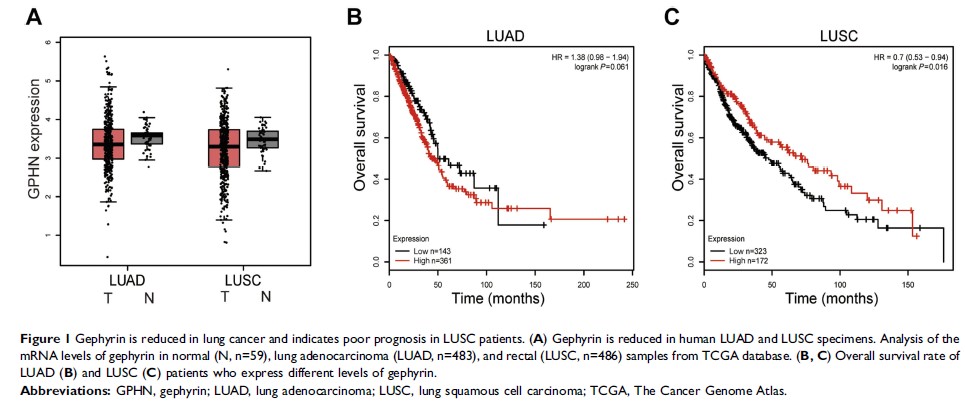
Results: Our results show that gephyrin was reduced in LUAD and LUSC, and its low expression in LUSC patients indicated poor prognosis. Gephyrin overexpression suppressed LUSC cell proliferation, arrested cell cycle progression, and decreased the expression of cell-cycle related proteins such as cyclin D1, cyclin-dependent kinase-2 (CDK2), and proliferation-related protein proliferating cell nuclear antigen (PCNA). Conversely, knockdown of gephyrin promoted LUSC cell growth. Moreover, gephyrin reduced mTOR pathway activation to inhibit cyclin D1 and CDK2 translation. Mechanistically, gephyrin suppressed mTOR pathway activation by promoting mTOR degradation. Furthermore, gephyrin overexpression suppressed LUSC tumorigenesis.
Conclusion: Gephyrin suppressed LUSC development by reducing mTOR pathway activation, implicating gephyrin as a potential molecular target for LUSC management.
Keywords: gephyrin, lung squamous cell carcinoma, mTOR pathway, degradation