117806
论文已发表
注册即可获取德孚的最新动态
IF 收录期刊
- 3.6 Breast Cancer (Dove Med Press)
- 4.3 Clin Epidemiol
- 2.6 Cancer Manag Res
- 3.2 Infect Drug Resist
- 4.1 Clin Interv Aging
- 6.1 Drug Des Dev Ther
- 4.1 Int J Chronic Obstr
- 8.7 Int J Nanomed
- 2.5 Int J Women's Health
- 3.2 Neuropsych Dis Treat
- 2.4 OncoTargets Ther
- 2.6 Patient Prefer Adher
- 2.6 Ther Clin Risk Manag
- 3.1 J Pain Res
- 3.5 Diabet Metab Synd Ob
- 4.5 Psychol Res Behav Ma
- 3.4 Nat Sci Sleep
- 2.4 Pharmgenomics Pers Med
- 2.6 Risk Manag Healthc Policy
- 4.6 J Inflamm Res
- 2.3 Int J Gen Med
- 3.9 J Hepatocell Carcinoma
- 3.3 J Asthma Allergy
- 2.5 Clin Cosmet Investig Dermatol
- 3.0 J Multidiscip Healthc

良性阵发性位置性眩晕 - 初级保健治疗建议
Authors Wang YH, Chan CY, Liu QH
Received 29 January 2019
Accepted for publication 9 May 2019
Published 11 June 2019 Volume 2019:15 Pages 719—725
DOI https://doi.org/10.2147/TCRM.S203291
Checked for plagiarism Yes
Review by Single-blind
Peer reviewers approved by Dr Amy Norman
Peer reviewer comments 3
Editor who approved publication: Professor Deyun Wang
Background: Benign paroxysmal positional vertigo (BPPV) is a common cause of vertigo that can be easily diagnosed and treated in primary care.
Purpose: We describe our experience with a large cohort of patients and include recommendations for diagnosis and treatment in the primary care setting.
Patients and methods: Three hundred and fifty-nine patients were diagnosed with BPPV between June 2011 and March 2017 at the dizziness clinic of Fujian Provincial Hospital, Fuzhou, China. We mainly used Epley’s maneuver and barbecue roll for the treatment of PSC-BPPV and HSC-BPPV respectively.
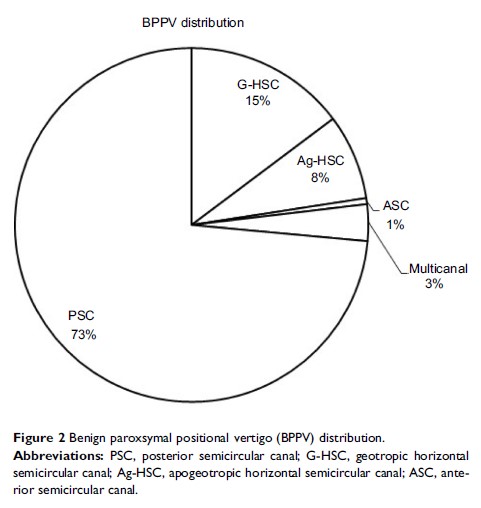
Results: Our results show that posterior semicircular canal (PSC) involvement is the most common (n=264, 73.5%), followed by horizontal semicircular canal (HSC, n=81, 22.5%) and multicanal (n=12, 3.3%) involvement. Anterior semicircular canal (ASC) BPPV is the rarest (n=2). Particle repositioning maneuvers (PRM) are the treatment of choice and have a high success rate (1 month after treatment), from 75% (9 out of 12) for multicanal to 95.8% (253 out of 264) for PSC, and to 100% for HSC and ASC involvement respectively.
Conclusion: We recommend the use of the Epley’s maneuver and barbecue roll for the treatment of PSC-BPPV and HSC-BPPV, respectively. Patients should be reviewed regularly and repeated maneuvers can be performed. Unresolving symptoms require tertiary evaluation.
Keywords: giddiness, benign paroxysmal positional vertigo, Epley’s maneuver, diagnosis, treatment