117745
论文已发表
注册即可获取德孚的最新动态
IF 收录期刊
- 3.6 Breast Cancer (Dove Med Press)
- 4.3 Clin Epidemiol
- 2.6 Cancer Manag Res
- 3.2 Infect Drug Resist
- 4.1 Clin Interv Aging
- 6.1 Drug Des Dev Ther
- 4.1 Int J Chronic Obstr
- 8.7 Int J Nanomed
- 2.5 Int J Women's Health
- 3.2 Neuropsych Dis Treat
- 2.4 OncoTargets Ther
- 2.6 Patient Prefer Adher
- 2.6 Ther Clin Risk Manag
- 3.1 J Pain Res
- 3.5 Diabet Metab Synd Ob
- 4.5 Psychol Res Behav Ma
- 3.4 Nat Sci Sleep
- 2.4 Pharmgenomics Pers Med
- 2.6 Risk Manag Healthc Policy
- 4.6 J Inflamm Res
- 2.3 Int J Gen Med
- 3.9 J Hepatocell Carcinoma
- 3.3 J Asthma Allergy
- 2.5 Clin Cosmet Investig Dermatol
- 3.0 J Multidiscip Healthc

体外降低粘菌素易感性和比较基因组学揭示了 MCR 阳性和 MCR 阴性粘菌素耐药性大肠杆菌之间的多重差异
Authors Luo Q, Niu T, Wang Y, Yin J, Wan F, Yao M, Lu H, Xiao Y, Li L
Received 30 March 2019
Accepted for publication 13 May 2019
Published 12 June 2019 Volume 2019:12 Pages 1665—1674
DOI https://doi.org/10.2147/IDR.S210245
Checked for plagiarism Yes
Review by Single-blind
Peer reviewers approved by Dr Amy Norman
Peer reviewer comments 2
Editor who approved publication: Professor Suresh Antony
Objectives: Although resistance to colistin is increasingly reported from clinical settings, the genetic mechanisms that lead to colistin resistance in Escherichia coli have not been fully characterized. Here, we assess the evolution of colistin resistance in clinical isolates of mobilized colistin resistance (MCR)-negative and MCR-positive Escherichia coli .
Methods: Spontaneously mutated colistin-resistant progeny were evolved using a step-wise reduction of colistin susceptibility. Resistance phenotypes were confirmed by minimum inhibitory concentration (MIC) determination, and the probable resistance mechanisms were investigated using PCR and reverse transcription-quantitative PCR. Mutated genes of the laboratory-evolved mutants were identified by whole-genome sequencing and comparative genomics. Fitness costs and serum resistance of the mutants were also compared to the corresponding wild types.
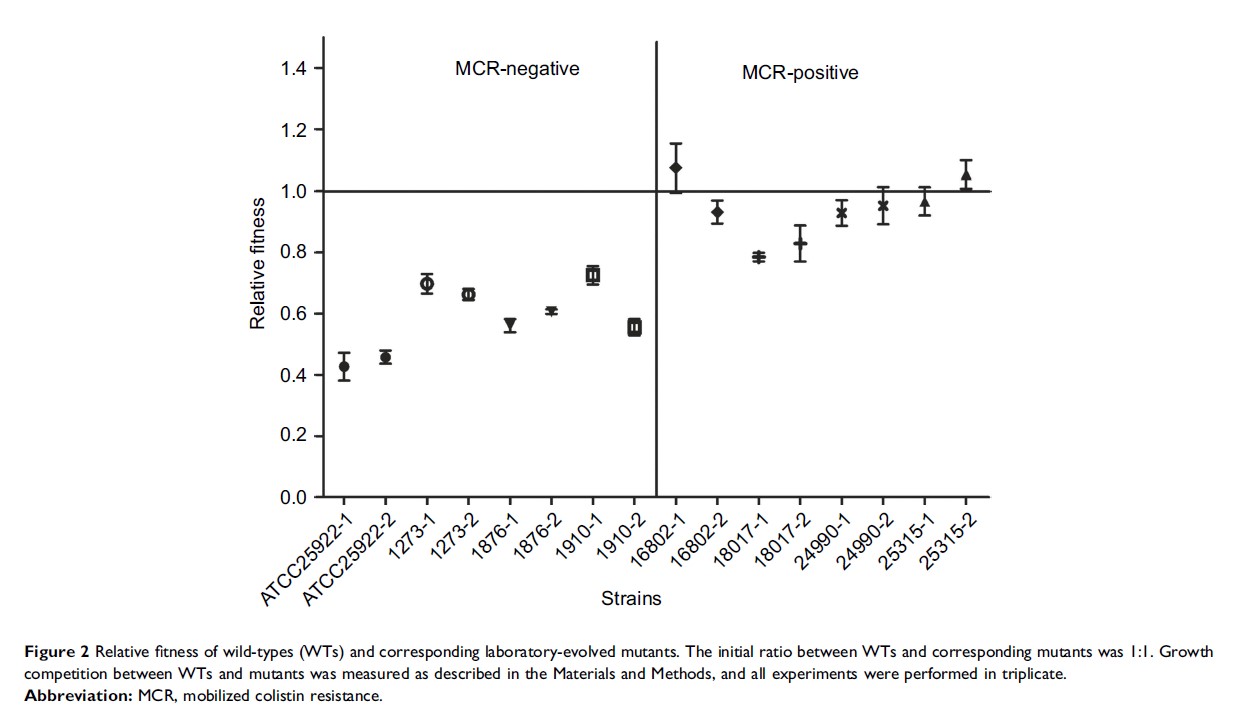
Results: MCR-negative isolates displayed higher increases in MICs than did MCR-positive isolates following colistin exposure. Upregulation of pmrAB and associated genes was evident among MCR-negative isolates but not MCR-positive isolates. Comparative genomic analysis of mutants and their corresponding wild-types (WTs) revealed numerous mutations in genes encoding membrane transporters and two-component systems. Additionally, MCR-negative mutants exhibited higher fitness costs than MCR-positive mutants compared with their corresponding WTs but displayed similar serum resistance.
Conclusion: Our findings reveal multiple differences between MCR-positive and MCR-negative E. coli strains following colistin exposure, which provide reference values for clinical medication.
Keywords: colistin resistance, MCR, comparative genomic, Escherichia coli