117806
论文已发表
注册即可获取德孚的最新动态
IF 收录期刊
- 3.6 Breast Cancer (Dove Med Press)
- 4.3 Clin Epidemiol
- 2.6 Cancer Manag Res
- 3.2 Infect Drug Resist
- 4.1 Clin Interv Aging
- 6.1 Drug Des Dev Ther
- 4.1 Int J Chronic Obstr
- 8.7 Int J Nanomed
- 2.5 Int J Women's Health
- 3.2 Neuropsych Dis Treat
- 2.4 OncoTargets Ther
- 2.6 Patient Prefer Adher
- 2.6 Ther Clin Risk Manag
- 3.1 J Pain Res
- 3.5 Diabet Metab Synd Ob
- 4.5 Psychol Res Behav Ma
- 3.4 Nat Sci Sleep
- 2.4 Pharmgenomics Pers Med
- 2.6 Risk Manag Healthc Policy
- 4.6 J Inflamm Res
- 2.3 Int J Gen Med
- 3.9 J Hepatocell Carcinoma
- 3.3 J Asthma Allergy
- 2.5 Clin Cosmet Investig Dermatol
- 3.0 J Multidiscip Healthc

有 pH 依赖性和组织蛋白酶 B 活化的 CaCO3 纳米探针用于靶向体内肿瘤成像
Authors Sun N, Wang D, Yao G, Li X, Mei T, Zhou X, Wong KY, Jiang B, Fang Z
Received 16 January 2019
Accepted for publication 9 April 2019
Published 13 June 2019 Volume 2019:14 Pages 4309—4317
DOI https://doi.org/10.2147/IJN.S201722
Checked for plagiarism Yes
Review by Single-blind
Peer reviewers approved by Dr Govarthanan Muthusamy
Peer reviewer comments 2
Editor who approved publication: Dr Linlin Sun
Background: The intraoperative visualization of tumor cells is a powerful modality for surgical treatment of solid tumors. Since the completeness of tumor excision is closely correlated with the survival of patients, probes that can assist in distinguishing tumor cells are highly demanded.
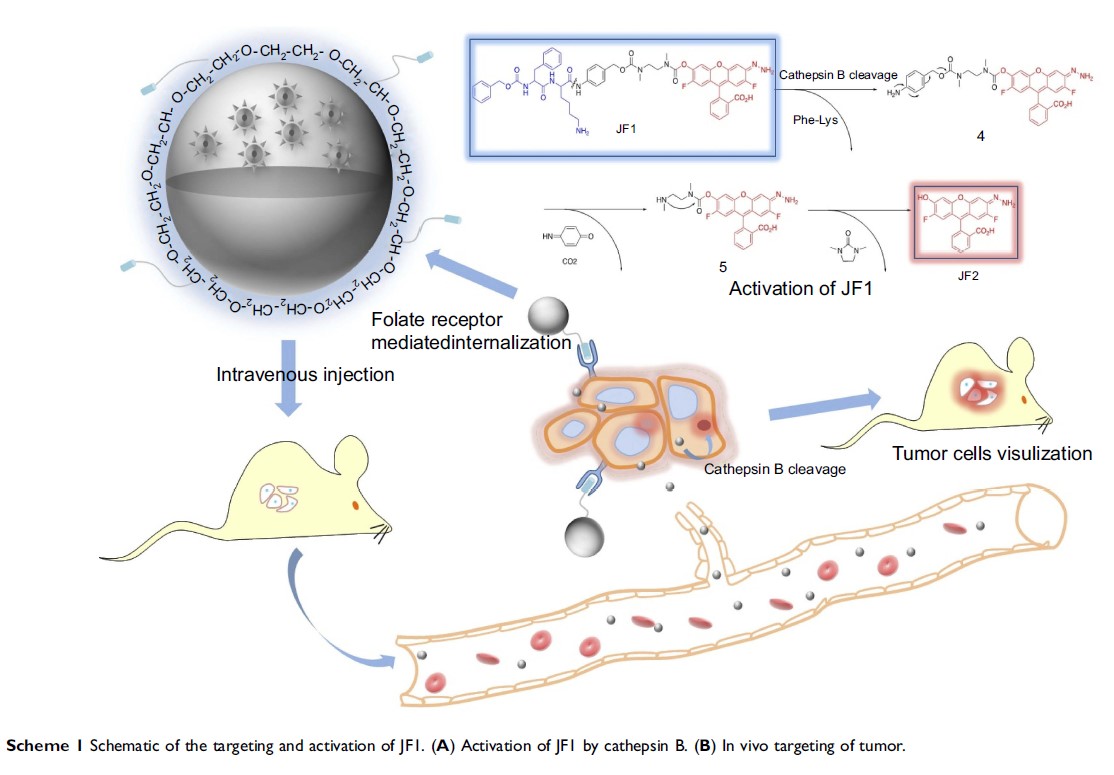
Purpose: In the present study, a fluorescent probe JF1 was synthesized for imaging of tumor cells by conjugating a substrate of cathepsin B (quenching moiety) to Oregon Green derivative JF2 using a self-immolative linker.
Methods: JF1 was then loaded into the folate-PEG modified CaCO3 nanoparticles. The folate receptor-targeted, pH-dependent, and cathepsin B activable CaCO3 nanoprobe was test in vitro and in vivo for tumor imaging.
Results: CaCO3 nanoprobe demonstrated good stability and fast lighting ability in tumors under low pH conditions. It also showed lower fluorescence background than the single cathepsin B dependent fluorescent probe. The pH-dependent and cathepsin B controlled “turn-on” property enables precise and fast indication of tumor in vitro and in vivo.
Conclusion: This strategy of controlled drug delivery enables in vivo imaging of tumor nodules with a high signal-to-noise ratio, which has great potential in surgical tumor treatment.
Keywords: cathepsin B, activable probe, fluorescent probe, CaCO3 nanoparticle, tumor imaging