117745
论文已发表
注册即可获取德孚的最新动态
IF 收录期刊
- 3.6 Breast Cancer (Dove Med Press)
- 4.3 Clin Epidemiol
- 2.6 Cancer Manag Res
- 3.2 Infect Drug Resist
- 4.1 Clin Interv Aging
- 6.1 Drug Des Dev Ther
- 4.1 Int J Chronic Obstr
- 8.7 Int J Nanomed
- 2.5 Int J Women's Health
- 3.2 Neuropsych Dis Treat
- 2.4 OncoTargets Ther
- 2.6 Patient Prefer Adher
- 2.6 Ther Clin Risk Manag
- 3.1 J Pain Res
- 3.5 Diabet Metab Synd Ob
- 4.5 Psychol Res Behav Ma
- 3.4 Nat Sci Sleep
- 2.4 Pharmgenomics Pers Med
- 2.6 Risk Manag Healthc Policy
- 4.6 J Inflamm Res
- 2.3 Int J Gen Med
- 3.9 J Hepatocell Carcinoma
- 3.3 J Asthma Allergy
- 2.5 Clin Cosmet Investig Dermatol
- 3.0 J Multidiscip Healthc

早期宫颈癌中循环肿瘤细胞表型的分布
Authors Pan L, Yan G, Chen W, Sun L, Wang J, Yang J
Received 15 December 2018
Accepted for publication 18 March 2019
Published 17 June 2019 Volume 2019:11 Pages 5531—5536
DOI https://doi.org/10.2147/CMAR.S198391
Checked for plagiarism Yes
Review by Single-blind
Peer reviewers approved by Dr Andrew Yee
Peer reviewer comments 3
Editor who approved publication: Dr Kenan Onel
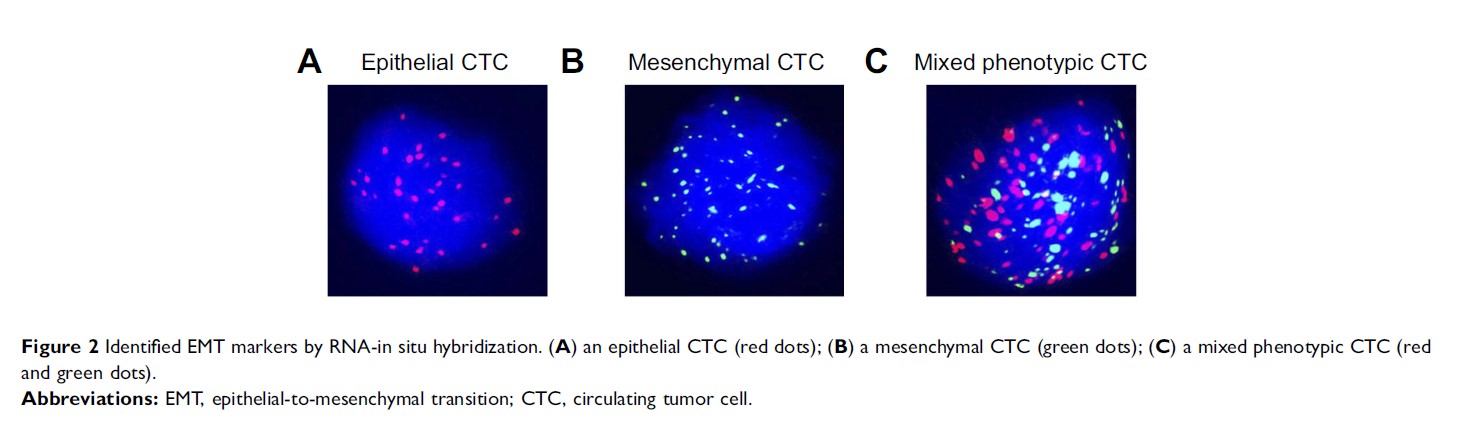
Background and objective: Circulating tumor cells (CTCs) can be classified into three phenotypes based on epithelial-to-mesenchymal transition (EMT) markers, including epithelial CTCs, mesenchymal CTCs, and mixed phenotypic CTCs. This study is aimed to analyze the correlation between CTC phenotypes and the clinicopathological features of patients with early cervical cancer.
Methods: Peripheral blood samples were obtained from 90 patients with early cervical cancer. CTCs were isolated and classified. The correlations of CTC counts and CTC phenotypes with clinicopathological features of patients were analyzed.
Results: The positivity rate for CTCs in patients with stage I-IIA cervical cancer was 90%. An increased CTC number was observed in patients with FIGO stage II, pelvic lymph node metastasis, and lymphovascular involvement. There were 38.89% epithelial CTCs, 23.33% mesenchymal CTCs, and 14.44% mixed phenotypic CTCs, Mesenchymal CTCs were more common in patients with FIGO stage II, pelvic lymph node metastasis, lymphovascular involvement, and deep stromal invasion.
Conclusion: CTCs with mesenchymal phenotypes are closely related to pelvic lymph node metastasis and lymphatic vascular invasion in stage I-IIA cervical cancer. Detection of circulating tumor cell phenotypes is helpful for the early diagnosis of cervical cancer micro-metastasis and for the assessment of disease status.
Keywords: circulating tumor cell, phenotype, cervical cancer