117745
论文已发表
注册即可获取德孚的最新动态
IF 收录期刊
- 3.6 Breast Cancer (Dove Med Press)
- 4.3 Clin Epidemiol
- 2.6 Cancer Manag Res
- 3.2 Infect Drug Resist
- 4.1 Clin Interv Aging
- 6.1 Drug Des Dev Ther
- 4.1 Int J Chronic Obstr
- 8.7 Int J Nanomed
- 2.5 Int J Women's Health
- 3.2 Neuropsych Dis Treat
- 2.4 OncoTargets Ther
- 2.6 Patient Prefer Adher
- 2.6 Ther Clin Risk Manag
- 3.1 J Pain Res
- 3.5 Diabet Metab Synd Ob
- 4.5 Psychol Res Behav Ma
- 3.4 Nat Sci Sleep
- 2.4 Pharmgenomics Pers Med
- 2.6 Risk Manag Healthc Policy
- 4.6 J Inflamm Res
- 2.3 Int J Gen Med
- 3.9 J Hepatocell Carcinoma
- 3.3 J Asthma Allergy
- 2.5 Clin Cosmet Investig Dermatol
- 3.0 J Multidiscip Healthc

外科气雾剂中的脂质作为诊断肺癌的诊断生物标志物
Authors Zhang J, Zheng Q, Zhang W, Wang N, Xu J, Cheng X, Wei Y
Received 12 October 2018
Accepted for publication 23 April 2019
Published 17 June 2019 Volume 2019:11 Pages 5537—5543
DOI https://doi.org/10.2147/CMAR.S190634
Checked for plagiarism Yes
Review by Single-blind
Peer reviewers approved by Ms Justinn Cochran
Peer reviewer comments 4
Editor who approved publication: Dr Rituraj Purohit
Introduction: Lung cancer is one of the most common malignancies worldwide, and the main effective treatment is surgical operation to cure this disease. This study assessed the feasibility of surgical aerosol for identification of lung cancer and adjacent normal tissue in surgery.
Methods: In vitro experiments, the surgical aerosol was released when the tissue sample was being cut using a standard electrosurgery handpiece. Surgical smoke was dissolved in methanol by negative-pressure suction and then get to the neutral sprayer for analysis. Multivariate analysis was performed using partial least squares (PLS) analysis in MatLab 2011.
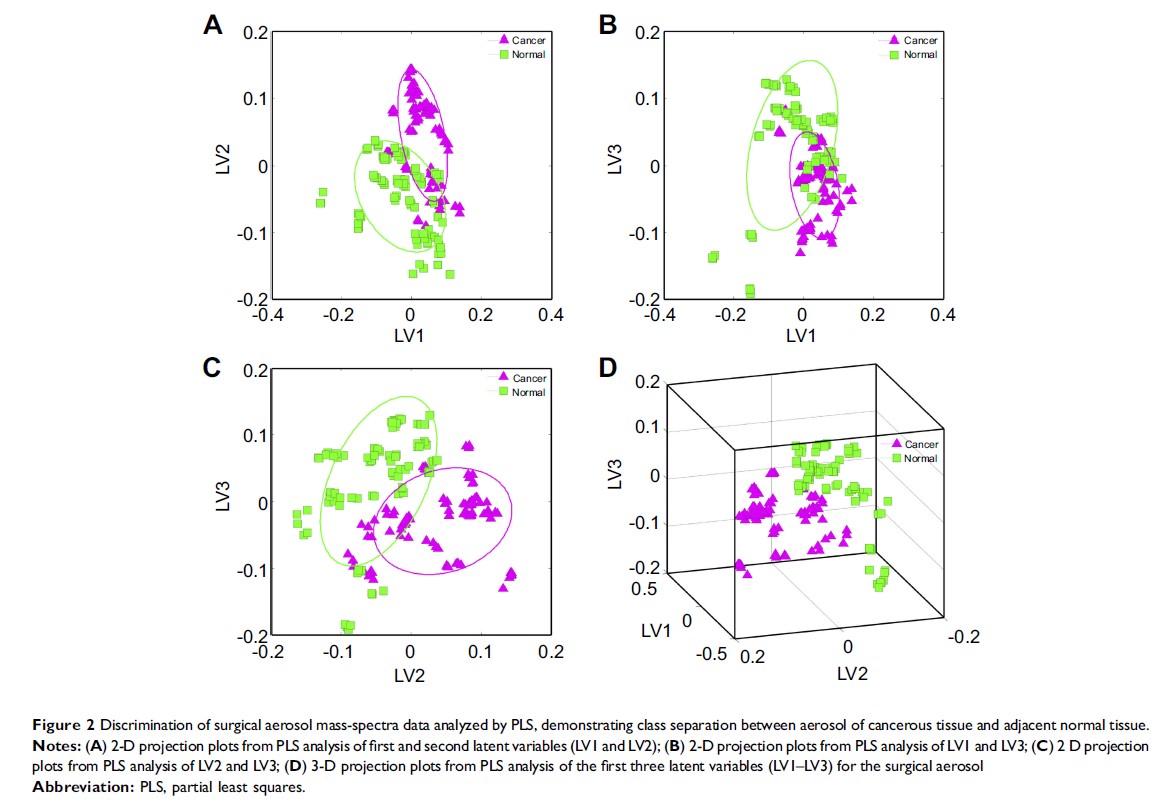
Results: A total of 208 surgical aerosol database entries were obtained from 26 patients. In the cancerous aerosol, relative abundance (760.61, 782.39, and 789.68 m/z) was increased, while relative abundances of (756.41 m/z) was decreased compared with normal-tissue aerosol. After PLS analysis, mass–spectrometry (MS) data for the cancer aerosol showed clear differentiation from normal. Four significant peaks were identified by collision-induced dissociation experiments. The cancerous aerosol showed overexpression of phosphatidylserine (34:2), phosphatidylcholine (36:4), and triacylglycerol (46:2), while phosphatidylcholine (34:3) was decreased. Coupling PLS and extractiveelectrospray-ionization MS analysis of the surgical aerosol data of lung cancer were clearly distinguished from normal.
Conclusion: The surgical aerosol might contain biomarkers for identification of lung cancer and normal tissue.
Keywords: lung cancer, biomarker, surgical aerosol, mass spectrometry