117745
论文已发表
注册即可获取德孚的最新动态
IF 收录期刊
- 3.6 Breast Cancer (Dove Med Press)
- 4.3 Clin Epidemiol
- 2.6 Cancer Manag Res
- 3.2 Infect Drug Resist
- 4.1 Clin Interv Aging
- 6.1 Drug Des Dev Ther
- 4.1 Int J Chronic Obstr
- 8.7 Int J Nanomed
- 2.5 Int J Women's Health
- 3.2 Neuropsych Dis Treat
- 2.4 OncoTargets Ther
- 2.6 Patient Prefer Adher
- 2.6 Ther Clin Risk Manag
- 3.1 J Pain Res
- 3.5 Diabet Metab Synd Ob
- 4.5 Psychol Res Behav Ma
- 3.4 Nat Sci Sleep
- 2.4 Pharmgenomics Pers Med
- 2.6 Risk Manag Healthc Policy
- 4.6 J Inflamm Res
- 2.3 Int J Gen Med
- 3.9 J Hepatocell Carcinoma
- 3.3 J Asthma Allergy
- 2.5 Clin Cosmet Investig Dermatol
- 3.0 J Multidiscip Healthc

生活在中国东南沿海地区的老年人血脂异常的患病率和 10 年 CVD 风险的预测:一个横断面研究
Authors Lin HQ, Wu JY, Chen ML, Chen FQ, Liao YJ, Wu YT, Guo ZJ
Received 5 March 2019
Accepted for publication 1 May 2019
Published 20 June 2019 Volume 2019:14 Pages 1119—1129
DOI https://doi.org/10.2147/CIA.S207665
Checked for plagiarism Yes
Review by Single-blind
Peer reviewers approved by Dr Bik-Wai Bilvick Tai
Peer reviewer comments 2
Editor who approved publication: Dr Zhi-Ying Wu
Objective: This study aims to analyze the prevalence of dyslipidemia and identify the cardiovascular disease (CVD) risk stratification among older adults living in Quanzhou, China’s southeast coastal region, where the ancient Maritime Silk Road starts.
Methods: A population-based cross-sectional survey of 2,018 adults was conducted in 60–98-year-old residents in Quanzhou from September 2016 to March 2018 using multistage stratified cluster random sampling. The 10-year CVD risk was also estimated by applying the Chinese model recommended by the Chinese Guidelines for Prevention of Cardiovascular Diseases.
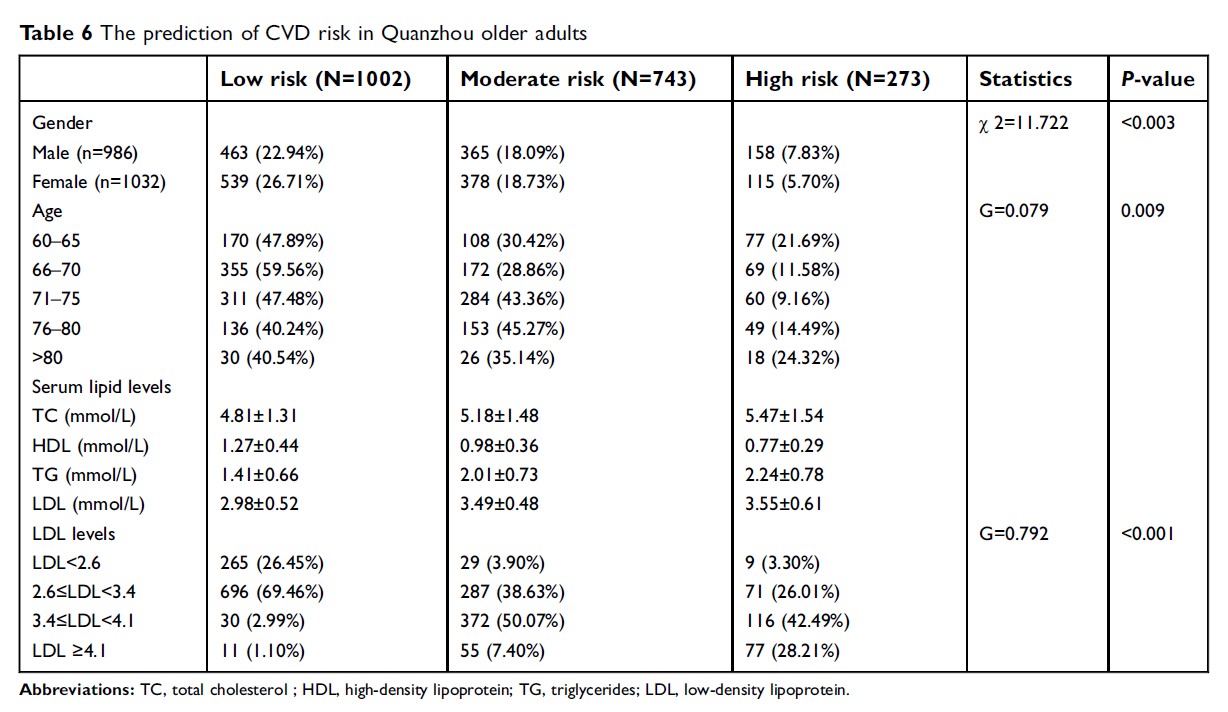
Results: The overall prevalence of dyslipidemia among older adults was 56.8%. The prevalence of high total cholesterol (TC), high low-density lipoprotein cholesterol (LDL-C), low high-density lipoprotein cholesterol (HDL-C) and high triglyceride (TG) were 8.4%, 13.9%, 23.1% and 11.4%, respectively. The mean levels of TC, LDL-C, HDL-C and TG were 5.12±1.18, 3.37±0.81, 1.03±0.27 and 1.65±0.76 mmol/L, respectively. Older adults had low risk, moderate risk and high risk for CVD, which were 49.7%, 36.8% and 13.5%, respectively. Age, body mass index and abdominal obesity were significantly associated with the risk of increasing LDL-C levels and were positively correlated to CVD risk.
Conclusion: The prevalence of high TC, high LDL-C, low HDL-C and high TG was relatively low among older adults in Quanzhou, but their lipid levels were high. Approximately half of the elderly adults had moderate or high CVD risk. The personalized primary prevention and control of CVD are recommended for elderly people to identify high-risk individuals.
Keywords: prevalence, prediction, dyslipidemia, CVD risk, older adults