117745
论文已发表
注册即可获取德孚的最新动态
IF 收录期刊
- 3.6 Breast Cancer (Dove Med Press)
- 4.3 Clin Epidemiol
- 2.6 Cancer Manag Res
- 3.2 Infect Drug Resist
- 4.1 Clin Interv Aging
- 6.1 Drug Des Dev Ther
- 4.1 Int J Chronic Obstr
- 8.7 Int J Nanomed
- 2.5 Int J Women's Health
- 3.2 Neuropsych Dis Treat
- 2.4 OncoTargets Ther
- 2.6 Patient Prefer Adher
- 2.6 Ther Clin Risk Manag
- 3.1 J Pain Res
- 3.5 Diabet Metab Synd Ob
- 4.5 Psychol Res Behav Ma
- 3.4 Nat Sci Sleep
- 2.4 Pharmgenomics Pers Med
- 2.6 Risk Manag Healthc Policy
- 4.6 J Inflamm Res
- 2.3 Int J Gen Med
- 3.9 J Hepatocell Carcinoma
- 3.3 J Asthma Allergy
- 2.5 Clin Cosmet Investig Dermatol
- 3.0 J Multidiscip Healthc

构建和验证 7 个微 RNA 标签作为肺鳞状细胞癌的预后工具
Authors Gan Z, Zou Q, Lin Y, Huang X, Huang Z, Chen Z, Xu Z, Lv Y
Received 21 October 2018
Accepted for publication 23 April 2019
Published 21 June 2019 Volume 2019:11 Pages 5701—5709
DOI https://doi.org/10.2147/CMAR.S191637
Checked for plagiarism Yes
Review by Single-blind
Peer reviewers approved by Dr Andrew Yee
Peer reviewer comments 2
Editor who approved publication: Dr Rituraj Purohit
Objective: The aim of this study was to construct and validate a microRNA (miR)-based signature as a prognostic tool for lung squamous cell carcinoma (LUSC).
Materials and methods: With the use of mature miR expression profiles downloaded from The Cancer Genome Atlas database, we identified differentially expressed miRs between LUSC and matched healthy lung tissue. Thereafter, we carried out an evaluation of the association of differentially expressed miRs with overall survival (OS) with the use of univariate and multivariate Cox regression analysis. This analysis was eventually employed for the construction of a miR-based signature, which effectively predicted the prognosis. The functional enrichment analysis of the miRs included in the signature was used to explore their potential molecular mechanism in LUSC.
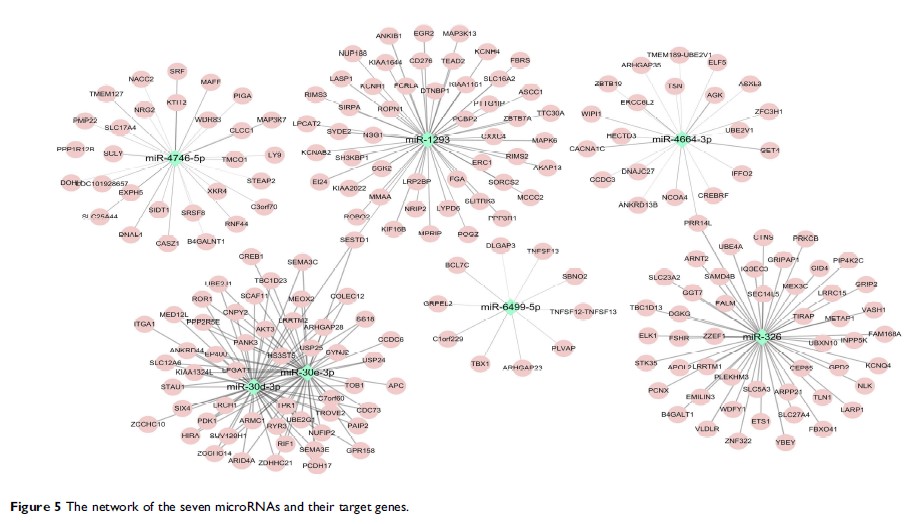
Results: A total of 316 miRs were differentially expressed between LUSC and matched healthy lung tissues in the training set. Following the univariate and multivariate Cox regression analysis, we found that seven miRs were independent prognostic factors. Each patient received a signature index ranging from 0 to 7. Patients with LUSC were divided into high-risk, intermediate-risk, and low-risk groups in accordance with their signature index and the OS in the three groups was significantly different. This finding remains consistent in the validation set. Besides that, this seven-miR signature remained an independent prognostic factor in comparison with routine clinicopathologic features. The seven-miR signature is a promising biomarker for predicting the 5-year survival rate of LUSC with an area under the receiver operating characteristic curveof 0.712 in the training set and 0.688 in the validation set, respectively. The target genes of seven miRs may be involved in various pathways associated with lung cancer, for instance the mitogen-activated protein kinase signaling pathway and the Wnt signaling pathway.
Conclusion: Using this signature, patients with LUSC can be divided into high-risk, intermediate-risk, and low-risk groups for more personalized management.
Keywords: lung squamous cell carcinoma, microRNA-based signature, prognosis