117745
论文已发表
注册即可获取德孚的最新动态
IF 收录期刊
- 3.6 Breast Cancer (Dove Med Press)
- 4.3 Clin Epidemiol
- 2.6 Cancer Manag Res
- 3.2 Infect Drug Resist
- 4.1 Clin Interv Aging
- 6.1 Drug Des Dev Ther
- 4.1 Int J Chronic Obstr
- 8.7 Int J Nanomed
- 2.5 Int J Women's Health
- 3.2 Neuropsych Dis Treat
- 2.4 OncoTargets Ther
- 2.6 Patient Prefer Adher
- 2.6 Ther Clin Risk Manag
- 3.1 J Pain Res
- 3.5 Diabet Metab Synd Ob
- 4.5 Psychol Res Behav Ma
- 3.4 Nat Sci Sleep
- 2.4 Pharmgenomics Pers Med
- 2.6 Risk Manag Healthc Policy
- 4.6 J Inflamm Res
- 2.3 Int J Gen Med
- 3.9 J Hepatocell Carcinoma
- 3.3 J Asthma Allergy
- 2.5 Clin Cosmet Investig Dermatol
- 3.0 J Multidiscip Healthc

恶性肿瘤髓内脊髓转移:体系分析和回顾
Authors Lv J, Liu B, Quan X, Li C, Dong L, Liu M
Received 2 November 2018
Accepted for publication 14 March 2019
Published 21 June 2019 Volume 2019:12 Pages 4741—4753
DOI https://doi.org/10.2147/OTT.S193235
Checked for plagiarism Yes
Review by Single-blind
Peer reviewers approved by Dr Colin Mak
Peer reviewer comments 3
Editor who approved publication: Dr Federico Perche
Background: Intramedullary spinal cord metastases (ISCM) in malignancies is a devastating issue with limited research. This study aims to identify the clinical features, management, prognostic factors, and outcomes of this special entity.
Methods: A retrospective review of 61 patients of ISCM diagnosed and treated in our institute from June 2010 to March 2018 was conducted (lost to follow-up: 3). Data were retrieved according to the items including age, gender, primary tumor, interval to the ISCM occurrence, ISCM segments, and other synchronous metastases. The interventions, response, prognostic factors, and outcomes of ISCM were systematically analyzed.
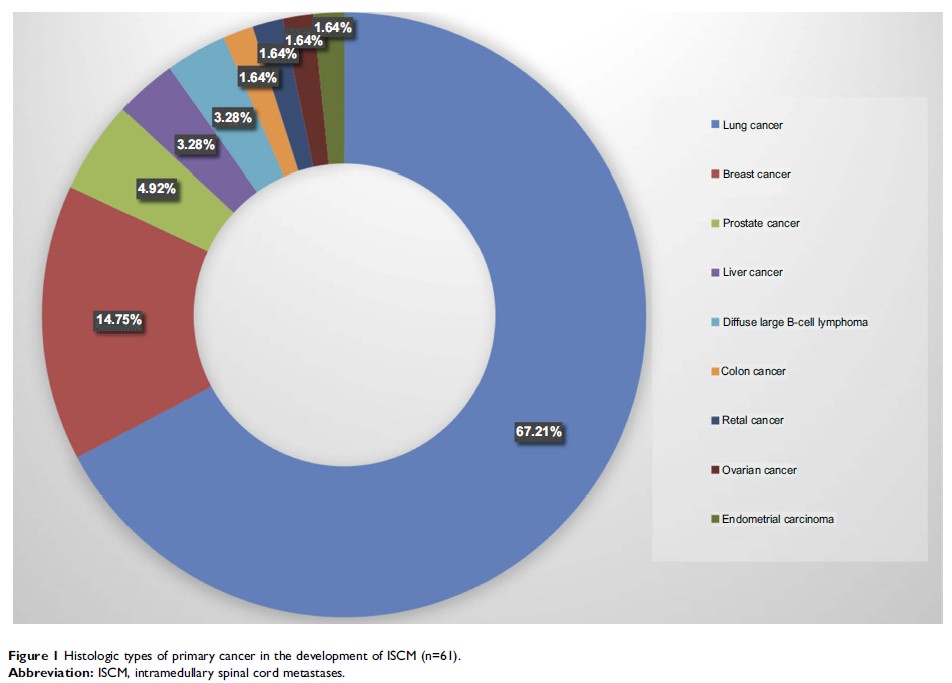
Results: Lung cancer (67.21%) was the commonest ISCM source, followed by breast cancer (14.75%). In total, 9.84% of patients presented with ISCM initially. The mean span from the primaries to ISCM was 18.77 months (range=0–10 years). The thoracic segment was most commonly involved (77.05%), followed by cervical (39.34%), lumbar level (34.43%), and conus medullaris (6.56%). The management of ISCM was challenging, since 55.74% of individuals had a poor physical condition (PS=3–4) and 72.41% had widespread dissemination synchronously (≥2 organs). Radiotherapy (RT) attained an objective response rate (ORR) of 61.90% or 62.50% and a local control rate (LCR) of 90.48% or 87.50% for symptoms used alone or with other strategies, respectively. ISCM bears a dismal prognosis, with a median overall survival (OS) of 4 months. Patients with only one segment involved had an apparently better prognosis than those with 2–4 involved segments (median OS=7.0 vs 3.0 months) (P <0.01). The OS of patients treated was remarkably superior to those without any intervention (median OS=5.0 vs 2.0 months) (P <0.01).
Conclusion: ISCM is a distinct entity needing more attention for high cancer incidence, prolonged survival, and lack of research. RT is the mainstay with satisfactory effect. Multiple spinal cord segments involvement and no treatment are poor prognostic factors of OS.
Keywords: intramedullary spinal cord metastasis, radiotherapy, combined treatment