117518
论文已发表
注册即可获取德孚的最新动态
IF 收录期刊
- 3.6 Breast Cancer (Dove Med Press)
- 4.3 Clin Epidemiol
- 2.6 Cancer Manag Res
- 3.2 Infect Drug Resist
- 4.1 Clin Interv Aging
- 6.1 Drug Des Dev Ther
- 4.1 Int J Chronic Obstr
- 8.7 Int J Nanomed
- 2.5 Int J Women's Health
- 3.2 Neuropsych Dis Treat
- 2.4 OncoTargets Ther
- 2.6 Patient Prefer Adher
- 2.6 Ther Clin Risk Manag
- 3.1 J Pain Res
- 3.5 Diabet Metab Synd Ob
- 4.5 Psychol Res Behav Ma
- 3.4 Nat Sci Sleep
- 2.4 Pharmgenomics Pers Med
- 2.6 Risk Manag Healthc Policy
- 4.6 J Inflamm Res
- 2.3 Int J Gen Med
- 3.9 J Hepatocell Carcinoma
- 3.3 J Asthma Allergy
- 2.5 Clin Cosmet Investig Dermatol
- 3.0 J Multidiscip Healthc

转型领导力与职业倦怠之间的关系,以及这种关系的心理赋权在 CDC 员工中产生的中介效应:一个横断面研究
Authors Liu C, Liu S, Yang S, Wu H
Received 24 February 2019
Accepted for publication 17 May 2019
Published 24 June 2019 Volume 2019:12 Pages 437—446
DOI https://doi.org/10.2147/PRBM.S206636
Checked for plagiarism Yes
Review by Single-blind
Peer reviewers approved by Dr Amy Norman
Peer reviewer comments 2
Editor who approved publication: Professor Mei-chun Cheung
Purpose: Centers for Disease Control and Prevention (CDC) is playing a vital role in protecting public health and safety. However, few studies have researched on the occupational burnout of CDC employees in the world. Previous studies have reported that transformational leadership could improve the level of psychological empowerment and ameliorate burnout of the employees. In this study, we aimed to analyze the association between transformational leadership and burnout and to test the mediating role of psychological empowerment in this relationship among CDC employees in China.
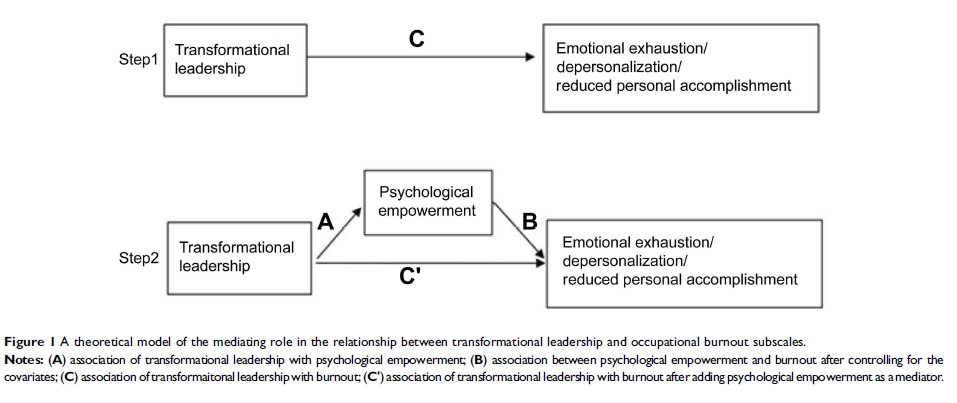
Methods: Maslach Burnout Inventory-Human Service Survey, Transformational Leadership Questionnaire, and Psychological Empowerment Scale were used to measure burnout, transformational leadership, and psychological empowerment. A total of 385 CDC employees (effective response rate: 96.25%) were included in the study. We analyzed the association between transformational leadership and three subscales of burnout with hierarchical linear regression analyses. The mediating role of psychological empowerment was finally examined by asymptotic and resampling strategies.
Results: Transformational leadership was negatively associated with emotional exhaustion, depersonalization, and reduced personal accomplishment after controlling sociodemographic and working context characteristics. Transformational leadership and psychological empowerment, respectively, accounted for 9.3% and 12.3% of the variance in emotional exhaustion; 8.5% and 16.7% of the variance in depersonalization; and 6.7% and 10.0% of the variance in reduced personal accomplishment. We found that psychological empowerment played a partially mediating role on the relationship between transformational leadership and burnout. The proportion of psychological empowerment’s mediating effect was 41.56% for emotional exhaustion, 50.62% for depersonalization, and 44.32% for reduced personal accomplishment.
Conclusions: It was suggested that transformational leadership could decrease the risk of burnout by the pathway of promoting the employee’s psychological empowerment. Interventions focusing on transformational leadership and psychological empowerment should be of significance to cut burnout.
Keywords: burnout, transformational leadership, psychological empowerment, CDC