117518
论文已发表
注册即可获取德孚的最新动态
IF 收录期刊
- 3.6 Breast Cancer (Dove Med Press)
- 4.3 Clin Epidemiol
- 2.6 Cancer Manag Res
- 3.2 Infect Drug Resist
- 4.1 Clin Interv Aging
- 6.1 Drug Des Dev Ther
- 4.1 Int J Chronic Obstr
- 8.7 Int J Nanomed
- 2.5 Int J Women's Health
- 3.2 Neuropsych Dis Treat
- 2.4 OncoTargets Ther
- 2.6 Patient Prefer Adher
- 2.6 Ther Clin Risk Manag
- 3.1 J Pain Res
- 3.5 Diabet Metab Synd Ob
- 4.5 Psychol Res Behav Ma
- 3.4 Nat Sci Sleep
- 2.4 Pharmgenomics Pers Med
- 2.6 Risk Manag Healthc Policy
- 4.6 J Inflamm Res
- 2.3 Int J Gen Med
- 3.9 J Hepatocell Carcinoma
- 3.3 J Asthma Allergy
- 2.5 Clin Cosmet Investig Dermatol
- 3.0 J Multidiscip Healthc

在中国社区研究中发现血压升高会增加血糖水平所改变的动脉僵硬度
Authors Dai X, Yang Y, Cheng GL, Jia J, Fan FF, Li JP, Huo Y, Liu Z, Chen D, Zhang Y
Received 21 November 2018
Accepted for publication 10 May 2019
Published 24 June 2019 Volume 2019:12 Pages 901—911
DOI https://doi.org/10.2147/DMSO.S195405
Checked for plagiarism Yes
Review by Single-blind
Peer reviewers approved by Dr Cristina Weinberg
Peer reviewer comments 3
Editor who approved publication: Dr Steven F. Abcouwer
Background: Increased arterial stiffness measured by brachial-ankle pulse wave velocity is associated with cardiovascular disease. However, the rates at which brachial-ankle pulse wave velocity and blood glucose accelerate within individuals who differ in blood pressure levels are largely unknown.
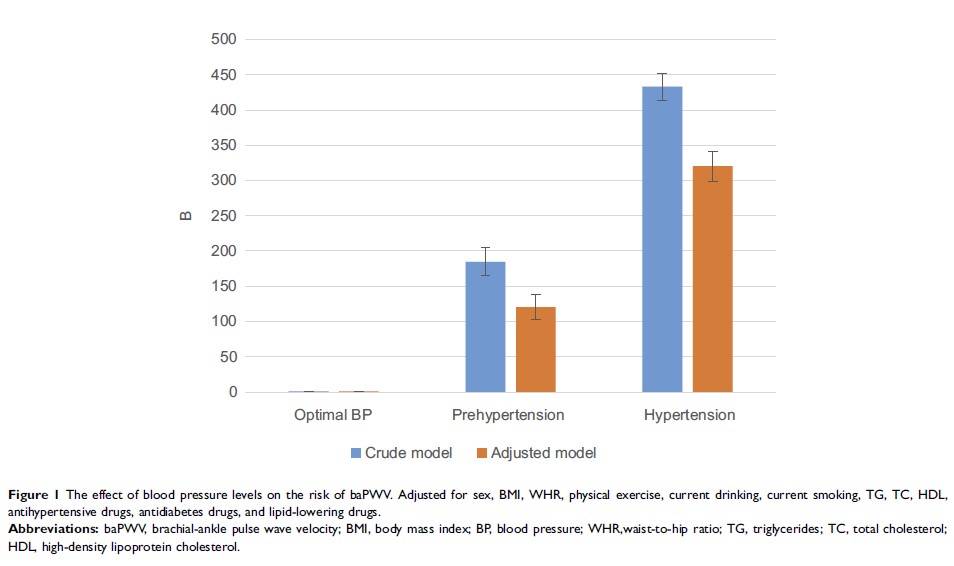
Methods: This study was based on the baseline data of a Chinese community-based atherosclerosis cohort which included 7402 individuals. Using generalized linear regression models, the relationship between blood glucose levels and brachial-ankle pulse wave velocity, and the relationship between blood pressure levels and brachial-ankle pulse wave velocity were examined.
Results: A marked interaction between hypertensive state and diabetic state was seen for brachial-ankle pulse wave velocity (P for interaction <0.001). The adjusted coefficient for subjects stratified by hypertensive groups and diabetic states showed that the highest brachial-ankle pulse wave velocity risk subjects were those who had both diabetes and hypertension (B=403.24; 95% CI: 372.43–434.05; P <0.001).
Conclusions: The participants with increased arterial stiffness demonstrate a high prevalence of higher blood pressure. When high blood glucose levels co-occur with high blood pressure levels, there is a remarkable increase in arterial stiffness.
Keywords: communities, diabetes, hypertension