117518
论文已发表
注册即可获取德孚的最新动态
IF 收录期刊
- 3.6 Breast Cancer (Dove Med Press)
- 4.3 Clin Epidemiol
- 2.6 Cancer Manag Res
- 3.2 Infect Drug Resist
- 4.1 Clin Interv Aging
- 6.1 Drug Des Dev Ther
- 4.1 Int J Chronic Obstr
- 8.7 Int J Nanomed
- 2.5 Int J Women's Health
- 3.2 Neuropsych Dis Treat
- 2.4 OncoTargets Ther
- 2.6 Patient Prefer Adher
- 2.6 Ther Clin Risk Manag
- 3.1 J Pain Res
- 3.5 Diabet Metab Synd Ob
- 4.5 Psychol Res Behav Ma
- 3.4 Nat Sci Sleep
- 2.4 Pharmgenomics Pers Med
- 2.6 Risk Manag Healthc Policy
- 4.6 J Inflamm Res
- 2.3 Int J Gen Med
- 3.9 J Hepatocell Carcinoma
- 3.3 J Asthma Allergy
- 2.5 Clin Cosmet Investig Dermatol
- 3.0 J Multidiscip Healthc

siPRDX2 升高的 DNM3 通过 AKT 信号通路抑制结肠癌细胞的增殖和转移
Authors Ma Y, Guan L, Han Y, Zhou Y, Li X, Liu Y, Zhang X, Zhang W, Li X, Wang S, Lu W
Received 7 November 2018
Accepted for publication 9 May 2019
Published 28 June 2019 Volume 2019:11 Pages 5799—5811
DOI https://doi.org/10.2147/CMAR.S193805
Checked for plagiarism Yes
Review by Single-blind
Peer reviewers approved by Dr Andrew Yee
Peer reviewer comments 2
Editor who approved publication: Professor Nakshatri
Purpose: We have previously reported that PRDX2 plays an oncogenic role in colon cancer. In this study, the mRNA expression profile of PRDX2 in HCT116 cells was investigated. Furthermore, we selected Dynamin 3 (DNM3), which is up-regulated by siPRDX2, to investigate its expression pattern and functions in colon cancer.
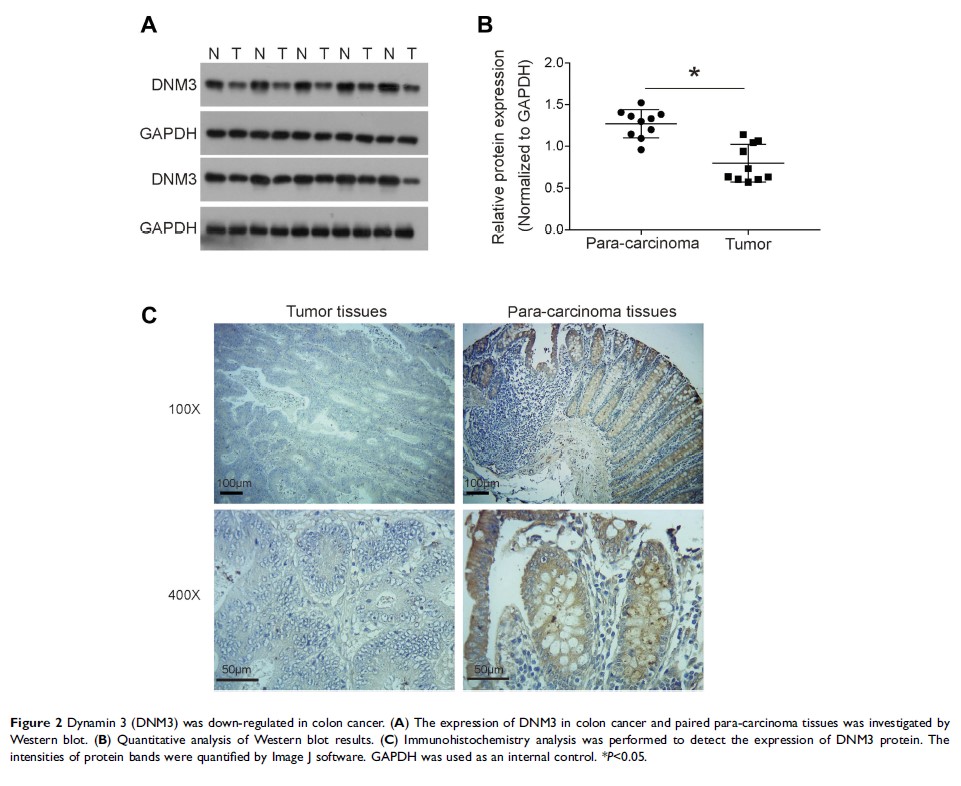
Patients and methods: PRDX2 siRNA was transfected into HCT116 cells and the mRNA profile was tested by RNA-Sequencing. The expression of interest proteins was determined by Western blot. DNM3 expression in colon cancer tissues and para-carcinoma tissues was evaluated by Western blot and immunohistochemistry assays. Full-length cDNA of DNM3 was cloned into pcDNA3.1 and introduced into HCT116 and HT29 cells. Cell proliferation was tested by CCK-8 and colony formation assays. Cell invasion and migration were tested by transwell assays. Gelatin zymography was utilized for detection of MMP9 activity. Cell apoptosis was investigated with Annexin V/PI staining and flow cytometry and visualized with Hoechst/PI staining assay. All statistical analysis was performed with SPSS 17.0 software.
Results: PRDX2 knockdown led to 210 up-regulated genes and 16 down-regulated genes in HCT116 cells. We also found that DNM3 expression was up-regulated following PRDX2 silencing in HCT116 and HT29 cells. In colon cancer patients, DNM3 was down-regulated and showed a significant association with pathologic grading. DNM3 overexpression inhibited cell proliferation and induced apoptosis in HCT116 and HT29 cells. Cell migration and invasion were also down-regulated in DNM3 overexpressing colon cancer cells, which might be due to the inhibition of MMP9 proteolytic activities. After thorough investigation of the potential mechanism involved, we hypothesized that DNM3 overexpression induced activation of the mitochondrial apoptosis pathway and inhibition of the AKT pathway.
Conclusion: These data suggest that DNM3 is down-regulated in colon cancer, serving as a tumor suppressor. Our study provides new sights into the prognostic value and therapeutic application of DNM3 in colon cancer.
Keywords: mRNA expression profile, proliferation, invasion; migration, apoptosis, AKT