117518
论文已发表
注册即可获取德孚的最新动态
IF 收录期刊
- 3.6 Breast Cancer (Dove Med Press)
- 4.3 Clin Epidemiol
- 2.6 Cancer Manag Res
- 3.2 Infect Drug Resist
- 4.1 Clin Interv Aging
- 6.1 Drug Des Dev Ther
- 4.1 Int J Chronic Obstr
- 8.7 Int J Nanomed
- 2.5 Int J Women's Health
- 3.2 Neuropsych Dis Treat
- 2.4 OncoTargets Ther
- 2.6 Patient Prefer Adher
- 2.6 Ther Clin Risk Manag
- 3.1 J Pain Res
- 3.5 Diabet Metab Synd Ob
- 4.5 Psychol Res Behav Ma
- 3.4 Nat Sci Sleep
- 2.4 Pharmgenomics Pers Med
- 2.6 Risk Manag Healthc Policy
- 4.6 J Inflamm Res
- 2.3 Int J Gen Med
- 3.9 J Hepatocell Carcinoma
- 3.3 J Asthma Allergy
- 2.5 Clin Cosmet Investig Dermatol
- 3.0 J Multidiscip Healthc

在无血浆细胞 DNA 中对一组新的体细胞突变的检测及其对肝细胞癌的诊断价值
Authors Xiong Y, Xie CR, Zhang S, Chen J, Yin ZY
Received 18 December 2018
Accepted for publication 24 April 2019
Published 28 June 2019 Volume 2019:11 Pages 5745—5756
DOI https://doi.org/10.2147/CMAR.S197455
Checked for plagiarism Yes
Review by Single-blind
Peer reviewers approved by Dr Cristina Weinberg
Peer reviewer comments 3
Editor who approved publication: Dr Antonella D'Anneo
Background/aims: Circulating cell-free DNA (cfDNA) contains tumor-specific alterations and could potentially serve as “liquid biopsy”. The study was to identify a novel panel of hepatocellular carcinoma (HCC)-specific mutations in plasma cfDNA and to assess its value in the diagnosis of HCC.
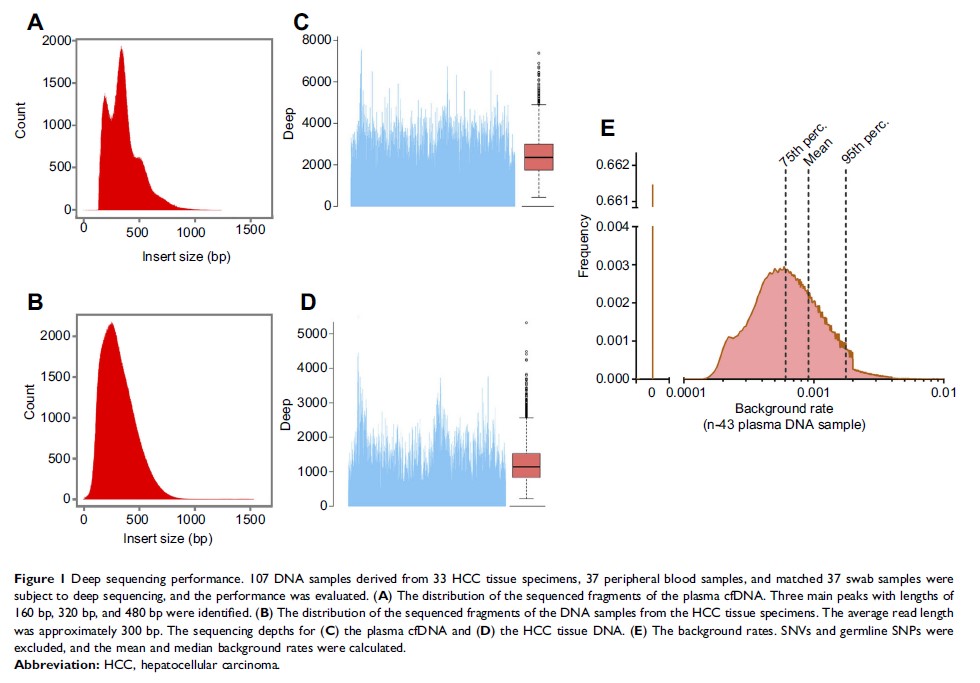
Materials and methods: 33 HCC tissue, 37 blood, and 37 swab specimens were collected from HCC patients and control individuals. Genomic DNA was subjected to next-generation sequencing. The selected mutations in the plasma cfDNA in the HCC versus control groups were compared, and the diagnostic performance of cfDNA mutations was evaluated.
Results: A majority of selected mutations in the HCC tissue DNA, ranging from 52% to 84%, was detected in the matched plasma cfDNA. For the selected mutations, receiver operating characteristic (ROC) analysis revealed an area under the ROC curve (AUC) of 0.92, sensitivity of 65%, and specificity of 100% for the diagnosis of HCC regardless of alpha-fetoprotein (AFP) status. Detection of the selected mutations in cfDNA in combination with AFP exhibited better diagnosis performance, with AUC of 0.96, sensitivity of 73%, and specificity of 100% for AFP-negative patients, whereas the AUC was 0.86 with sensitivity of 53% and specificity of 100% for AFP-positive patients. Furthermore, the rates of the selected mutations were significantly greater in recurrent HCC than in non-recurrent HCC (P <0.05).
Conclusions: This study has identified a novel panel of somatic mutations, and detection of the mutations in plasma cfDNA shows good diagnostic performance. Therefore, this approach holds promise as a novel tool for diagnosing HCC.
Keywords: cell-free DNA, hepatocellular carcinoma, next-generation sequencing, alpha-fetoprotein, somatic mutation