115195
论文已发表
注册即可获取德孚的最新动态
IF 收录期刊
- 3.6 Breast Cancer (Dove Med Press)
- 4.3 Clin Epidemiol
- 2.6 Cancer Manag Res
- 3.2 Infect Drug Resist
- 4.1 Clin Interv Aging
- 6.1 Drug Des Dev Ther
- 4.1 Int J Chronic Obstr
- 8.7 Int J Nanomed
- 2.5 Int J Women's Health
- 3.2 Neuropsych Dis Treat
- 2.4 OncoTargets Ther
- 2.6 Patient Prefer Adher
- 2.6 Ther Clin Risk Manag
- 3.1 J Pain Res
- 3.5 Diabet Metab Synd Ob
- 4.5 Psychol Res Behav Ma
- 3.4 Nat Sci Sleep
- 2.4 Pharmgenomics Pers Med
- 2.6 Risk Manag Healthc Policy
- 4.6 J Inflamm Res
- 2.3 Int J Gen Med
- 3.9 J Hepatocell Carcinoma
- 3.3 J Asthma Allergy
- 2.5 Clin Cosmet Investig Dermatol
- 3.0 J Multidiscip Healthc

ARHGAP4 通过 mTOR 和 HIF-1α 信号通路来介导 Warburg 在胰腺癌中的作用
Authors Shen Y, Chen G, Zhuang L, Xu L, Lin J, Liu L
Received 4 March 2019
Accepted for publication 20 May 2019
Published 28 June 2019 Volume 2019:12 Pages 5003—5012
DOI https://doi.org/10.2147/OTT.S207560
Checked for plagiarism Yes
Review by Single-blind
Peer reviewers approved by Ms Rachel Predeepa
Peer reviewer comments 2
Editor who approved publication: Dr XuYu Yang
Objective: The phenomenon that cancer cells avidly exhibit glycolysis with lactate secretion and decrease in mitochondrial activity under aerobic conditions is known historically as the Warburg effect. Rho GTPase-activating protein 4 (ARHGAP4) is an important negative regulator of the Rho signaling pathway that was associated with the tumorigenesis. Our study aims to determine the function of ARHGAP4 in controlling the glycolytic process of pancreatic cancer in vitro and possible molecular mechanism involved.
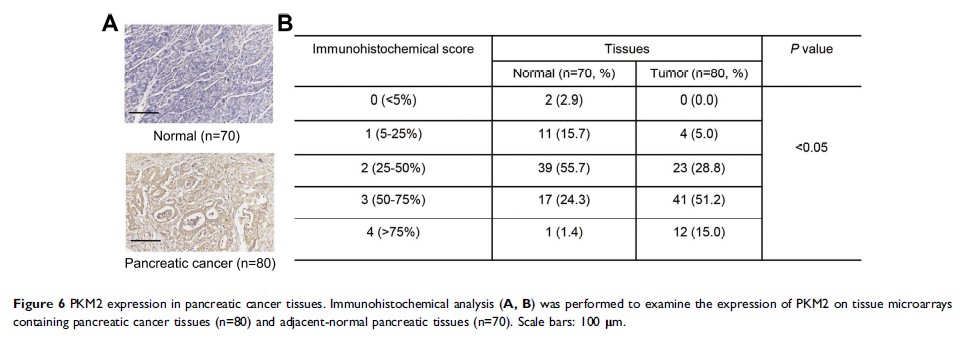
Methods: ARHGAP4 and PKM2 expressions in pancreatic cancer tissues were measured by immunohistochemistry. Human pancreatic cancer cells transfected with ARHGAP4 expressing lentivirus or siRNA were treated with either mTOR inhibitor (Rapamycin) or HIF-1α inhibitor (YC-1), and the effects were analyzed on cell viability, glucose uptake, lactate release, and the levels of ARHGAP4, p-mTOR, mTOR, PKM2, and HIF-1α expression.
Results: Our findings showed that ARHGAP4 and PKM2 expressions were, respectively, down-regulated and up-regulated in pancreatic cancer tissues. Overexpression of ARHGAP4 significantly inhibited cell viability, glucose uptake, lactate release, PKM2 expression, and activation of mTOR and HIF-1α signaling pathways in pancreatic cancer cells while ARHGAP4 silencing and treatment of Rapamycin or YC-1 showed inverse effects. Additionally, ARHGAP4 downregulation induced cell morphology of pancreatic cancer was inhibited by Rapamycin or YC-1 treatment.
Conclusion: These findings suggest that mTOR and HIF-1α signaling pathways can regulate the ARHGAP4-mediated glycolytic process of pancreatic cancer.
Keywords: pancreatic cancer, ARHGAP4, glycolysis, cell viability