115195
论文已发表
注册即可获取德孚的最新动态
IF 收录期刊
- 3.6 Breast Cancer (Dove Med Press)
- 4.3 Clin Epidemiol
- 2.6 Cancer Manag Res
- 3.2 Infect Drug Resist
- 4.1 Clin Interv Aging
- 6.1 Drug Des Dev Ther
- 4.1 Int J Chronic Obstr
- 8.7 Int J Nanomed
- 2.5 Int J Women's Health
- 3.2 Neuropsych Dis Treat
- 2.4 OncoTargets Ther
- 2.6 Patient Prefer Adher
- 2.6 Ther Clin Risk Manag
- 3.1 J Pain Res
- 3.5 Diabet Metab Synd Ob
- 4.5 Psychol Res Behav Ma
- 3.4 Nat Sci Sleep
- 2.4 Pharmgenomics Pers Med
- 2.6 Risk Manag Healthc Policy
- 4.6 J Inflamm Res
- 2.3 Int J Gen Med
- 3.9 J Hepatocell Carcinoma
- 3.3 J Asthma Allergy
- 2.5 Clin Cosmet Investig Dermatol
- 3.0 J Multidiscip Healthc

乳制品消费和痤疮:阿富汗喀布尔的病例对照研究
Authors Aalemi AK, Anwar I, Chen H
Received 14 April 2019
Accepted for publication 27 May 2019
Published 1 July 2019 Volume 2019:12 Pages 481—487
DOI https://doi.org/10.2147/CCID.S195191
Checked for plagiarism Yes
Review by Single-blind
Peer reviewers approved by Dr Melinda Thomas
Peer reviewer comments 2
Editor who approved publication: Dr Jeffrey Weinberg
Background: Previous observational studies suggest that the development of acne may be triggered by dairy intake.
Objective: This study aimed to investigate the association of dairy intake and acne in Kabul citizens.
Methods: From February to September 2018, 279 acne patients and 279 controls aged 10–24 years were enrolled in a case control study at the dermatologic outpatient department of Maiwand Teaching Hospital in Kabul City, Afghanistan. The acne severity was determined by a dermatologist using the Global Acne Severity Scale.
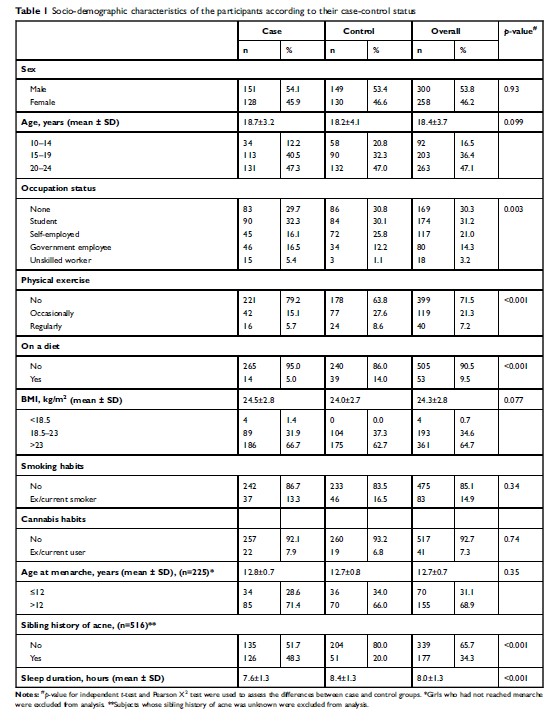
Results: The consumption of whole milk 3 days or more per week was associated with moderate to severe acne (OR =2.36, 95% CI, 1.39–4.01). The association for low fat milk was less marked than for whole milk (OR 1.95 CI, 1.10–3.45). The risk was increased in those with a family history of acne in siblings (OR =4.13, 95% CI, 2.55–6.69). The risk was reduced in subjects doing physical exercise. No association with smoking emerged. A protective effect was associated with chicken consumption (OR =0.27, 95% CI, 0.15–0.49). Consumption of chocolate and chips was positively associated with acne.
Conclusion: This study showed an association between high intakes of dairy products and acne in adolescence suggesting that dairy intake may be a factor contributing to acne.
Keywords: acne, milk, dairy, dietary, case-control study, Kabul